Better 3D Printing Through Magnets

Just like Goldilocks found some porridge too hot and some too cold, 3D printers often have beds that don’t stick well enough or stick too well. A few weeks ago I switched two of my three printers to use magnetic beds and thought I’d share with you how that worked out. Spoiler alert: like most things it has its plusses and minuses.

It isn’t a secret that 3D printing is not a plug-and-play operation, especially at the price most of us are willing to pay for printers. There are lots of variables to get right: temperature, speeds, bed leveling, and a bunch of other things. However, one of the things that vexes many people is the relationship between getting that first layer to stick and being able to get the print off the bed when you are done. It is hard to find a happy medium. If the first layer won’t stick, you print is doomed. If the first layer sticks too well, you are likely to damage the part or your fingers getting it removed. I switched to BuildTak surfaces long ago, and many people like PEI. But it is sometimes hard to get a big part removed. A few weeks ago, I took the plunge and bought some magnetic build surfaces for two of my printers. These were “no name” inexpensive affairs from Ali Express.

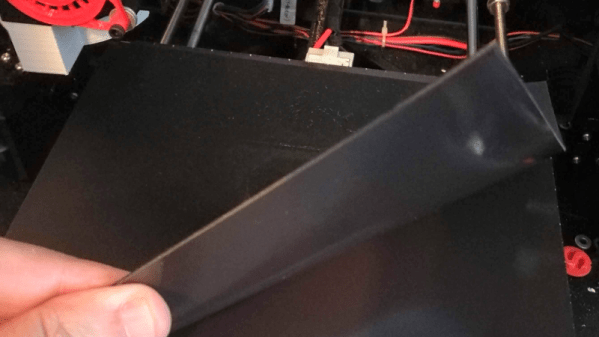
The idea is simple. There are two sheets that look like a rubberized plastic and have magnetic properties. One piece has some 3M adhesive on the back. The other has one surface that resembles BuildTak. Once you glue down the one sheet you leave it alone. Then you put the other sheet on top and print on it. When you are done, you can pull the sheet out and flex it to pop the print off. That’s the theory, anyway. Continue reading “Better 3D Printing Through Magnets”
Teardown And Repair Of A Police Recorder

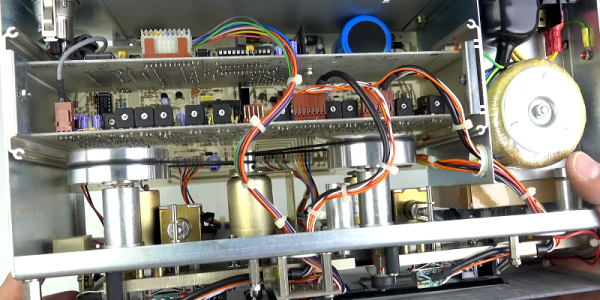
You should probably hope you haven’t seen [Techmoan’s] cassette recorder before. That’s because it is a Neal interview recorder that was mainly used by police to tape interrogations. This one was apparently used by the Royal Navy and was sold for parts. Turns out, the repair was simple, but the teardown and the analysis of the machine — you can see it in the video below — is pretty interesting if you’ve never seen one of these before.

The unit looks like a heavy-duty piece of industrial electronics from the 1980s. Unlike a commercial tape deck, this one is made to do one thing: record. You can’t even rewind a tape in it. Also unlike a consumer recorder, the Neal has a few special features aimed at making sure you didn’t miss some important confession on tape. First, it beeps if there’s no microphone plugged in. When [Techmoan] showed the recording head, we noticed it looked like it was split in half. Towards the end of the video, we found out why. In addition, the unit records two tracks: one audio track and another with a voice reading the elapsed time every 10 seconds — pretty high tech for its day.

Continue reading “Teardown And Repair Of A Police Recorder”

FT8: Saving Ham Radio Or Killing It?

It is popular to blame new technology for killing things. The Internet killed newspapers. Video killed the radio star. Is FT8, a new digital technology, poised to kill off ham radio? The community seems evenly divided. In an online poll, 52% of people responding says FT8 is damaging ham radio.  But ham operator [K5SDR] has an excellent blog post about how he thinks FT8 is going to save ham radio instead.

If you already have an opinion, you have probably already raced down to the comments to share your thoughts. I’ll be honest, I think what we are seeing is a transformation of ham radio and like most transformations, it is probably both killing parts of ham radio and saving others. But if you are still here, let’s talk a little bit about what’s going on in ham radio right now and how it relates to the FT8 question. Oddly enough, our story starts with the strange lack of sunspots that we’ve been experiencing lately. Continue reading “FT8: Saving Ham Radio Or Killing It?”

Hands On With The Arduino FPGA

All of the tools you need to work with the FPGA Arduino — the Vidor — are now in the wild!

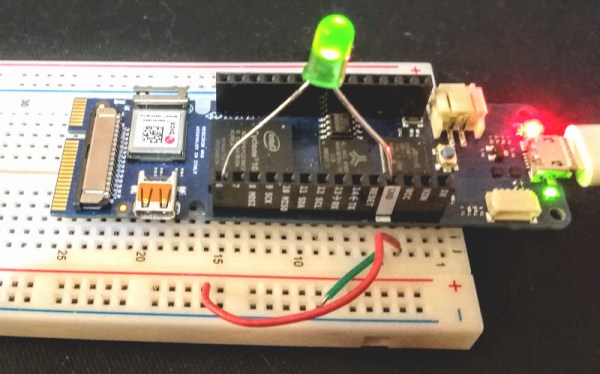
We reported earlier that a series of French blog posts finally showed how all the pieces fit together to program the FPGA on the Arduino MKR4000 Vidor board. Of course, I wasn’t content to just read the Google translation, I had to break out the board and try myself.

I created a very simple starter template, a tool in C to do the bitstream conversion, required, and bundled it all together in one place. Here’s how you can use my starter kit to do your own FPGA designs using the Vidor. I’m going to assume you know about FPGA basics and Verilog. If you don’t, why not check out the FPGA boot camps first?

The first thing you’ll want to do is grab my GitHub repo. You’ll also need the Arduino IDE (a recent copy) and Intel’s Quartus software. Inside, you’ll find three directories, two of which contain slightly modified copies of original Arduino files. But before you start digging in, let’s get the high-level overview of the process.

Continue reading “Hands On With The Arduino FPGA”

Ask Hackaday: What Are Your Less Extreme Brain Hacks?

Kahn — perhaps Star Trek’s best-hated villain — said: “Improve a mechanical device and you may double productivity, but improve man and you gain a thousandfold.” In fact, a lot of hacking effort goes into doing just that. Your phone has become an extension of your memory, for example. We use glasses, cameras, and hearing aids to shore up failing senses or even give us better senses than normal. But hacking your body — or someone else’s — has always been controversial. While putting an RFID chip in your finger is one thing, would you consider having a part of your brain removed? That sounds crazy, but apparently, there is a growing interest in having your amygdala removed.

To be clear: we think this is a terrible idea. The science is shaky, at best, and we certainly wouldn’t want to be among the first to try something so radical. But why is anyone even talking about it?

The amygdala is part of your brain that causes at least some of your fear and anxiety. Get rid of your amygdala, get rid of anxiety? What’s even stranger is this the procedure — an amygdalectomy — has been going on since the 1960s! Injections of oil and wax destroy the tissue and this treatment is used for some forms of epilepsy and to manage certain aggressive behavior problems in mentally ill patients. In modern times, the procedure is not very common although it appears that it does still occur in some places. But the technology to do it does exist. There have also been documented cases where people lose their amygdala from natural causes that gives us some clues of what life would be like without one.

However, it is hard to say if these people lost fear. Most of the surgical patients were already suffering from a variety of problems. There is some evidence that the naturally occurring amygdalaless patients experienced less fear in some situations, but may experience more fear in others. They also may have other problems such as difficulty understanding social cues or making eye contact. We’re not 100% sure what the amygdala does, even disregarding potential side effects.

Continue reading “Ask Hackaday: What Are Your Less Extreme Brain Hacks?”

Helium Can Stop Your IPhone — Maybe Other MEMS, Too

Sometimes hacking isn’t as much about building something, it’s about getting to the root of a particularly difficult problem. [Erik Wooldrige] was facing a problem like that. He’s a system specialist at a hospital near Chicago. Suddenly a bunch of iPhones and Apple watches were failing or glitching. The only thing anyone could think of was the recent install of an MRI machine.

Sure, an MRI machine can put out some serious electromagnetic pulses, but why would that only affect Apple products? Everything else in the hospital, including Android phones, seemed to be OK. But about 40 Apple devices were either dead or misbehaving.

Continue reading “Helium Can Stop Your IPhone — Maybe Other MEMS, Too”

Brain Cell Electronics Explains Wetware Computing Power

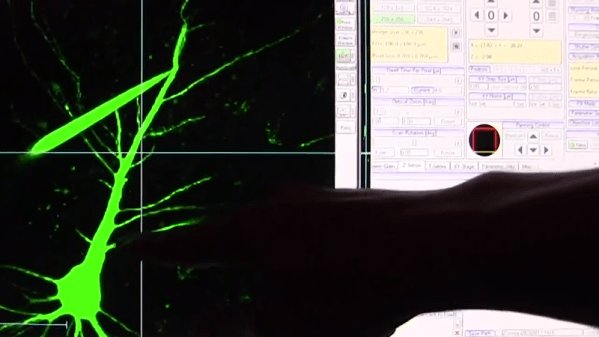
Neural networks use electronic analogs of the neurons in our brains. But it doesn’t seem likely that just making enough electronic neurons would create a human-brain-like thinking machine. Consider that animal brains are sometimes larger than ours — a sperm whale’s brain weighs 17 pounds — yet we don’t think they are as smart as humans or even dogs who have a much smaller brain. MIT researchers have discovered differences between human brain cells and animal ones that might help clear up some of that mystery. You can see a video about the work they’ve done below.

Neurons have long finger-like structures known as dendrites. These act like comparators, taking input from other neurons and firing if the inputs exceed a threshold. Like any kind of conductor, the longer the dendrite, the weaker the signal. Naively, this seems bad for humans. To understand why, consider a rat. A rat’s cortex has six layers, just like ours. However, whereas the rat’s brain is tiny and 30% cortex, our brains are much larger and 75% cortex. So a dendrite reaching from layer 5 to layer 1 has to be much longer than the analogous neuron in the rat’s brain.

These longer dendrites do lead to more loss in human brains and the MIT study confirmed this by using human brain cells — healthy ones removed to get access to diseased brain cells during surgery. The researchers think that this greater loss, however, is actually a benefit to humans because it helps isolate neurons from other neurons leading to increased computing capability of a single neuron. One of the researchers called this “electrical compartmentalization.” Dig into the conclusions found in the research paper.

We couldn’t help but wonder if this research would offer new insights into neural network computing. We already use numeric weights to simulate dendrite threshold action, so presumably learning algorithms are making weaker links if that helps. However, maybe something to take away from this is that less interaction between neurons and groups of neurons may be more helpful than more interaction.

Watching them probe neurons under the microscope reminded us of probing on an IC die. There’s a close tie between understanding the brain and building better machines so we try to keep an eye on the research going on in that area.

Continue reading “Brain Cell Electronics Explains Wetware Computing Power”