Getting Started With ARM Using Mbed

Even though the Arduino was hardly the first 8 bit microcontroller board to support a bootloader and the C/C++ language, it quickly became the de facto standard for hobby-level microcontrollers as well as a common choice for one-off or prototype projects. I’m sure there are a lot of reasons why this occurred, but in my mind there were three major reasons: price, availability of lots of library and sample code, and the existence of a simplified GUI IDE that you could install in a few minutes. The build process is simple, too, even though if you ever have to actually figure it out, it is quite ugly. For most people, it works, and that makes it not ugly.

I like the ATMega chips. In fact, I had boards based around the ATMega8 and a bootloader way before there was an Arduino. However, they are fairly small parts. It is true that the Arduino infrastructure has grown to support more ATMega chips, many with more memory and I/O and clock speeds. However, 32-bit processors are getting inexpensive enough that for all but the simplest or highest volume projects, you should be thinking about using 32-bit.

If you’ve tried to go that route before, you’ve probably been daunted by the price, especially the price of development tools. Your alternative is to roll your own tool chain which is very doable (and there are some nice scripts out there that will help you). You also need to worry about libraries and how to integrate them. Not to mention, many of the advanced processors require a lot of setup to get, say, an A/D converter turned on. Most processors keep things they aren’t using turned off, and each pin requires setup to select the 4 or 5 things shared on that pin.

All of this has been a barrier to entry. The vendors have all figured this out, though, and many have tried to build tools aimed at breaking up the Arduino market ranging from inexpensive development boards to code-generating wizards, to full blown IDEs. I want to tell you (and show you, in the video below) how you can make the jump from 8-bit to 32-bit much easier than you might think.

Continue reading “Getting Started With ARM Using Mbed”

Zynq And The OPL3 Music Synthesizer

We’re big fans of the Zynq, which is an answer to the question: what do you get when you cross a big ARM processor with a big FPGA? So it isn’t surprising that [GregTaylor’s] project to emulate the OPL3 FM Synthesis chip in an FPGA using the Zynq caught our eye.

The OPL3 (also known as the Yamaha YMF262) was a very common MIDI chip on older PC sound cards. If you had a Sound Blaster Pro or 16 board, you had an OPL3 chip in your PC. The OPL3 was responsible for a lot of the music you associate with vintage video games like Doom. [Greg] not only duplicated the chip’s functions, but also ported imfplay from DOS to run on the Zynq’s ARM processors so he could reproduce those old video game sounds.

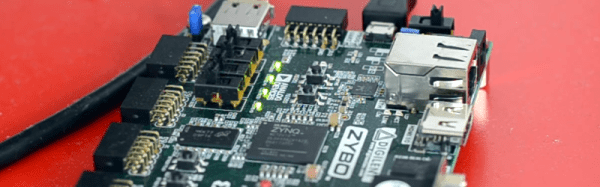
The Zybo board that [Greg] uses includes an Analog Devices SSM2603 audio codec with dual 24-bit DACs and 256X oversampling. However, the interface to the codec is isolated in the code, so it ought to be possible to port the design to other hardware without much trouble.

To better match the original device’s sampling rate with the faster CODEC, this design runs at a slightly slower frequency than the OPL3, but thanks to the efficient FPGA logic, the new device can easily keep up with the 49.7 kHz sample rate.

Using an FPGA to emulate an OPL3 might seem to be overkill, but we’ve seen worse. If you prefer to do your synthesis old school, you can probably get a bulk price on 555 chips.

Continue reading “Zynq And The OPL3 Music Synthesizer”

Fisher Price Bluetooth Speaker Hack

A good hacker hates to throw away electronics. We think [Matt Gruskin] must be a good hacker because where a regular guy would see a junky old 1980’s vintage Fisher Price cassette player, [Matt] saw a retro stylish Bluetooth speaker. His hack took equal parts of electronics and mechanics. It even required some custom 3D printing.

You might think converting a piece of old tech to Bluetooth would be a major technical challenge, but thanks to the availability of highly integrated modules, the electronics worked out to be fairly straightforward. [Matt] selected an off the shelf Bluetooth module and another ready-to-go audio amplifier board. He built a custom board to convert the stereo output to mono and hold the rotary encoder he used for the volume control. An Arduino (what else?) reads the encoder and also provides 3.3V to some of the other electronics.

The really interesting part of the hack is the mechanics. [Matt] managed to modify the existing mechanical buttons to drive the electronics using wire and hot glue. He also added a hidden power switch that doesn’t change the device’s vintage look. Speaking of mechanics, there’s also a custom 3D printed PCB holder allowing for the new board to fit in the original holder. This allows [Matt] to keep the volume control in its original location

Continue reading “Fisher Price Bluetooth Speaker Hack”

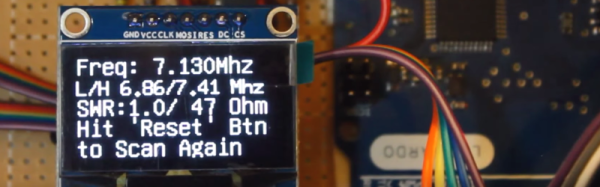
$40 Antenna Analyzer With Arduino And AD9850

If you are a hacker, you might consider ham radio operators as innovative. Most people, however, just see them as cheap. So it is no surprise that hams like [jmharvey] will build an antenna analyzer from a DDS module and an Arduino instead of dropping a few hundred dollars on a commercial unit. As he points out, you probably only need an analyzer for a day or two while you set up an antenna. Unless you are a big time antenna builder, the unit will then sit idle on the shelf (or will wind up on loan to hams even cheaper than you are).

The design is rooted in another proven design, but changed to take advantage of parts he happened to have on hand. Although the build is on a universal circuit board, [jmharvey] used Eagle to lay out the circuit as though it were a PCB. Since placement can be important with an RF circuit, this isn’t a bad idea. It’s always easier to move stuff around on the screen than on the perf board.

Since this is a no frills, unit, you are expected to grab the output from the Arduino and manually put it in a spreadsheet to plot the results. There is another version of the Arduino code that drives an OLED screen, although you still need a PC to kick the process off. One interesting feature of the Arduino code is how it deals with the nonlinear nature of the diodes used in the circuit. After plotting the values with known loads, [jmharvey] broke the diode operation into three regions and used different equations for each region. Even so, he warns that readings higher than 1:1 VSWR are only accurate to 10% or 20% – still good enough for ham shack use.

If you want an antenna analyzer for $40 (or less, if you have a good stock of parts) this looks like a worthwhile project. If, however, you want to repurpose it to Rickroll your neighbor’s AM radio, you might want to go with the commercial unit.

Click past the break to see the analyzer in action.

Continue reading “$40 Antenna Analyzer With Arduino And AD9850”

Hacking A Universal Assembler

I have always laughed at people who keep multitools–those modern Swiss army knives–in their toolbox. To me, the whole premise of a multitool is that they keep me from going to the toolbox. If I’ve got time to go to the garage, I’m going to get the right tool for the job.

Not that I don’t like a good multitool. They are expedient and great to get a job done. That’s kind of the way I feel about axasm — a universal assembler I’ve been hacking together. To call it a cross assembler hack doesn’t do it justice. It is a huge and ugly hack, but it does get the job done. If I needed something serious, I’d go to the tool box and get a real assembler, but sometimes you just want to use what’s in your pocket.

Continue reading “Hacking A Universal Assembler”

Build A Baby Plasma Cutter–Right Now!

What hacker doesn’t want a plasma cutter? Even if you aren’t MacGyver, you can probably build this one in a few minutes using things you have on hand. The catch? You probably can’t cut anything more than tin foil with it, and it is probably more a carbon-air arc gouger (which uses plasma) than a true plasma cutter. Still, as [Little Shop of Physics] shows on the video, it does a fine job of slicing right through foil.

If you are like us, you are back now after getting four 9V batteries, some tin foil, a pencil lead, and some clip leads and trying it. If you have more self-restraint than we do, you might want to think about what you are going to put the tin foil over. In the video, they used a laundry basket and a rubber band, but anything that keeps the foil suspended would do the trick.

Although it isn’t really a practical plasma cutter, we were thinking about strapping something like this to a 3D printer and cutting foil stencils. The jagged edges on the video are, hopefully, more from being operated by hand and less from the jagged mini-lightning bolt vaporizing the foil.

Continue reading “Build A Baby Plasma Cutter–Right Now!”

Hack Your C++ With LLVM

Have you ever wanted to analyze or mutate some C or C++ code? You can do some simple pattern matching with regular expressions, but there’s always some special case or another that will break your logic. To do it right, you need to develop an entire parser, perhaps using a formal grammar and a tool like Yacc. That’s a big job, though, just to change all the floats to doubles.

[Adrian Sampson] wrote a blog entry to make you go from “mostly uninterested in compilers to excited to use LLVM to do great work.” LLVM – the Low Level Virtual Machine compiler infrastructure — provides tools for a lot of languages, including CLANG for C and C++. [Adrian] points out a few key differences between LLVM and other compilers and tools you might use for a similar purpose:

  • LLVM uses a consistent intermediate representation that is human-readable
  • It is extremely modular
  • It is both highly hackable and an industrial-strength, well-supported compiler

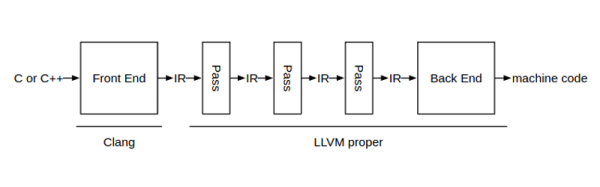
He points out that compiler tools aren’t just for compiling. You can use them to analyze source code, build simulators, and inject code for security or testing, among other things (speaking of security testing, check out the use of LLVM to analyze binaries for security issues in the video after the break). The high hackability of LLVM is due to its modular nature. By default, a front end chews up the C or C++ code into the intermediate representation. Then multiple passes can modify the representation before handing it off for the next pass. The final pass does actual code generation for the target processor.

Continue reading “Hack Your C++ With LLVM”