WiFiWart Boots Linux, Moves To Next Design Phase

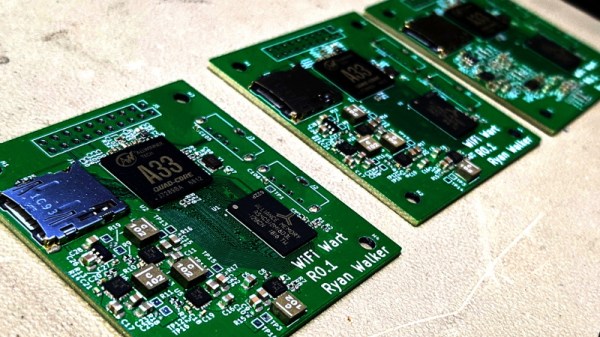
Over the last few months we’ve been keeping an eye on WiFiWart, an ambitious project to develop a Linux single-board computer (SBC) small enough to fit inside a USB wall charger. Developer [Walker] says the goal is to create an easily concealable “drop box” for penetration testing, giving security researchers a valuable foothold inside a target network from which to preform reconnaissance or launch attacks. Of course, we don’t need to tell Hackaday readers that there’s plenty of other things you can do with such a tiny open hardware Linux SBC.

Today we’re happy to report that [Walker] has gotten the first version of the board booted into Linux, though as you might expect given a project of this complexity, there were a few bumps along the way. From the single missing resistor that caused U-Boot to throw up an error to the finer points of compiling the kernel for an embedded board, the latest blog post he’s written up about his progress provides fascinating insight into the little gotchas of bringing up a SBC from scratch.

Once the board was booted into Linux, [Walker] started testing out different aspects of the system. A memory benchmark confirmed the finicky DDR3 RAM was working as expected, and he was able to load the kernel modules for the dual RTL8188 interfaces and connect to a network. While the two WiFi modules are currently hanging off the board’s full-sized USB ports, they will eventually be integrated into the PCB.

Critically, this prototype board is also allowing [Walker] to get an idea of what the energy consumption of the final hardware might be. Even at full tilt, this larger board doesn’t go over 500 mA at 5 VDC; so if he designs the power supply with a maximum output of 1 A, he should have a nice safety margin. As mentioned in the previous post, the plan is currently to put the PSU on its own board, which will allow more effective use of the charger’s internal volume.

With the software and hardware now largely locked in, [Walker] says his attention will be turned towards getting everything small enough to fit into the final form factor. This will certainly be the most challenging aspect of the project, but with a growing community of hackers and engineers lending their expertise to the cause, we’re confident the WiFiWart will soon be a reality.

Little Quadruped Uses Many Servos

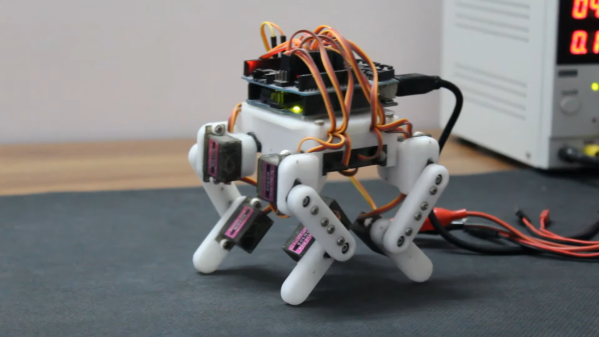
Walking robots were once the purview of major corporations spending huge dollars on research programs. Now, they’re something you can experiment with at home. [Technovation] has been doing just that with his micro quadruped build.

The build runs twelve servos – three per leg – to enable for a great range of movement for each limb. The servos are all controlled by an Arduino Uno fitted with an Arduino Sensor Shield. Everything is fitted together with a 3D printed chassis and limb segments that bolt directly on to the servo output shafts. This is a common way of building quick, easy, lightweight assemblies with servos, and it works great here. Inverse kinematics is used to calculate the required motions of each joint, and the robot can take steps from 1 to 4cm long in a variety of gaits.

We’d love to see a few sensors and a battery pack added on to allow the ‘bot to explore further in an untethered fashion. [Technovation] has left some provision to mount extra hardware, so we look forward to seeing what comes next.

We’ve seen bigger quadrupeds do great things, too. Video after the break.

Continue reading “Little Quadruped Uses Many Servos”

Linux Fu: Superpowers For Mere Mortals

You can hardly mention the sudo command without recalling the hilarious XKCD strip about making sandwiches. It does seem like sudo is the magic power to make a Linux system do what you want. The only problem is that those superpowers are not something to be taken lightly.

CC-BY-NC-2.5 by [XKCD]
If you are surfing the web, for example, you really don’t want to be root, because if someone naughty takes over your computer they could do a lot more harm with your root password. But still, there are times when you want to run certain commands that are normally root-only and don’t want to bother with a password. Luckily, sudo can handle that use case very easily.

Why?

As a simple example, suppose you like to shut your computer down at the end of the day. You run the shutdown command from the terminal but it doesn’t work because you aren’t root. You then have to do it again with sudo and if you haven’t logged in lately, provide your password. Ugh.

Continue reading “Linux Fu: Superpowers For Mere Mortals”

How To Build With Acrylic Using The Tools You Have

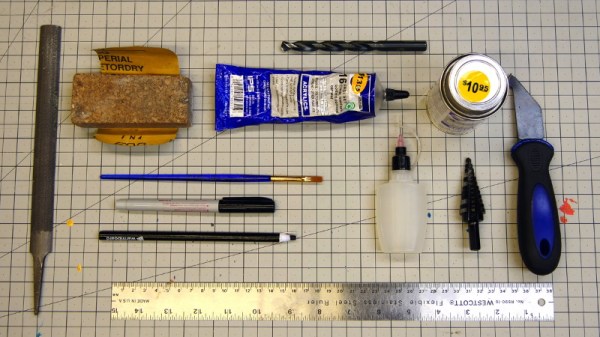
In a perfect world, we’d all have laser cutters and could pop intricate designs out of acrylic sheets with just a few clicks of the mouse. But in reality, most of us have to make do with the pedestrian tools we have at hand. For many, that might even mean everything has to be done by hand. Luckily, [Eric Strebel] has been working on a series of videos that cover how you can make professional looking parts out of acrylic using a wide array of common tools.

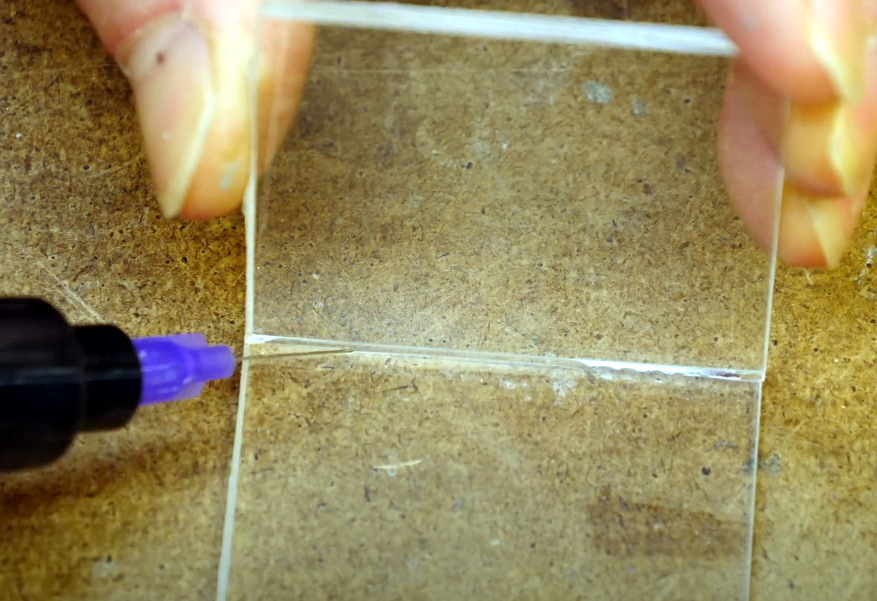
Solvent welding hand-cut pieces of acrylic.

The first video demonstrates how a simple cube can be constructed by a band saw, a table saw, and if need be, with hand tools. You might think the two power saws would have similar results, but as [Eric] explains, the table saw ends up being far more accurate and requires less post-processing to get a smooth edge. Ideally you’d run the cut pieces through a router to bevel them, but that’s a tall order for many home gamers.

As for the hand tool approach, scoring and snapping the sheets ends up making a surprisingly clean break that can actually be cleaner than the edge you’d get with a power tool. No matter how you cut them, [Eric] shows the proper way to apply the water-like solvent to your acrylic pieces to create a strong and visually attractive bond.

The next video in the series covers more advanced techniques that can still be pulled off without a top-of-the-line workshop. Sure the water-cooled acrylic bender he has is pretty slick, but if you can’t afford the $100 USD gadget, he shows you how to get similar results with an old toaster oven that you can pick up from the thrift store or even the side of the road. With some hand-made jigs and molds, you can warp and flex the heated plastic into whatever shape your project needs. Combining the tips from both videos, you might be surprised at what can be created with little more than a ruler, some hot air, and the appropriate techniques.

These are just the latest in a long line of fantastic videos that [Eric Strebel] has produced about at-home design and fabrication. Whether its making a two part silicone mold or creating functional prototypes out of foam board, there’s an excellent chance that he’s covered a topic you’ve wanted to learn more about.

Continue reading “How To Build With Acrylic Using The Tools You Have”

RNA Therapeutics And Fighting Diseases By Working With The Immune System

Before the SARS-CoV-2 pandemic took hold, few people were aware of the existence of mRNA vaccines. Yet after months of vaccinations from Moderna and BioNTech and clear indications of robust protection to millions of people, it now seems hard to imagine a world without mRNA vaccine technology, especially as more traditional vaccines seem to falter against the new COVID-19 variants and the ravages of so-called ‘Long COVID’ become more apparent.

Yet, it wasn’t that long ago that Moderna and BioNTech were merely a bunch of start-ups, trying to develop profitable therapies for a variety of diseases, using the brand-new and largely unproven field of RNA therapeutics. Although the use of mRNA in particular for treatments has been investigated since 1989, even as recently as 2017 there were still many questions about safe and effective ways to deliver mRNA into cells, as per Khalid A. Hajj et al.

Clearly those issues have been resolved now in 2021, which makes one wonder about the other exciting possibilities that mRNA delivery offers, from vaccines for malaria, cancer, HIV, as well as curing autoimmune diseases. How did the field of mRNA vaccines develop so quickly, and what can we expect to see the coming years?

Continue reading “RNA Therapeutics And Fighting Diseases By Working With The Immune System”

Get Some Close Air Support With A Nerf Drone

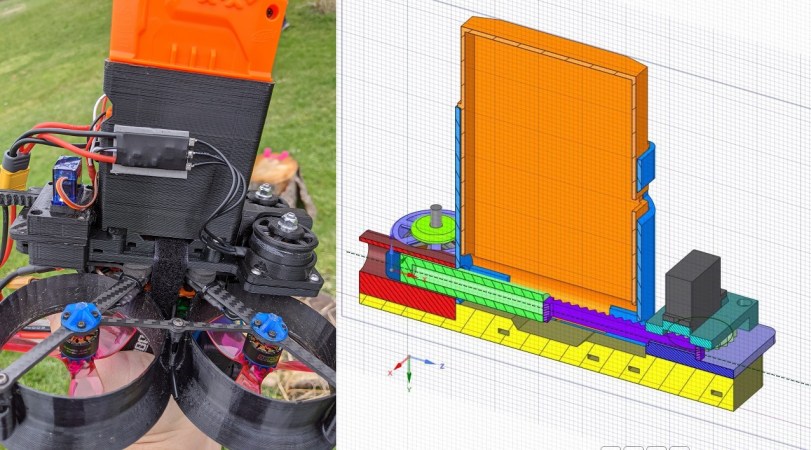
Working from home has the major advantage of spending more time with loved ones, but it all that time can sometimes lead to friction. [Cory] found that Nerf battles with his kids is an effective way to blow off some steam, but felt he was getting a bit too much exercise in the process. Instead, he equipped an FPV quadcopter with a 3D printed Nerf gun to take his place.

Since manually reloading the Nerf gun after every shot wasn’t an option, he needed to create an autoloader. The darts are propelled by a pair of brushless drone motors mounted side-by-side, with just enough space for a dart the squeeze between. The motors are allowed to spin up, and then a dart is loaded servo-operated plunger, out of an off-the-shelf Nerf magazine. The motors ESCs and servo is controlled by an Arduino Nano, which receives the fire command from one of the spare outputs on the drone’s flight controller. To nerf gear is easily removable from the drone, so [Cory] to also fly the drone on more peaceful missions. See the video of one of the battles after the break. [Cory] might need to find an alternative control location to prevent himself being used as cover by his adversaries.

Nerf guns are a fun and harmless way to live out your sci-fi warfare fantasies, especially with the technology we have available these days. From FPV sentry guns to auto-aiming rifles, and heavy artillery, anything is possible.

Continue reading “Get Some Close Air Support With A Nerf Drone”

Seeing Inside A Gas Regulator

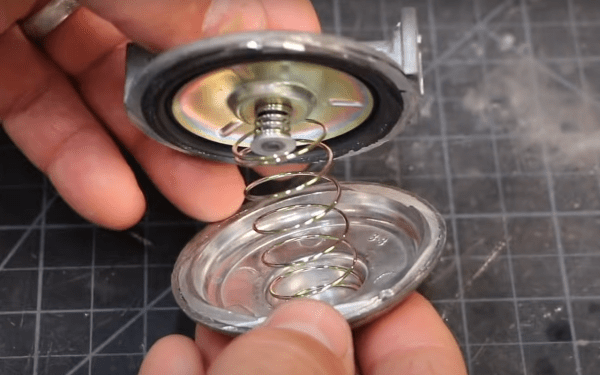
We’re surrounded by interesting engineering, but some of it is sealed inside a housing, away from easy inspection. A case in point; the humble gas regulator. It’s in equipment all around us, from a propane grill to welding gear. It’s a sealed unit — have you ever seen the inside, to know how it really works? Well thanks to [FarmCraft101], we get to do just that, in the video after the break.

To let the cat out of the bag, it’s essentially a hydraulic lever. A large diaphragm is pressurized by the low pressure side of the regulator, and is held back by a spring. When the pressure compared to ambient atmosphere is high enough to overcome the spring tension, the lever is tilted, closing the high pressure valve. Hence, pressure is determined by spring strength. We also get a look at how the system can fail — in this case it seemed to be some grit interfering with the valve. We find hidden engineering to be supremely satisfying, particularly when we get to understand it so clearly as we do here. Enjoy!

Continue reading “Seeing Inside A Gas Regulator”