Animatronics Hack Chat

Join us on Wednesday, May 20 at noon Pacific for the Animatronics  Hack Chat with Will Cogley!

While robots have only a made a comparatively recent appearance on the technology timeline, people have been building mechanical simulations of living organisms for a long time indeed. For proof, one needs only to look back at the automatons built by clever craftsmen to amuse and delight their kings and queens. The clockwork mechanisms that powered fanciful birds and animals gave way to the sophisticated dolls and mannequins that could perform complex tasks like writing and performing music, all with the goal of creating something that looked and acted like it was alive.

Once the age of electronics came around, the springs that drove the early automatons and the cams that programmed their actions were replaced by motors and control circuits. New materials made once-clunky mechanisms finer and more precise, sensors and servos made movements more lifelike, and the age of animatronics was born.

Animatronics have since become a huge business, mostly in the entertainment industry. From robotic presidents to anachronistic dinosaurs to singing rodents designed to sell pizza, animatronics have been alternately entertaining and terrifying us for decades. The fact that they’re not “real” robots doesn’t make the melding of mechanical, electrical, and computer systems into a convincing representation of a real being any less challenging. Will Cogley has more than a few amazing animatronic designs under his belt, some of which we’ve featured on Hackaday. From hearts to hands to slightly terrifying mouths, Will puts a ton of work into his mechanisms, and he’ll stop by the Hack Chat to tell us all about designing and building animatronics.

join-hack-chatOur Hack Chats are live community events in the Hackaday.io Hack Chat group messaging. This week we’ll be sitting down on Wednesday, May 20 at 12:00 PM Pacific time. If time zones have got you down, we have a handy time zone converter.

Click that speech bubble to the right, and you’ll be taken directly to the Hack Chat group on Hackaday.io. You don’t have to wait until Wednesday; join whenever you want and you can see what the community is talking about.

Continue reading “Animatronics Hack Chat”

Take A 3D Printed Brushless Motor Demo For A Spin

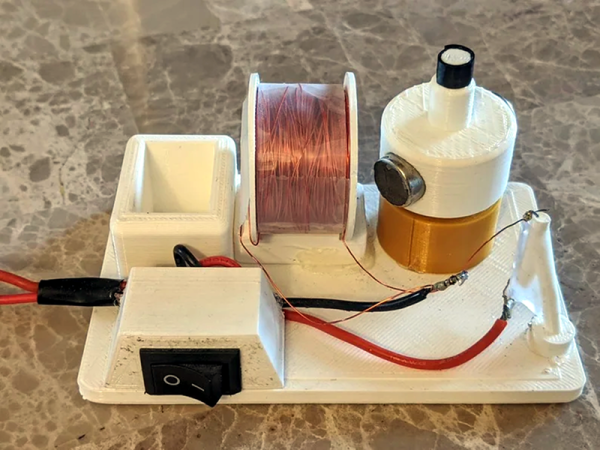
It used to be a staple of junior high physics class to build some sort of motor with paperclips or wire. A coil creates a magnetic field that makes the rotor move. In the process of moving, brushes that connect the coil to the rest of the circuit will reverse its polarity and change the magnetic field to keep the rotor turning. However, brushless motors work differently. The change in magnetic field comes from the drive controller, not from brushes. If you want to build that model, [Rishit] has you covered. You can see his 3D printed model brushless motor running in the video below.

Usually, you have a microcontroller determining how to drive the electromagnets. However, this model is simpler than that. There are two permanent magnets mounted to the shaft. One magnet closes a reed switch to energize the coil and the other magnet is in position for the coil to attract it, breaking the current. As the shaft turns, eventually the second magnet will trip the reed switch, and the coil will attract the first magnet. This process repeats over and over.

Continue reading “Take A 3D Printed Brushless Motor Demo For A Spin”

Plasma “Ghosts” May Help Keep Future Aircraft Safe

Air-to-air combat or “dogfighting” was once a very personal affair. Pilots of the First and Second World War had to get so close to land a hit with their guns that it wasn’t uncommon for altercations to end in a mid-air collision. But by the 1960s, guided missile technology had advanced to the point that a fighter could lock onto an enemy aircraft and fire before the target even came into visual range. The skill and experience of a pilot was no longer enough to guarantee the outcome of an engagement, and a new arms race was born.

An F-15 launching flare countermeasures.

Naturally, the move to guided weapons triggered the development of defensive countermeasures that could confuse them. If the missile is guided by radar, the target aircraft can eject a cloud of metallic strips known as chaff to overwhelm its targeting system. Heat-seeking missiles can be thrown off with a flare that burns hotter than the aircraft’s engine exhaust. Both techniques are simple, reliable, and have remained effective after more than a half-century of guided missile development.

But they aren’t perfect. The biggest problem is that both chaff and flares are a finite resource: once the aircraft has expended its stock, it’s left defenseless. They also only work for a limited amount of time, which makes timing their deployment absolutely critical. Automated dispensers can help ensure that the countermeasures are used as efficiently as possible, but sustained enemy fire could still deplete the aircraft’s defensive systems if given enough time.

In an effort to develop the ultimate in defensive countermeasures, the United States Navy has been working on a system that can project decoy aircraft in mid-air. Referred to as “Ghosts” in the recently published patent, several of these phantom aircraft could be generated for as long as the system has electrical power. History tells us that the proliferation of this technology will inevitably lead to the development of an even more sensitive guided missile, but in the meantime, it could give American aircraft a considerable advantage in any potential air-to-air engagements.

Continue reading “Plasma “Ghosts” May Help Keep Future Aircraft Safe”

ESP32 Trail Camera Goes The Distance On AA Batteries

There’s no shortage of things to like about the ESP8266 and ESP32, but if we had to make a list of the best features these WiFi-enabled microcontrollers have to offer, their power management capabilities would certainly be near the top. Which is how we assumed [Mark] was able to take a whopping 23,475 pictures on his ESP32 camera while powered by nothing more exotic than four AA batteries from the grocery store.

But as it turns out, the full story is quite a bit more interesting. As far as we can tell, [Mark] isn’t bothering with the ESP32’s sleep modes all. In fact, it looks like you could pull this trick off with whatever chip you wanted, which certainly makes it worth mentally filing away for the future; even if it depends on a fairly specific use case.

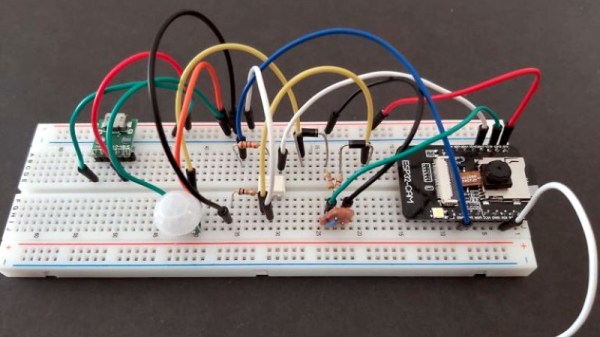
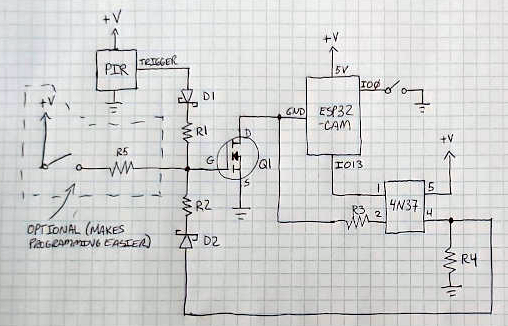
In the most simplistic of terms, [Mark] is cutting power to the ESP32 completely when it’s not actively taking pictures. The clever circuit he’s come up with only turns on the microcontroller when a PIR sensor detects something moving around in front of the camera. Once the chip is powered up and running code, it brings one of its GPIO pins high which in turn triggers a 4N37 optoisolator connected to the gate on the circuit’s MOSFET. As long as the pin remains high, the circuit won’t cut power to the ESP32. This gives the chip time to take the requested number of pictures and get everything in order before bringing the pin low and allowing the circuit to pull the plug.

If you’re looking to maximize runtime without wrangling any MOSFETs, we’ve seen some excellent examples of how the low power modes on the ESP8266 and ESP32 can be put to impressive use.

[Thanks to Jason for the tip.]

New Breakout Board For Grid-EYE Thermal Sensor

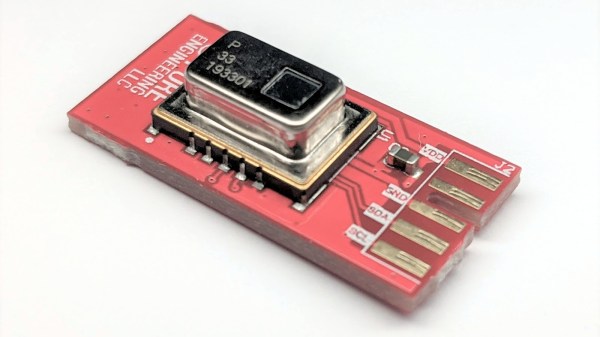
Panasonic’s Grid-EYE sensor is essentially a low-cost 8×8 thermal imager with a 60 degree field of view, and a nice breakout board makes it much easier to integrate into projects. [Pure Engineering] has created an updated version of their handy breakout board for the Grid-EYE and are currently accepting orders. The new breakout board is well under an inch square and called the GridEye2 (not to be confused with the name of the main component, the AMG8833 Grid-EYE by Panasonic.)

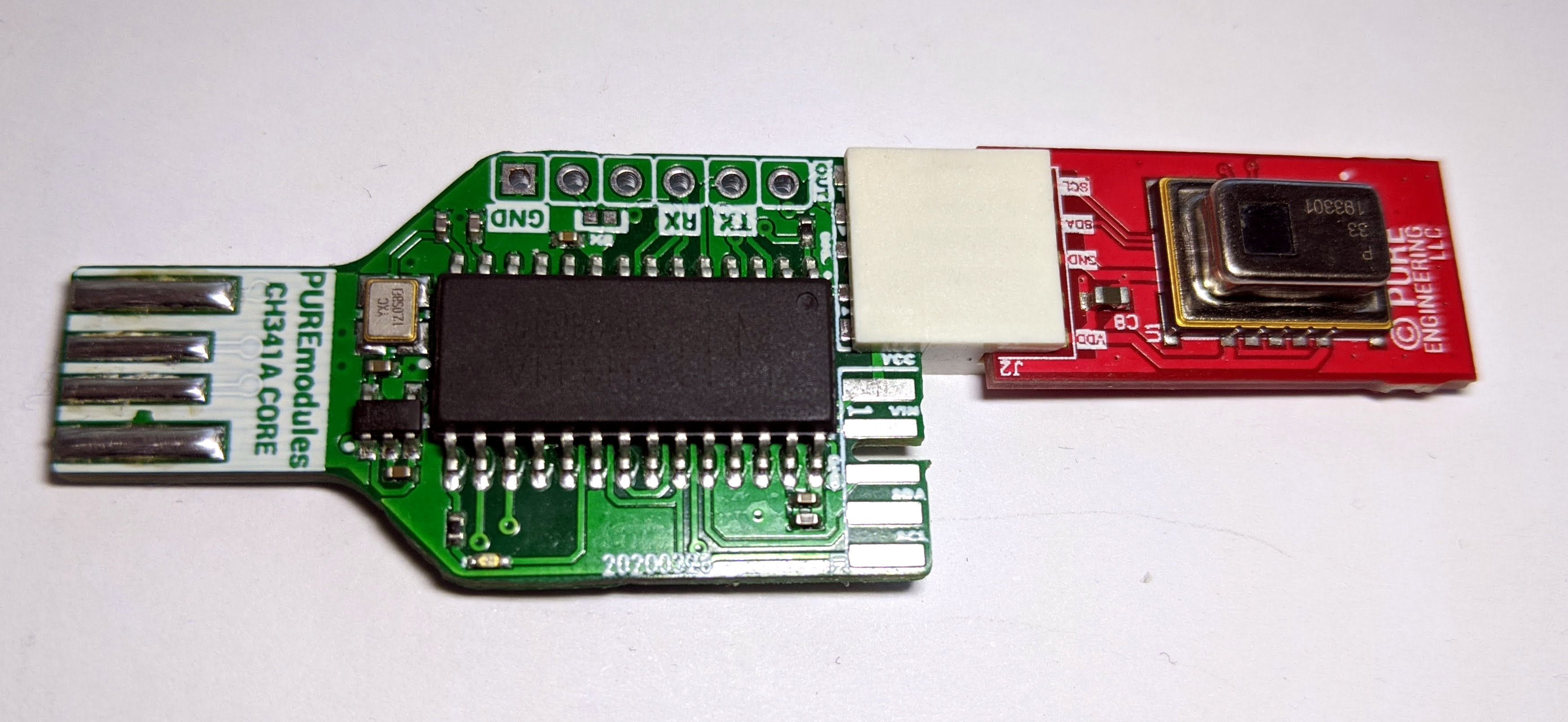
GridEye2 connected to CH341A dev board, allowing easy PC interface over USB.

A common way to interface with the Grid-EYE is over I2C, but to make connecting and developing on a PC more straightforward, [Pure Engineering] has made sure the new unit can plug right into their (optional) CH341A development board to provide a USB interface. Getting up and running on a Linux box is then as simple as installing the Linux drivers for the CH341A, and using sample C code to start reading thermal data from an attached GridEye2 board.

The Grid-EYE is a low-cost and capable little device that mates well with an LED matrix display, and on the more advanced side, a simple Gaussian interpolation can have a striking effect when applied to low-resolution sensors, making them appear higher resolution than they actually are.

Keyboard Switch Is Really A Transformer

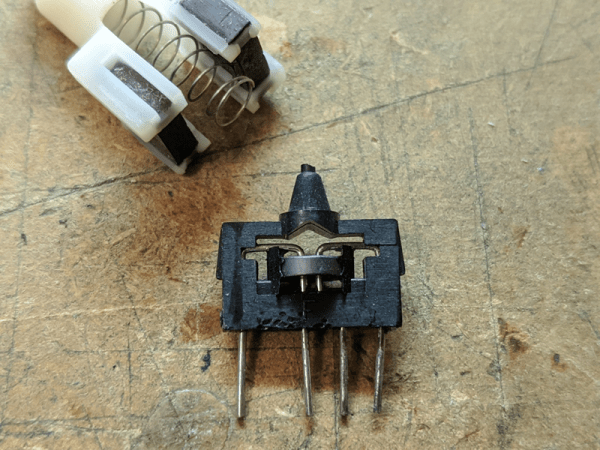
We don’t know why [TubeTime] decided to show off this oddball keyboard switch as a series of Twitter posts, but we were glad to see them somewhere. At first, the switch looks pretty conventional. But as the pictures reveal the insides, you’ll notice something unusual: a ferrite toroid! These switches operate as a transformer and are known as magnetic valve switches.

The switches have two sets of two pins — one set for the primary and one for the secondary of the transformer wound around the ferrite core. That transformer remains stationary, but a pair of permanent magnets move. When the key is up, the magnets are close to the core and cause the transformer to saturate, so there is little or no output at the secondary. When you depress the key, the magnet moves away from the core, allowing the signal to pass through the transformer. What that means is there is no mechanical contact, which is good for switch life. It is also important in environments where a small spark could cause an explosion. You can watch a video about a keyboard that used those switches, below.

Continue reading “Keyboard Switch Is Really A Transformer”

Defense Department Funds Wearables To Detect COVID-19

As many countries across the globe begin loosening their stay-at-home orders, we’re seeing government agencies and large companies prepare for the lasting effects of the pandemic. A recent solicitation from the United States Department of Defense (DoD) indicates they are investing $25 million into wearable devices that can detect early signs of COVID-19.

Based on a few details from the request for project proposals, it looks like the DoD is targeting mostly companies in this particular solicitation, but have left the door open for academic institutions as well. That makes intuitive sense. Companies can generally operate at a faster pace than most academic research labs. Given the urgency of the matter, faster turnarounds in technological development are imperative. Nonetheless, we have seen quite a bit of important COVID-19 work coming from academic research labs and we imagine that battling this pandemic will take all the brilliant minds we can muster together.

It’s good to see the DoD join the fight in what could be a lengthy battle with the coronavirus.

Please feel free to read through the request for project proposals for more details.