Hacking Diabetes Hack Chat

Join us on Wednesday, October 16 at noon Pacific for the Hacking Diabetes Hack Chat with Dana Lewis!

When your child is newly diagnosed with Type 1 diabetes (T1D), everyone is quick to point out, “It’s a great time to be a diabetic.” To some degree, that’s true; thanks to genetically engineered insulin, more frequent or even continuous glucose monitoring (CGM), and insulin infusion pumps, diabetics can now avoid many of the truly terrifying complications of a life lived with chronically elevated blood glucose, like heart disease, kidney failure, blindness, and amputations.

Despite these advances, managing T1D can be an overwhelming task. Every bite of food, every minute of exercise, and every metabolic challenge has to be factored into the calculations for how much insulin to take. Diabetics learn to “think like a pancreas,” but it’s never good enough, and the long-promised day of a true artificial pancreas always seems to remain five years in the future.

Dana Lewis is one diabetic who decided not to wait. After realizing that she could get data from her CGM, she built a system to allow friends and family to monitor her blood glucose readings remotely. With the addition of a Raspberry Pi and some predictive algorithms, she later built an open-source artificial pancreas, which she uses every day. And now she’s helping others take control of their diabetes and build their own devices through OpenAPS.org.

Join us on the Hack Chat as Dana drops by to discuss OpenAPS and her artificial pancreas. We’ll find out what her background is – spoiler alert: she wasn’t a hacker when she started this – what challenges she faced, the state of the OpenAPS project, and where she sees the artificial pancreas going.

join-hack-chatOur Hack Chats are live community events in the Hackaday.io Hack Chat group messaging. This week we’ll be sitting down on Wednesday, October 16 at 12:00 PM Pacific time. If time zones have got you down, we have a handy time zone converter.

Click that speech bubble to the right, and you’ll be taken directly to the Hack Chat group on Hackaday.io. You don’t have to wait until Wednesday; join whenever you want and you can see what the community is talking about.

[Dana Lewis image source: GeekWire]

Continue reading “Hacking Diabetes Hack Chat”

The MorningRod Wants Your Mornings Easier, Not Harder

Curtains are about as simple as household devices get, but they can be remarkably troublesome to automate. Everyone’s window treatments are slightly different, which frustrates a standardized solution. [dfrenkel] has a passion for DIY and wanted his mornings flooded with sunlight for more peaceful awakenings, so the MorningRod Smart Curtain Rod was born.

Replacing the curtain rod with aluminum extrusion and 3D printed fixtures goes a long way towards standardizing for automation.

MorningRod’s design takes advantage of affordable hardware like aluminum extrusions and 3D printed parts to create a system that attempts to allow users to keep their existing curtains as much as possible.

The curtain rod is replaced with aluminum extrusion. MorningRod borrows ideas from CNC projects to turn the curtain rod into a kind of double-ended linear actuator, upon which the curtains are just along for the ride. An ESP32 serves as the brains while a NEMA17 stepper motor provides the brawn. The result is a motorized curtain opening and closing with a wireless interface that can be easily integrated into home automation projects.

[dfrenkel] is offering a kit, but those who would prefer to roll their own should check out the project page on Thingiverse.

Military Gliders Are Making A Comeback, This Time In Unmanned Form

Sun Tzu said, “The line between disorder and order lies in logistics.” This is as true in the modern world as it was 2500 years ago, and logistics have helped win and lose many wars and battles over the centuries. To this end, Logistical Gliders Inc. is developing one-time use, unmanned delivery gliders, for the US Military.

Reminiscent of the military gliders used in WW2, the gliders are designed to be dropped from a variety of aircraft, glide for up to 70 miles and deliver supplies to troops in the field. Specifically intended to be cheap enough to be abandoned after use, the gliders are constructed from plywood, a few aluminum parts for reinforcement and injection molded wing panels. There are two versions of the glider, both with huge payloads. The LG-1K, with a payload capacity of 700 lbs/320 kg and the larger LG-2K, with a payload capacity of 1,600 lbs/725 kg. Wings are folded parallel to the fuselage during transport and then open after release with the help of gas springs. The glider can either do a belly landing in an open area or deploy a parachute from the tail at low altitude to land on the crushable nose.

Gliders like these could be used to deliver supplies after natural disasters, or to remote locations where road travel is difficult or impossible while reducing the flight time required for conventional aircraft. Powered UAVs could even be used to carry/tow a glider to the required release point and then return much lighter and smaller, reducing the required fuel or batteries.

Drones are already used to deliver medical supplies in Rwanda and Ghana, and it’s possible to build your own autonomous unmanned glider. Check out the video after the break to see the big boys in action. Continue reading “Military Gliders Are Making A Comeback, This Time In Unmanned Form”

Gutted Hoverboard Becomes Formidable Track-Drive Robot

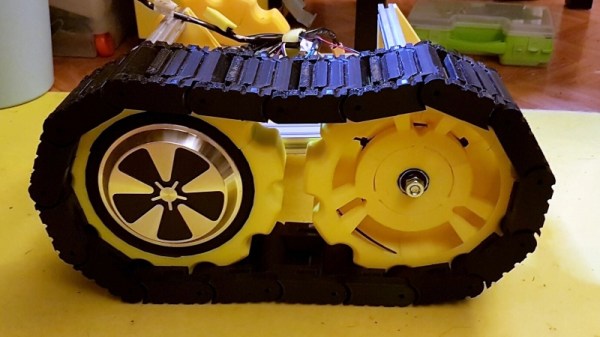
When “hoverboards” first came out, you may have been as disappointed as we were that they did not even remotely fulfill the promises of Back to the Future II. Nothing more than a fancified skateboard, hoverboards are not exactly groundbreaking technology. That doesn’t mean they’re not useful platforms for hacking, though, as this hoverboard to track-propelled robot tank conversion proves.

Most of the BOM for this build came from the junk bin – aluminum extrusions, brackets, and even parts cannibalized from a 3D-printer. But as [pasoftdev] points out, the new-in-box hoverboard was the real treasure trove of components. The motors, the control and driver electronics, and the big, beefy battery were all harvested and mounted to the frame. To turn the wheels into tracks, [pasoftdev] printed some sprockets to fit around the original tires. The tracks were printed in sections and screwed to the wheels. Idlers were printed in sections too, using central hubs and a clever method for connecting everything together into a sturdy wheel. Printed tank tread links finished the rolling gear eventually; each of the 34 pieces took almost five hours to print. The dedication paid off, though, as the 15-kg tank is pretty powerful; the brief video below shows it towing an office chair around without any problems.

We noticed that [pasoftdev] found the assembly of the tread links a bit problematic. These 3D-printed links that are joined by Airsoft BBs might make things a little easier next time.

Continue reading “Gutted Hoverboard Becomes Formidable Track-Drive Robot”

Get Dirty In Your Quest For Power!

A fascinating oddity in the list of potential alternative power sources is the microbial fuel cell, in which the chemical reactions of micro-organisms digesting their food are harnessed to harvest electrons and thus generate electrical current. We’d like to know more, so [Williamolyolson]’s soil microbial fuel cell is a particularly interesting glimpse into this field.

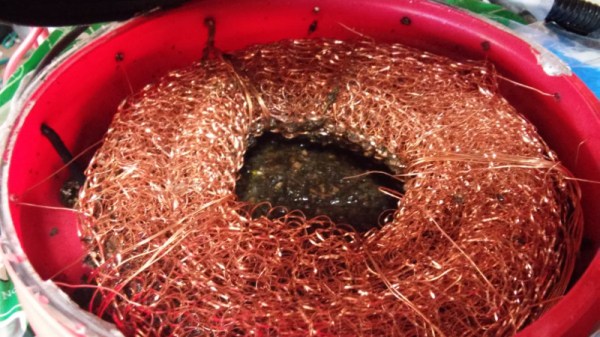
In this type of cell, an anode is placed at the bottom of a container of anaerobic wet soil medium laced with biomass to provide a food source for the bacteria, and a cathode is placed on the top of the medium exposed to air. The cell in this project appears to be a plastic coffee tub, and the electrodes are copper pan scourers. Unlike a chemical battery they do not need to be different materials and they themselves are not part of the chemistry of the cell, instead, they serve to collect and return the electrons to the cell.

The project logs detail a series of time-series measurements and experiments with placement of the cathode. Yield seems to be in the region of 200mV at about 1mA, though peaks as high as 400mV have been seen. It’s clear that this is not a cell that will replace your grid hook-up any time soon, but it still retains a lot of possibilities for use in micropower applications. There has been plenty of work in the field of micropower harvesting using other sources such as small solar cells, and this has the advantage of microbe-laden dirt being ubiquitous and free.

A couple of previous MFCs we’ve brought you include this multi-cell design said to be capable of charging a phone, and this cell that also supports a fish.

Hacking Broken Plastic Parts Without A 3D Printer

We’ve all encountered the odd plastic part that is broken and unobtainable. Sure, 3D printers can print big replacement parts, but sometimes you just need to rebuild a very specific piece. [AkBkukU] shows off a technique for doing just that using a process you could almost call manual 3D printing. We’ve seen baking soda used to cure cyanoacrylate glue before, but this technique uses it to build layers of glue that are apparently quite solid.

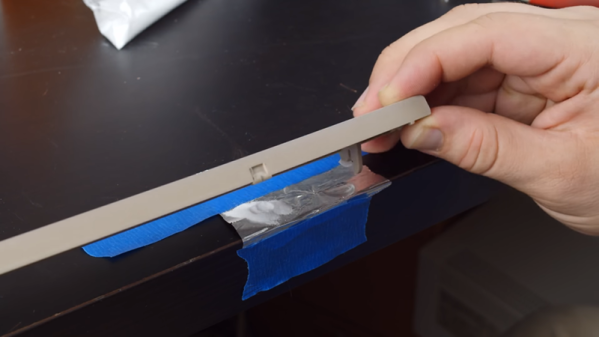
There’s quite a bit of nuance in the video below, but the basic idea is to put a pile of soda on one side of a piece of tin foil and a glob of glue. You dip the part in glue and then into the soda. Each time you get a little thicker layer of glue.

Afterward, you’ll have to file and otherwise shape the new part, but the fact that it can survive being filed should tell you something. We were reminded of how some people use epoxy to form repair parts and then machine them to the exact shape needed. At the very end of the video he builds up layers on a part he can’t dip. Did it work? Watch it and see.

In addition to the manual 3D printing technique, he demonstrates using baking soda to cure repairs on a knurled knob from an old clock radio. That’s a bit more conventional, but if you haven’t seen it done before, it is nearly miraculous.

Glue is amazing. We’ve seen hot glue do injection molding. There are many more types out there, too.

Continue reading “Hacking Broken Plastic Parts Without A 3D Printer”

What The Scale? Mouse Teardown Throws Up A Few Surprises

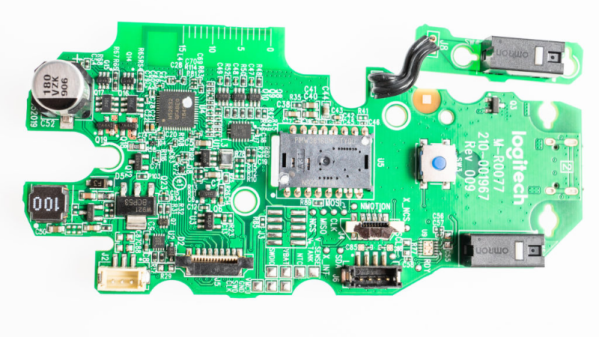
[Eric Weinhoffer] and his colleagues did a great comparative tear down of the MX Master 3 and the MX Master 2S mice from Logitech. Tear down’s are great fun and often end up teaching us a lot. Looking at the insides of a product can tell us a great deal about how to solve certain problems, or avoid pitfalls. Opening up two versions of the same product provides an even greater wealth of useful information on how product design evolves based on lessons learned from the earlier versions. Logitech is no greenhorn when it comes to Mice design, so the MX Master 2S was already almost perfect. But looking at the Master MX 3 shows where the earlier version fell short of expectations and how it could be improved upon.

These mice have intelligent scroll wheels, which can rotate in either “detente” or “freewheel” modes. Detente allows slower, precise scrolling, while freewheeling allows rapid scrolling. The two mice models have completely different, and interesting, methods of achieving these actions. The older version has a rubber-coated wheel and uses a motor, which turns a cam. This forces a detent ball onto the inside of the wheel for detent mode and releases it for free mode. Once the rubber wears off, the mouse is pretty much headed for the dumpster. The new metal wheel does away with the rubber coating as well as the noisy, slow, and prone to wear-and-tear motor assembly. The actuation is now done using a bi-stable electromagnet. A 25 V pulse magnetizes the coil which sits inside the wheel and it pulls on little metal teeth on the inside rim of the wheel. This gives a noiseless detente feel, without any physical contact. A second 25 V spike de-magnetizes the coil, allowing the scroll wheel to spin freely.

[Eric] points out several incremental changes in design which have resulted in improved ergonomics. He also uncovers a few nuggets of useful information. The use of interchangeable mold inserts help make molds last longer while still offering the flexibility to make changes in the molded part. It’s interesting to see special components being used for withstanding vibration and high-G forces. Some of these insights can be useful for those moving from prototyping to production. There’s one puzzling feature on the new PCB that [Eric] cannot figure out. There is a 15 mm scale screen-printed over the blue tooth antenna. If you have an answer on its purpose, let us know in the comments below.



If you are left-handed (which makes 10% of us), you’re out of luck with these right-handed mice and might like to sign one of the several online petitions demanding lefty versions.