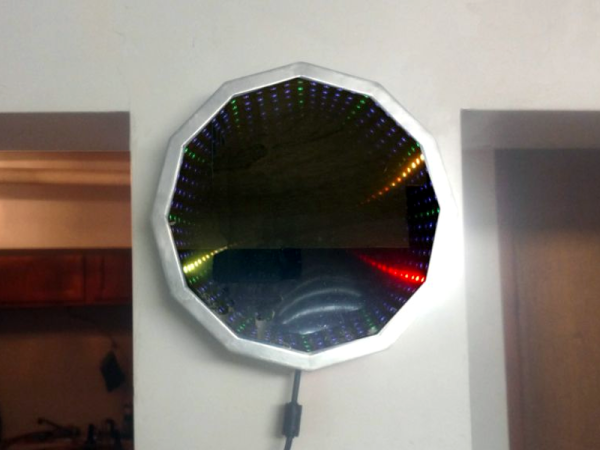
It’s About Time We Saw Another Infinity Mirror Clock

Have you made an infinity mirror yet? They’re pretty much a rite of passage project at this point. But unlike that DIY power supply, most of them serve no function beyond looking cool (not that there’s anything wrong with that). Might as well make it do something, right?

[How Do You – DIY] has a built a few mirrors because he likes experimenting with the effects of different reflective surfaces in various positions. This time, he’s built a clock from the ground up. Basic infinity mirror rules apply here, though he used semi-transparent reflective film on both sides for greater effect and put an adjustable warping bar in the back so the trail curves toward the center. The actual timekeeping is done by an Arduino Nano.
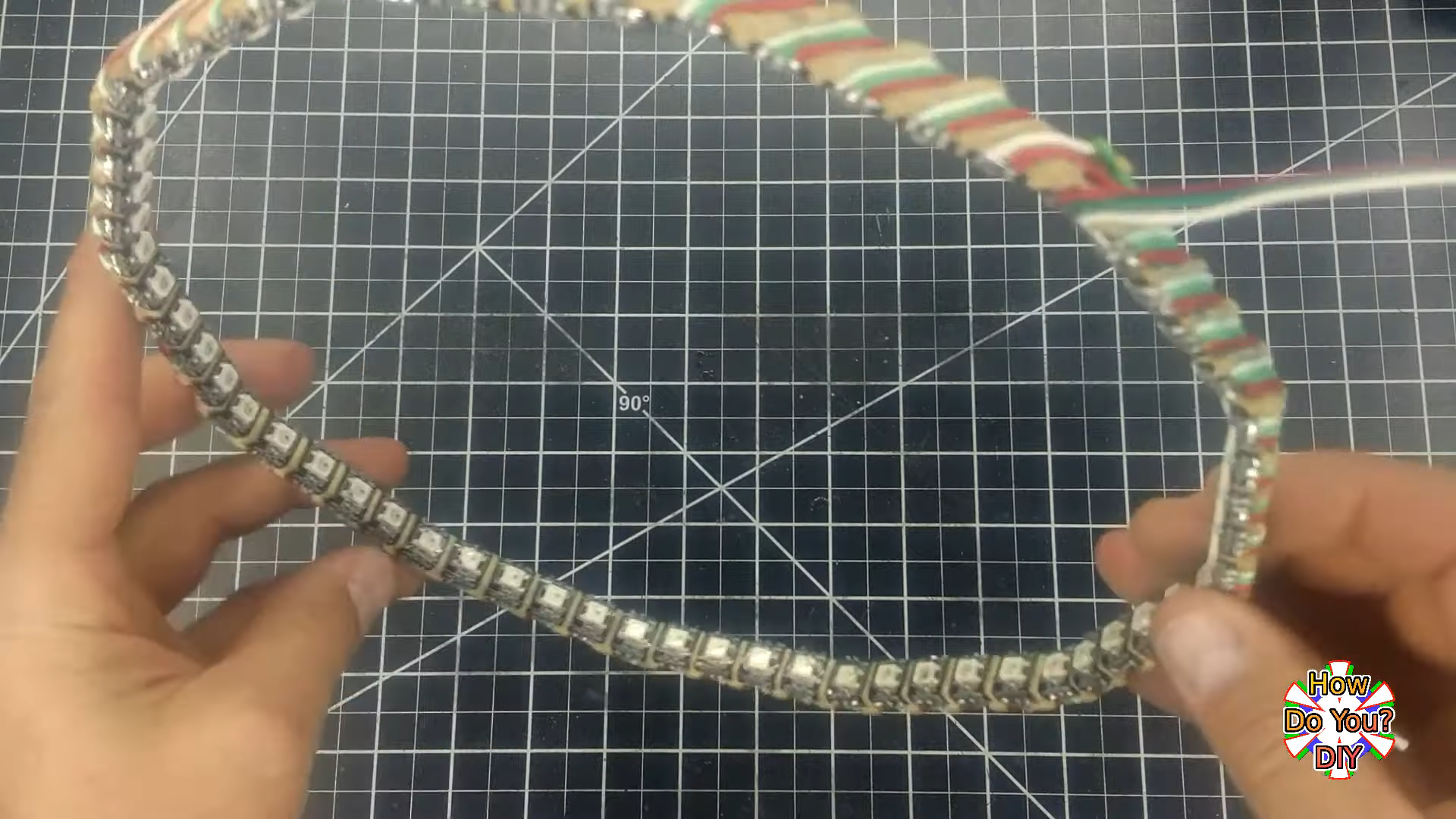
The RGB LEDs on his strip were a few millimeters too far apart for his liking, so he added a few dozen hours to the build by cutting it apart and painstakingly placing them all around the wood frame. Then he Dremeled a groove for each set of three wires that link the LEDs so that they sit flush. The final product is beautiful, and it’s a shame that this LED-holding frame is hidden away inside the equally well-crafted aluminium frame.

Don’t waste another minute — sweep past the break to check out the build video. If it’s a portable and functional conversation piece you want, make a set of infinity mirror coasters.

Oh, and did we mention that we’re running a clock contest? Hint, hint.

Continue reading “It’s About Time We Saw Another Infinity Mirror Clock”

Replica Proton Pack Is A Great Halloween Build

Way back in 1984, the Ghostbusters defended New York City from an onslaught of supernatural phenomena. In their honor, [BALES] created this costume for Halloween, replete with an amazing replica proton pack.

(We know, this is a little late for Halloween 2019, but just think about how early you’re going to be for Halloween 2020!)

While not actually capable of trapping and harnessing entities from the spirit realm, the replica pack nonetheless is impressive. Constructed primarily from EVA foam and PVC pipe, it’s built on a custom built Alice pack frame to make it easy to carry. The cyclotron scores some LEDs, and EL wire completes the neutrino wand. A rough-and-ready paintjob make the gear look well used, and the laser-printed labels go a long way to completing the look.

[BALES] didn’t skimp on the clothing side either. The olive drab overalls, an embroidered patch, and belt were sourced from Amazon, and a custom name badge was produced to complete the ensemble. We’re sure the costume was an absolute hit at Halloween, and gives us plenty ideas of our own. It would pair well with this PKE meter that actually detects radiation, too!

Edge-Lit Ping Pong Paddle Lights Up The Fight

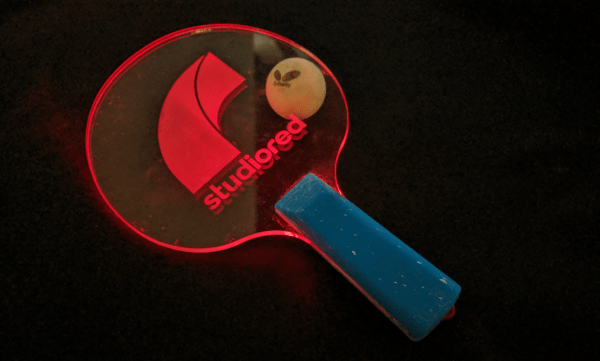
[George] and his coworkers like to blow off a little lunchtime steam on the company ping pong table. We might do the same, except it’d just be us versus the wall, and most of the exercise would consist of bending over to pick the ball up off the floor. When he found a scrap piece of acrylic out in their shop, [George] got the bright idea to make an edge-lit paddle featuring the company’s logo.

Not only does the paddle look cool, it works pretty well, too, even though it’s heavier and has smooth surfaces compared to a standard paddle. To begin, [George] found a regulation-size paddle outline and imported it into SolidWorks, then designed all the necessary cuts for the LEDs and other electronics. He also designed and printed ergonomic grips to protect the goods.

Continuing the stuff-on-hand theme, [George] used through-hole LEDs and dug into the abundance of battery clips and springs they have lying around for designing prototypes, instead of making it all fancy with SMT LEDs and a rechargeable battery pack. Slip on those sweatbands, because we’re serving up the build video after the break.

We see more ping pong balls than paddles around here, and that’s probably because they make great LED diffusers.

Continue reading “Edge-Lit Ping Pong Paddle Lights Up The Fight”

Yosys Fronts For Xilinx ISE

We always marvel at how open-source tools can often outstrip their commercial counterparts. Yosys, the open-source tool for Verilog synthesis, is a good example. Although the Xilinx ISE design suite is something close to abandonware, a lot of people still use it because it supports older FPGAs the newer tools don’t. Its Verilog parser is somewhat slow to catch up to new standards, and according to a recent GitHub update, Yosys can now provide files for ISE that target Spartan 6, Virtex 7, and Series 7 FPGAs. In addition, there is some support for Spartan 3, Virtex 2, 4, and 5, although those are not ready yet.

According to the post, you’ll want to use the synth_xilinx command along with the -ise option and a -family option that matches your target (that is, xc6s for Spartan 6).  On the output side, you’ll write an EDIF file using the write_edif command.

Continue reading “Yosys Fronts For Xilinx ISE”

Burning Propane Beautifully Illustrates How A Tesla Valve Works

When you hear the name “Tesla”, chances are good that thoughts turn instantly to the company that’s trying to reinvent the motor vehicle and every industry that makes it possible. While we applaud the effort, it’s a shame that they chose to appropriate the surname of a Serbian polymath as their corporate brand, because old [Nikola] did so many interesting things in his time, and deserves to be remembered in his own right.

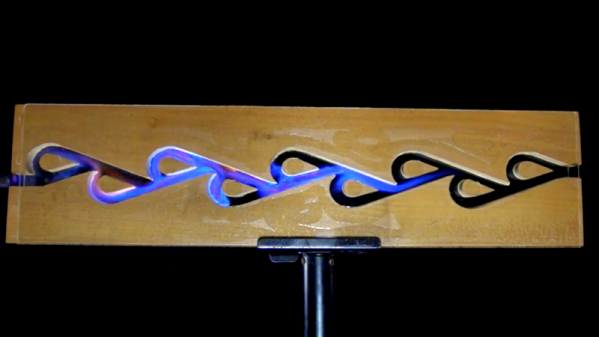
Take the Tesla valve. In essence a diode for fluids, the Tesla valve uses a tortuous path to allow flow in one direction but severely restrict it in the other. Understanding how it works isn’t necessarily intuitive, though, which is why [NightHawkInLight] chose to demonstrate the Tesla valve principle with exploding propane. It’s not new territory to him; we’ve covered his propane-powered rifle in the past.

The swirling blue and green flame front in those experiments make burning propane the perfect working fluid to demonstrate how the Tesla valve works. The video below tells the tale, with high-speed footage showing the turbulence that restricts the reverse flow. The surprise discovery is that in the forward direction, the burning gas actually seems to accelerate as it moves down the valve; hypersonic Tesla plasma cannon, anyone?

We’ve seen Tesla valves before, including one made from a “Shrinky Dink”. That did a pretty good job of visualizing the flow patterns that make the valve work, but there’s a huge showmanship gap between tiny channels filled with colored water and the explosive decomposition of a fuel-air mix. It’s a bit riskier, and standard “don’t try this at home” disclaimers apply, but luckily [NightHawkInLight] still has his eyebrows, so he must be doing something right.

Continue reading “Burning Propane Beautifully Illustrates How A Tesla Valve Works”

A Modular System For Building Heavy Duty 18650 Battery Packs

With 18650 cells as cheap and plentiful as they are, you’d think building your own custom battery packs would be simple. Unfortunately, soldering the cells is tricky, and not everyone is willing to invest in a spot welding setup just to put the tabs on them. Of course that’s only half the battle, you’ll still want some battery protection and management onboard to protect the cells.

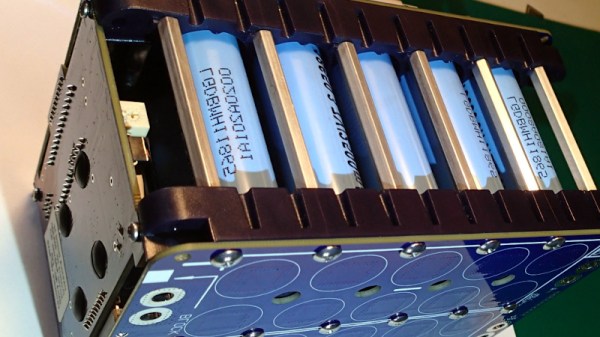
The lack of a good open source system for pulling all this together is why [Timothy Economu] created DKblock. Developed over the last three years, his open source system allows users to assemble large 18650 battery packs for electric vehicles or home energy storage, complete with integrated intelligent management and protection systems. Perhaps best of all there’s no welding required, the packs simply get bolted together.

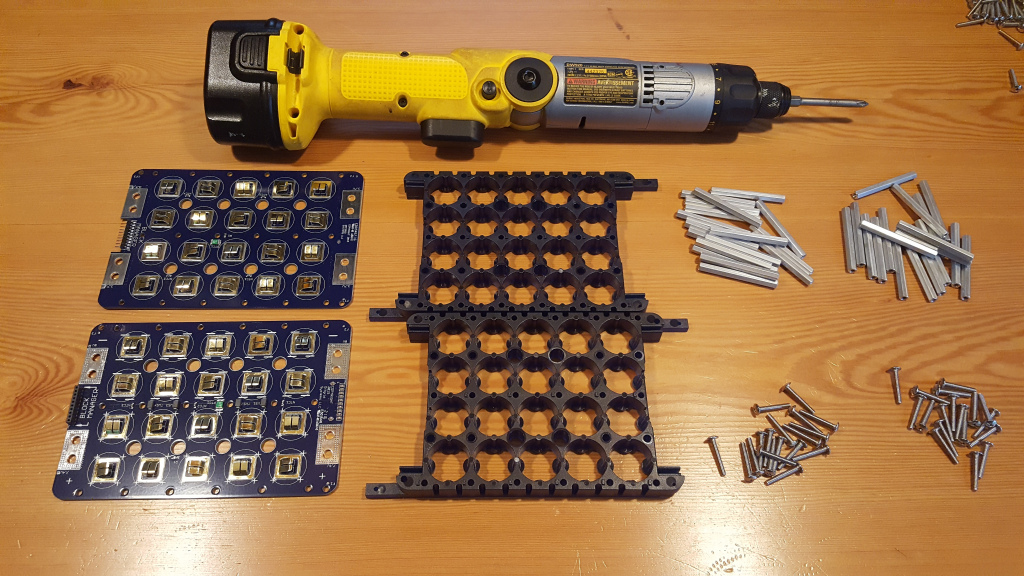
Each block of batteries is assembled using screws and standoffs in conjunction with ABS plastic cell holders. A PCB is placed on each side of the stack, and with tabs not unlike what you’d see in a traditional battery compartment, all the cells get connected without having to solder or weld anything to them. This allows for the rapid assembly of battery packs from 7.2 VDC all the way up to 150 VDC , and means individual cells can easily be checked and replaced in the future should the need arise.

For monitoring the cells, a “Block Manager” board is installed on each block, which communicates wirelessly to a “Pack Supervisor” board that monitors the overall health of the system. Obviously, such a robust system is probably a bit overkill if you’re just looking to build a pack for your quadcopter, but if you’re looking to build a DIY Powerwall or juice up a custom electric vehicle, this could be the battery management system you’ve been looking for.

Interview: FieldKit Team The Morning After Winning The 2019 Hackaday Prize

We caught up with Shah Selbe and Jacob Lewallen the morning after their project, FieldKit, won the Hackaday Prize. FieldKit is an open-source field-based research data collection platform. Which is basically a lot of fancy words for saying it’s a system for collecting sensor data in the field without being snagged by the myriad of problems associated with putting electronics in remote locations. It’s a core project of Conservify, a non-profit organization that seeks to empower conservation research.

As grand prize winner the FieldKit project was awarded a $125,000 cash prize, which Shah and Jacob say is transformative for a non-profit pursuing technology research and development. It seems the grant process has not evolved to embrace developing electronics, while opportunities for research projects have begun to involve recording large data sets in order to test a hypothesis. This is where FieldKit truly shines. Their vision is to provide a low-cost and extensible system that other researchers can use to collect data while making their own grant dollar go much further.

Continue reading “Interview: FieldKit Team The Morning After Winning The 2019 Hackaday Prize”