The Great Ohio Key Fob Mystery, Or “Honey, I Jammed The Neighborhood!”

Hack long enough and hard enough, and it’s a pretty safe bet that you’ll eventually cause unintentional RF emissions. Most of us will likely have our regulatory transgression go unnoticed. But for one unlucky hacker in Ohio, a simple project ended up with a knock at the door by local authorities and pointed questions to determine why key fobs and garage door remotes in his neighborhood and beyond had suddenly been rendered useless, and why his house seemed to be at the center of the disturbance.

Few of us want this level of scrutiny for our projects, so let’s take a more in-depth look at the Great Ohio Key Fob Mystery, along with a look at the Federal Communications Commission regulations that govern what you can and cannot do on the airwaves. As it turns out, it’s easy to break the law, and it’s easy to get caught.

Continue reading “The Great Ohio Key Fob Mystery, Or “Honey, I Jammed The Neighborhood!””

Comprinter Hides A Laptop Inside A Printer

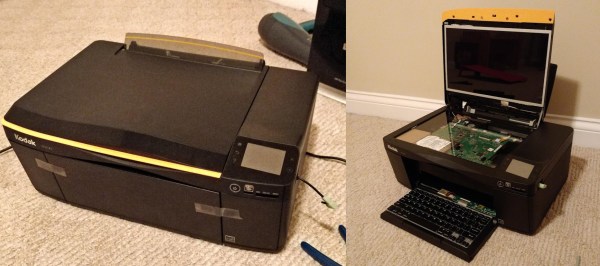
Sometimes we find projects that border on the absurd but are too cool to pass up. The Comprinter is exactly that. [Mason Stooksbury] had a dream. An all-in-one scanner printer that was also a computer. What would turn heads more than walking into a hackerspace with a printer, plugging your headphones in, then opening up the top to reveal a monitor?

[Mason’s] dream became possible when friends gave him some old laptops and a dead Kodak printer. After going through the laptops, he picked a Dell Inspiron 1440 to be the donor machine. The printer and laptop were both carefully stripped down. [Mason’s] goal for the project was to build a “beautiful” printer/computer. No bodges allowed. He spent most of his time planning out how to mount the motherboard and display inside the scanner section of the chassis.

The actual assembly was quite fiddly. Working with only an inch or so of clearance, [Mason] installed standoffs for the motherboard and display. He to do all this without breaking the wires for the display and WiFi antennas.

Once the main parts of the laptop were assembled, [Mason] completed the build with a nine-port USB hub, some internally mounted speakers and a USB keyboard mounted in the paper tray. The twelve-hour operation was a complete success. What looks to be a cheap inkjet actually hides a complete laptop running Xubuntu. The only downside is that the printer doesn’t actually print, but [Mason] is quick to note that if the printer hadn’t been broken in the first place, it would work fine — all the modifications are in the scanner section.

We’ve seen some wild casemods over the years, including a Nintendo in a toaster, a modern PC stuffed into an original Xbox, and Raspberry Pi’s stuffed into just about everything.

Microscope-Inspired Toolchanger Spins Multicolor 3D Prints

The 3D printing community is simply stirring with excitement over toolchanging printers, but these machines are still the exception rather than the norm. Here’s an exceptional exception: [Paul Paukstelis] built a five-color printer with a novel head-changing solution.

[Paul’s] 3D printer is a hat-tip to anyone who’s spent time in the wetlab. For starters, the printer is born from the remains of a former liquid handling system, a mighty surplus score. When it comes to headchanging, [Paul] combined some honest inspiration from E3D’s toolchanging videos with some design features borrowed from the microscope in his lab. The result is that the printer’s five-tool head-changer mechanically behaves very similarly to the nose piece in a compound light microscope.

Because the printer evolved from old lab equipment, [Paul] dubs his printer into a lineage that he calls the “Reclaimed Rapid-Prototyper,” or the RecRap. Best of all, he’s kindly posted up the CAD files on the Thingiverse such that you too can take a deep look into this head-changing solution.

We love seeing these tools get a second life, and we think there’s plenty of potential for new offspring in this lineage of discarded lab equipment.

Continue reading “Microscope-Inspired Toolchanger Spins Multicolor 3D Prints”

Deflecting Earthquakes The Way Ancient Romans Did It

A recent French study indicates that the ancient Romans may have figured out how to deal with earthquakes by simply deflecting the energy of the waves using structures that resemble metamaterials. These are materials which can manipulate waves (electromagnetic or otherwise) in ways which are normally deemed impossible, such as guiding light around an object using a special pattern.

In a 2012 study, the same researchers found that a pattern of 5 meter deep bore holes in the ground was effective at deflecting a significant part of artificially generated acoustic waves. One of the researchers, [Stéphane Brûlé], noticed on an aerial photograph of a Gallo-Roman theater near the town of Autun in central France that its pattern of pillars bore an uncanny resemblance to this earlier experiment: a series of concentric (semi) circles with the distance between the pillars (or holes) decreasing nearer the center.

Further research using archaeological data of this theater site confirmed that it did appear to match up the expected pattern if one would have aimed to design a structure that could successfully deflect the acoustic energy from an earthquake. This raises the interesting question of whether this was a deliberate design choice, or just coincidence.

Additional research on the Colosseum in Rome and various other amphitheaters did however turn up the same pattern, which makes it seem like a deliberate choice by the Roman builders over a long period of time. With this pattern apparently capable of protecting a structure from the destructive effects of the acoustic waves generated by an earthquake, the remaining question is whether they discovered this pattern over time by observing damage to buildings and decided to implement it in new buildings.

Although we’ll likely never get an answer to that question, this discovery can however lead to improvements to individual buildings today, as well as entire cities, that may protect them against earthquakes and save countless lives that way.


The Kalman Filter Exposed

If we are hiring someone such as a carpenter or an auto mechanic, we always look for two things: what kind of tools they have and what they do when things go wrong. For many types of embedded systems, one important tool that serious developers use is the Kalman filter. It is also something you use when things go “wrong.” [Carcano] recently posted a tutorial on Kalman filter equations that tries to demystify the topic. His example — a case of things going wrong — is when you have a robot that knows how far it is supposed to move and also has GPS coordinates of its positions. Since the positions probably don’t agree, you can consider that a problem with the system.

The obvious answer is to average the two positions. That’s fine if the error is small. But a Kalman filter is much more robust in more situations. [Carcano] does a good job of taking you through the math, but we will warn you it is plenty of math. If you don’t know what a Gaussian distribution is or the word covariance makes you think of sailboats, you are going to have to do some reading to get through the post.

Continue reading “The Kalman Filter Exposed”

The Clickiest Game Of Tetris You’ll Ever Play, On A Flip-Dot

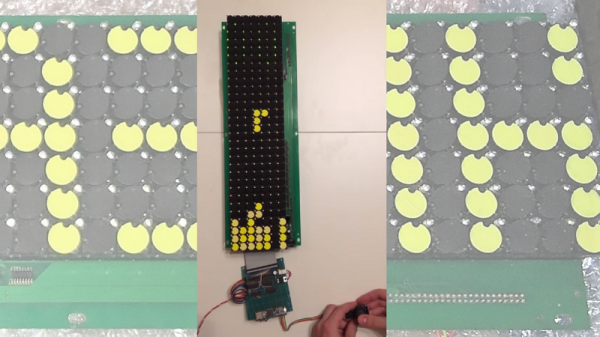
Like many other classics it’s easy to come up with ways to ruin Tetris, but hard to think of anything that will make it better. Adding more clickiness is definitely one way to improve the game, and playing Tetris on a flip-dot display certainly manages to achieve that.

The surplus flip-dot display [sinowin] used for this version of Tetris is a bit of an odd bird that needed some reverse engineering to be put to work. The display is a 7 x 30 matrix with small dots, plus a tiny green LED for each dot. Those LEDs turned out to be quite useful for replicating the flashing effect used in the original game when a row of blocks was completed, and the sound of the dots being flipped provides audio feedback. The game runs on a Teensy through a custom driver board and uses a Playstation joystick for control. The video below, in perfectly acceptable vertical format, shows the game in action and really makes us want to build our own, perhaps with a larger and even clickier flip-dot display.

The best thing about Tetris is its simplicity: simple graphics, simple controls, and simple gameplay. It’s so simple it can be played anywhere, from a smartwatch to a business card and even on a transistor tester.

Continue reading “The Clickiest Game Of Tetris You’ll Ever Play, On A Flip-Dot”

Turn Your Car Into A Simulator

Video games, while entertaining to be sure, are a great way to experience things that could not easily be recreated in real life. Shooting aliens on a giant ring in space is an obvious example, but there are some more realistic examples that video games make much more accessible, such as driving a race car. You can make that experience as realistic as you want, too, and can even go as far as using a real car as your controller.

All modern cars use a communication system to allow their various modules to talk to one another. Fuel injection, throttle position, pedal positions, steering wheel angle, and climate control systems can all communicate on the CAN bus, and by tapping into that information the car can be used as a controller for a video game. Once you plug in to the OBD-II port on a car, you’ll need a piece of software to decode all of that information. [Andrew] uses uinput, a tool that allows Linux machines to take any input signal and map it in any way that can be programmed.

The build also includes the use of an integrated pico projector, allowing the car to be parked and turned into a simulator at any time. It’s similar to another project which used a Mazda instead of a Chevrolet Volt, but it just goes to show how straightforward it can be to take information from the CAN bus of a modern car.

Continue reading “Turn Your Car Into A Simulator”