A 6502 With A Custom Language

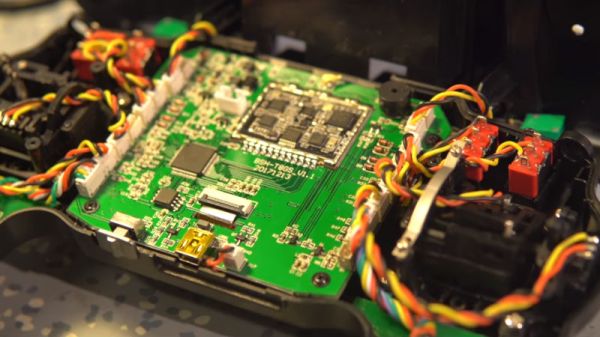
The 6502 has a long history with hackers. The Apple computer (the one with no keyboard or even case) had a 6502. So did the Kim-1. [Dolo’s] version is a bit more refined, though. He started it a few years ago in response to one of our contests, but he’s been making improvements to it ever since. In particular, the custom programming language, Dflat, has many improvements lately, including true functions and high-resolution drawing.

The hardware has a CPU running at over 2.5 MHz, 44K of RAM, 16K of PROM, and 16K of video RAM. There’s plenty of I/O, including a keyboard, sound, and joysticks. An SD card provides mass storage and it all goes in a hacked BBC Micro case. You can see an overview video, below.

Continue reading “A 6502 With A Custom Language”

Photograph Of Single Atom Captured With A Plain Old Camera

The Engineering and Physical Sciences Research Council awarded a remarkable photograph its overall prize in science photography. The subject of the photograph? A single atom visible to the naked eye. Well, perhaps not exactly the naked eye, but without a microscope. In the picture above (click here to enlarge), the atom is that pale blue dot between the two needle-like structures.

You probably learned in school that you couldn’t see a single atom, and that’s usually true. But [David Nadlinger] from the University of Oxford, trapped a positively charged strontium atom in an ion trap and then irradiated it with a blue-violet laser. The atom absorbs and reemits the light, and a camera can pick up the light, creating a one-of-a-kind photograph. The camera was a Canon 5D Mk II with a 50mm f/1.8 lens — a nice camera, but nothing too exotic.

The ion trap keeps the single atom balanced between two small needle points about 2 millimeters apart. [Nadlinger] did some math that convinced him the photograph could be possible and made it a reality on a Sunday afternoon. The pale dot isn’t especially spectacular by itself, but when you realize that it is the visual effect of a single atom, it is mind-blowing. Turns out, the lab has taken some similar photographs in the past. They don’t remember who took it, but they have a picture of 9 calcium-43 ions trapped, that you can seen below. The ions are 10 microns apart and at an effective temperature of 0.001 degrees Kelvin.

Other winning photographs included patterns on a soap bubble, an EEG headset in use, and microbubbles used to deliver drugs. There’s also an underwater robot, a machine for molecular beam epitaxy that looks like a James Bond villain’s torture device, and lattices made with selective laser melting 3D printing.

If you want to look at atoms from the comfort of your own home, maybe you should build an STM. You might even try NIST’s improved atom probe while you are at it. Just remember you can’t trust atoms. They make up everything.

Photo credit: David Nadlinger

The Most Utilitarian 3D Print Has The Widest Reach

3D Printing is often heralded as a completely new fabrication method, creating things that simply cannot be manufactured in other ways. While this is true, the widest reaching usefulness of 3D printers isn’t for pushing the limits of fabrication. The real power is in pushing the limits of manufacturing for individuals who need one-off parts.

The proof point is in the story shown above. A missing key on a keyboard could have meant an otherwise fine piece of hardware headed for recycling, but was saved by a single part printed on a desktop 3D printer. Multiply this by the increasing number of people who have access to these printers and you can see how using 3D printing for repairs will have a huge impact on keeping our gear in service longer.

We want to see how you’ve saved things from the rubbish pile. Show them off in Hackaday’s Repairs You Can Print contest. The best Student entry and the best Organization entry (think Hackerspace) will each win a high-end 3D Printer. But anyone can enter, with the top twenty entries receiving $100 credit for Tindie.

If you’re like us though, these prizes are just icing on the cake. The real reward is showing what some think is mundane but the Hackaday crowd believes is worth celebrating. Check out all the entries so far and join us below for a few highlights.

Continue reading “The Most Utilitarian 3D Print Has The Widest Reach”

OpenSCAD: Tieing It Together With Hull()

What’s your favorite OpenSCAD command? Perhaps it’s intersection() or difference()? Or are you a polygon() and extrude() modeler? For me, the most useful, and maybe most often overlooked, function is hull(). Hull() does just what it says on the can — creates a convex hull around the objects that are passed to it as children — but that turns out to be invaluable.

Hull() solves a number of newbie problems: making things round and connecting things together. And with a little ingenuity, hull() can provide a nearly complete modelling strategy all on its own. If you use OpenSCAD and your creations end up with hard edges, or you spend too much time figuring out angles, or if you just want to experience another way to get the job done, read on!

Continue reading “OpenSCAD: Tieing It Together With Hull()”

Particle Introduces New Hardware, Adds Mesh Support

Particle, makers of the WiFi and Cellular IoT modules everyone loves, is introducing their third generation of hardware. The Particle Argon, Boron, and Xenon are Particle’s latest offering in the world of IoT dev boards, and this time they’re adding something amazing: mesh networking.

New Particle boards named Argon, Boron, and XenonThe three new boards are all built around the Nordic nRF52840 SoC and include an ARM Cortex-M4F with 1MB of Flash and 256k of RAM. This chip supports Bluetooth 5 and NFC. Breaking the new lineup down further, the Argon adds WiFi with an ESP32 from Espressif, the Boron brings LTE to the table with a ublox SARA-U260 module, and the Xenon ditches WiFi and Cellular, relying only on Bluetooth, but still retaining mesh networking. This segmentation makes sense; Particle wants you to buy a ton of the Xenon modules to build out your network, and use either the Argon or Boron module to connect to the outside world.

The form factor of the boards conforms to Adafruit Feather standard, a standard that’s good enough, and much better than gigantic Arduino shields with offset pins.

Of particular interest is the support for mesh networks. For IoT solutions (whatever they may be), mesh networking is nearly a necessity if you have a sufficient number of nodes or are covering a large enough area. The technology going into this mesh networking is called Particle Mesh, and is built on OpenThread. While it’s a little early to see Particle’s mesh networking in action, we’re really looking forward to a real-world implementation.

Preorder pricing for these boards sets the Argon module at $15, the Boron at $29, and the Xenon at $9. Shipping is due in July.

Mary Somerville: The First Scientist

Science, as a concept, is relatively new. Benjamin Franklin wasn’t a scientist probing the mysteries of amber and wool and electricity and ‘air baths’; he was a natural philosopher. Antonie van Leeuwenhoek was simply a man with a proclivity towards creating new and novel instruments. Robert Hooke was a naturalist and polymath, and Newton was simply a ‘man of science’. None of these men were ever called ‘scientists’ in their time; the term hadn’t even been coined yet.

The word ‘scientist’ wouldn’t come into vogue until the 1830s. The word itself was created by William Whewell, reviewing The Connexion of the Physical Sciences by Mary Somerville. The term used at the time, ‘a man of science’, didn’t apply to Mrs. Somerville, and, truth be told, the men of science of the day each filled a particular niche; Faraday was interested in electricity, Darwin was a naturalist. Mary Somerville was a woman and an interdisciplinarian, and the word ‘scientist’ was created for her.

Continue reading “Mary Somerville: The First Scientist”

Returning A Lost Sheep To The NASA Fold

About three weeks ago, we reported that a satellite enthusiast in Canada found an unexpected signal among his listening data. It was a satellite, and upon investigation it turned out to be NASA’s IMAGE satellite, presumed dead since a power failure in 2005 interrupted its mission to survey the Earth’s magnetosphere.

This story is old news then, they’ve found IMAGE, now move on. And indeed the initial excitement is past, and you might expect that to be it from the news cycle perspective. But this isn’t the Daily Mail, it’s Hackaday. And because we are interested in the details of stories like these it’s a fascinating read to take a look at NASA’s detailed timeline of the satellite’s discovery and subsequent recovery.

In it we read about the detective work that went into not simply identifying the probable source of the signals, but verifying that it was indeed IMAGE. Then we follow the various NASA personnel as they track the craft and receive telemetry from it. It seems they have a fully functional spacecraft with a fully charged battery reporting for duty, the lost sheep has well and truly returned to the fold!

At the time of writing they are preparing to issue commands to the craft, so with luck by the time you read this they will have resumed full control of it and there will be fresh exciting installments of the saga. Meanwhile you can read our report of the discovery here, and read about a previous satellite brought back from the dead.

Picture of IMAGE satellite: NASA public domain.