Lithium-ion and lithium-polymer rechargeable batteries have given us previously impossible heights of electronics power and miniaturization, but there’s a downside they have brought along with them. When a battery pack has to contain electronics for balancing cells, it’s very easy for a manufacturer to include extra functions such as locking down the battery. Repair a battery, replace cells, or use a third-party battery, and it won’t work. [Zolly] has this with a DJI Mavic Mini pack, and shares with us a method for bypassing it.
The pack talks to the multi-rotor with a serial line, and the hack involves interrupting that line at the opportune moment to stop it telling its host that things are amiss. Which is a good start — but we can’t help hacing some misgivings around the rest of the work. Disconnecting the balance line between the two cells and fooling the Battery Management System (BMS) with a resistive divider seems to us like a recipe of disaster, as does bypassing the protection MOSFETs with a piece of wire. It may work, and in theory the cells can be charged safely with an external balance charger, but we’re not sure we’d like to have a pack thus modified lying around the shop.
It does serve as a reminder that BMS boards can sometimes infuriatingly lock their owners out. We once encountered this with a second-generation iBook battery that came back to life after a BMS reset, but it’s still not something to go into unwarily. Read our guide to battery packs and BMS boards to know more.
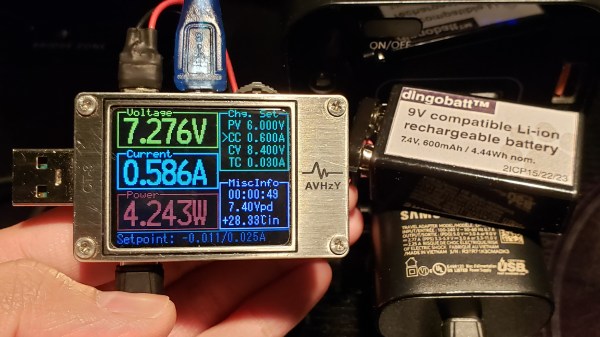
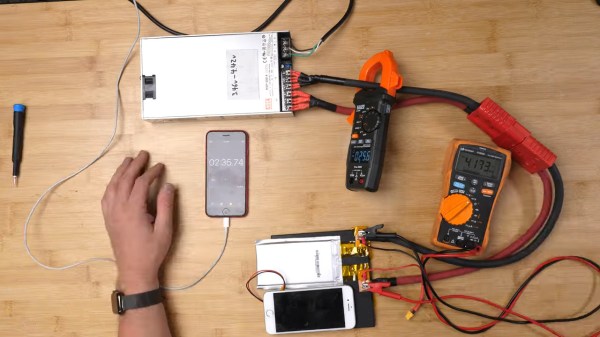
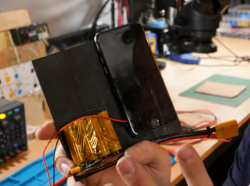 What people commonly encounter is that charging speed depends on the charger involved, but even one hundred chargers in parallel won’t speed up this iPhone’s charging rate, so what’s up? First off, the phone’s charger chip and the battery’s BMS will both limit charging current, so for experiment purposes, those had to be bypassed. First attempt was using a hefty DC power supply with the original cell, and, unsatisfied with the lack of fire and still relatively slow charging, [Scotty] decides to up the ante.