Hackaday Links Column Banner

Hackaday Links: May 2, 2021

Mars is getting to be a busy place, what with helicopters buzzing around and rovers roving all about the place. Now it’s set to get a bit more crowded, with the planned descent of the newly-named Chinese Zhurong rover. Named after the god of fire from ancient Chinese mythology, the rover, which looks a little like Opportunity and Spirit and rides to the surface aboard something looking a little like the Viking lander, will carry a suite of scientific instruments around Utopia Planitia after it lands sometime this month. Details are vague; China usually plays its cards close to the vest, and generally makes announcements only when a mission is a fait accompli. But it appears the lander will leave its parking orbit, which it entered back in February, sometime this month. It’s not an easy ride, and we wish Zhurong well.

Speaking of space, satellites don’t exactly grow on trees — until they do. A few groups, including a collaboration between UPM Plywood and Finnish startup Arctic Astronautics, have announced intentions to launch nanosatellites made primarily of wood. Japanese logging company Sumitomo Forestry and Kyoto University also announced their partnership, formed with the intention to prove that wooden satellites can work. While it doesn’t exactly spring to mind as a space-age material, wood does offer certain advantages, including relative transparency to a wide range of the RF spectrum. This could potentially lead to sleeker satellite designs, since antennae and sensors could be located inside the hull. Wood also poses less of a hazard than a metal spaceframe does when the spacecraft re-enters the atmosphere. But there’s one serious disadvantage that we can see: given the soaring prices for lumber, at least here in the United States, it may soon be cheaper to build satellites out of solid titanium than wood.

If the name Ian Davis doesn’t ring a bell with you, one look at his amazing mechanical prosthetic hand will remind you that we’ve been following his work for a while now. Ian suffered a traumatic amputation of the fingers of his left hand, leaving only his thumb and palm intact, and when his insurance wouldn’t pay for a prosthetic hand, he made his own. Ian has gone through several generations, each of which is completely mechanical and controlled only by wrist movements. The hands are truly works of mechanical genius, and Ian is now sharing what he’s learned to help out fellow hand-builders. Even if you’re not building a hand, the video is well worth watching; the intricacy of the whiffle-tree mechanism used to move the fingers is just a joy to behold, and the complexity of movement that Ian’s hand is capable of is just breathtaking.

If mechanical hands don’t spark your interest, then perhaps the engineering behind top fuel dragsters will get you going. We’ll admit that most motorsports bore us to tears, even with the benefit of in-car cameras. But there’s just something about drag cars that’s so exciting. The linked video is a great dive into the details of the sport, where engines that have to be rebuilt after just a few seconds use, fuel flows are so high that fuel lines the size of a firehouse are used, and the thrust from the engine’s exhaust actually contributes to the car’s speed. There’s plenty of slo-mo footage in the video, including great shots of what happens to the rear tires when the engine revs up. Click through the break for more!


Continue reading “Hackaday Links: May 2, 2021”

Ingenuity Completes Fourth Flight On Mars, Gets A New Mission

It’s the same on Mars as it is here — just when you’re getting used to your job, the bosses go and change things up.

At least that’s our read on the situation at Jezero crater, where the Mars Ingenuity helicopter has just had its mission upgraded and extended. In a Friday morning press conference, the Ingenuity flight team, joined by members of the Perseverance team and some NASA brass, made the announcement that Ingenuity had earned an extra 30 sols of flight time, and would be transitioned from a mere “technology demonstrator” to an “operations demonstration” phase. They also announced Ingenuity’s fourth flight, which concluded successfully today, covering 266 meters and staying airborne for 117 seconds.

Continue reading “Ingenuity Completes Fourth Flight On Mars, Gets A New Mission”

If You Can Measure It, You Must Display It

When can you be sure that you’re logging enough data? When you’re logging all of the data! Of course there are exceptions to the above tongue-in-cheek maxim, but it’s certainly a good start. Especially since data storage on, for instance, an SD card is so easy and cheap these days, there’s almost no reason to not record most every little bit of data that your project can produce. Even without an SD card, many microcontrollers have enough onboard flash, or heck even RAM, to handle whatever you throw at them. The trick, then, is to make sense out of that data, and for me at least, that often means drawing pretty pictures.

I was impressed this week by a simple but elegant stepper motor diagnosis tool hacked together by [Zapta]. Essentially, it’s a simple device: it’s a “Black Pill” dev board, two current sensors, an EEPROM for storing settings, and a touchscreen. Given that most of us with 3D printers rely on stepper motors to get the job done, it’s certainly interesting to do some diagnostics.

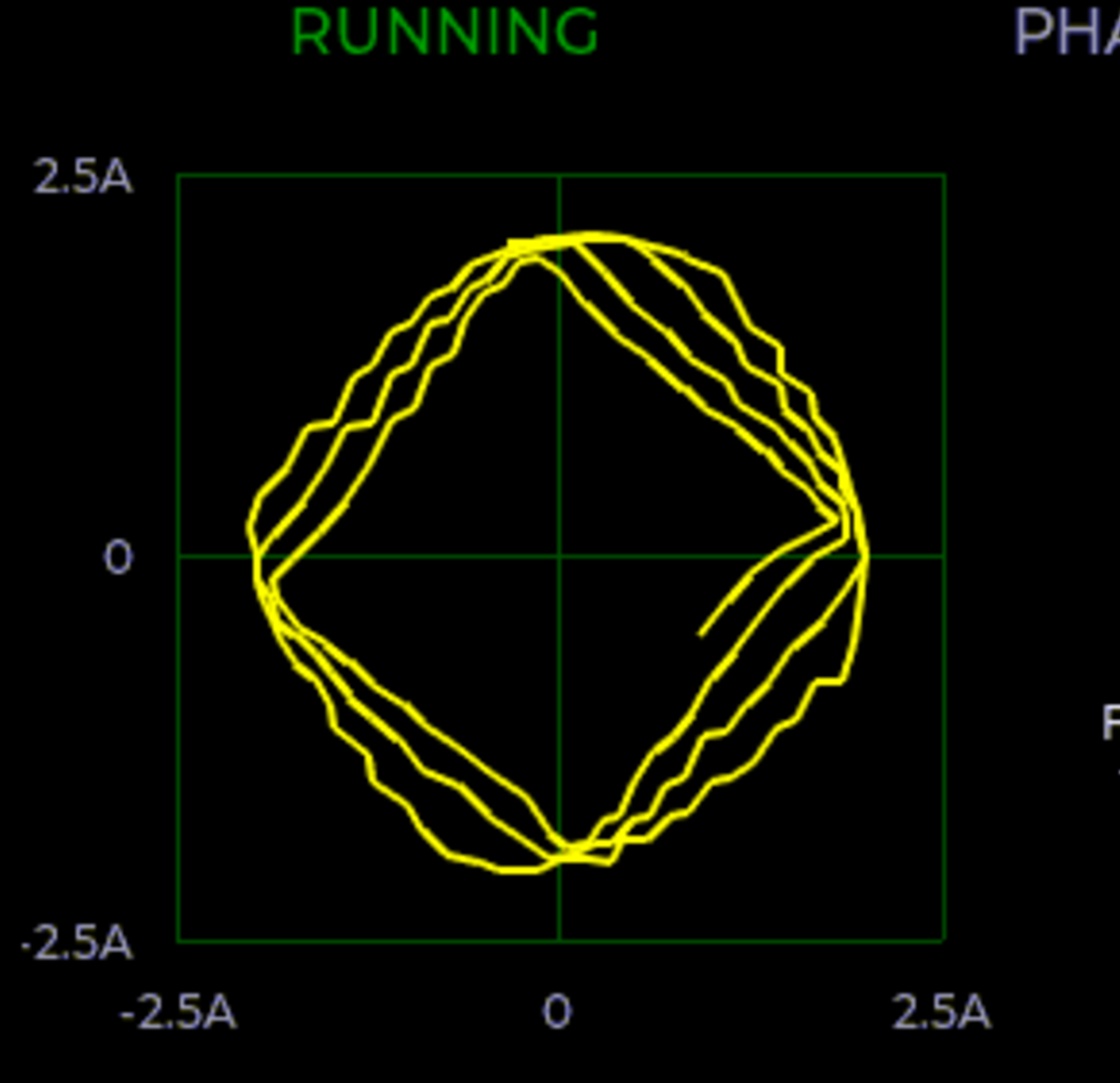
By logging voltage and current measurement on each phase of a stepper motor, you can learn a lot about what’s going on, at least if you can visualize all that data. And that’s where [Zapta]’s tool shines. It plots current vs motor speed to detect impedance problems. Tuning the current in the first place is a snap with Lissajous patterns, and it’ll track your extruder’s progress or look out for skipped steps for you across an entire print job. It does all this with many carefully targeted graphs.

I was talking to [Niklas Roy] about this, and he said “oh check out my hoverboard battery logger“. Here we go again! It sits inline with the battery and logs current and voltage, charging or discharging. Graphs let you visualize power usage over time, and a real-time-clock lets you sync it with video of using the hoverboard to help make even more sense of the data.

So what are you waiting for? Sensors are cheap, storage is cheap, and utilities to graph your data after the fact are plentiful. If you’re not logging all the relevant data, you’re missing out on some valuable insights. And if you are, we’d love to see your projects! (Hint, hint.)

Hackaday Podcast 116: Three DIY Lab Instruments, Two Tickers, And A MicroCar

Hackaday editors Elliot Williams and Mike Szczys select our favorite hardware hacks of the past week. This episode is packed with DIY lab instruments, including a laser microscope, a Raspberry Pi spectrometer, and a stepper motor tester that can tell you what’s going on all the way down to the microsteps. We wax poetic about what modular hardware really means, fall in love with a couple of stock-ticker robots, and chat with special guest Tom Nardi about his experience at the VCF Swap Meet.


Take a look at the links below if you want to follow along, and as always, tell us what you think about this episode in the comments!

Direct download (~55 MB)

Places to follow Hackaday podcasts:

Continue reading “Hackaday Podcast 116: Three DIY Lab Instruments, Two Tickers, And A MicroCar”

This Week In Security: Dan Kaminsky, Banned From Kernel Development, Ransomware, And The Pentagon’s IPv4 Addresses

This week we’re starting off with a somber note, as Dan Kaminsky passed at only 42, of diabetic ketoacidosis. Dan made a name for himself by noticing a weakness in DNS response verification that could allow attackers to poison a target DNS resolver’s cache. A theoretical attack was known, where spoofed DNS responses could collide with requests, but Time-To-Live values meant that DNS requests only go out once per eight hours or so. The breakthrough was realizing that the TTL limitation could be bypassed by requesting bogus subdomains, and aiming the spoofed responses at those requests. This simple technique transformed a theoretical attack that would take 87 years to a very real 10 second attack. Check out the period video after the break, where Dan talked about his efforts in getting the problem fixed.
Continue reading “This Week In Security: Dan Kaminsky, Banned From Kernel Development, Ransomware, And The Pentagon’s IPv4 Addresses”

Wireless MicroPython Programming With Thonny

I’ve been playing with a few MicroPython projects recently on several different embedded platforms, including a couple of ESP32 WiFi modules. There are various ways to program these modules:

  • Use a serial terminal and ampy (maintained by [devxpy] since being dropped by Adafruit in 2018).
  • If you use Pycom boards or WiFy firmware, there are the pymakr plugins for Atom and Visual Studio.
  • If you prefer the command-line like me, there is rshell by one of the top MicroPython contributors [Dave Hylands].

For over a year, I have been quite happy with rshell until I started working on these wireless nodes. Being lazy, I want to tinker with my ESP32 modules from the sofa, not drag my laptop into the kitchen or balcony to plug up a USB cable. Can’t I work with them wirelessly?

Well, you can use WebREPL. While its functional, it just didn’t strike my fancy for some reason. [Elliot] mentioned in a recent podcast that he’s using telnet to access his wireless nodes, but he’s using esp-link on an ESP8266, which means throwing another chip into the mix.

The Thonny IDE

I had all but given up when by chance I saw this video on the Dronebot Workshop channel about running MicroPython on the new Raspberry Pi Pico boards. Bill was using Thonny, a Python IDE that is popular in the education community. Thonny was introduced in 2015 by Aivar Annamaa of the University of Tartu in Estonia. Thonny was designed to address common issues observed during six years of teaching Python programming classes to beginners. If you read about the project and its development, you’ll see that he’s put a lot of effort into making Thonny, and it shows.

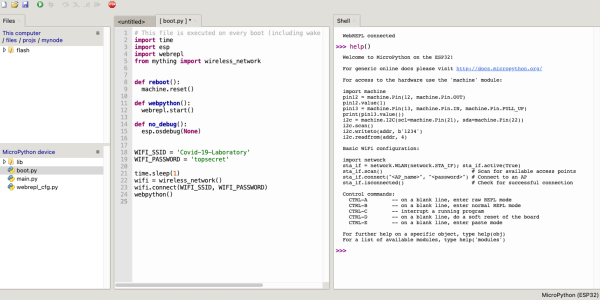
Leaning about Thonny got me curious, and after a little digging I discovered that it has WebREPL support for MicroPython right out-of-the-box. Although this is a new feature and classified as experimental, I found it reasonably stable to use and more than adequate for home lab use. Continue reading “Wireless MicroPython Programming With Thonny”

VCF Swap Meet Takes Step Back To Move Forward

When computers were the sort of thing you ordered from a catalog and soldered together in your garage, swap meets were an invaluable way of exchanging not just hardware and software, but information. As computers became more mainstream and readily available, the social aspect of these events started to take center stage. Once online retail started really picking up steam, it was clear the age of the so-called “computer show” was coming to a close. Why wait months to sell your old hardware at the next swap when you could put it on eBay from the comfort of your own home?

Of course, like-minded computer users never stopped getting together to exchange ideas. They just called these meets something different. By the 2000s, the vestigial remnants of old school computer swap meets could be found in the vendor rooms of hacker cons. The Vintage Computer Festival (VCF) maintained a small consignment area where attendees could unload their surplus gear, but it wasn’t the real draw of the event. Attendees came for the workshops, the talks, and the chance to hang out with people who were passionate about the same things they were.

Consignment goods at VCF East XIII in 2018.

Then came COVID-19. For more than a year we’ve been forced to cancel major events, suspend local meetups, and in general, avoid one another. Some of the conventions were revamped and presented virtually, and a few of them actually ended up providing a unique and enjoyable experience, but it still wasn’t the same. If you could really capture the heart and soul of these events with a video stream and a chat room, we would’ve done it already.

But this past weekend, the folks behind VCF East tried something a little different. As indoor gatherings are still strongly discouraged by New Jersey’s stringent COVID restrictions, they decided to hold a computer swap meet in the large parking lot adjacent to the InfoAge Science and History Museum. There were no formal talks or presentations, but you could at least get within speaking distance of like-minded folks again in an environment were everyone felt comfortable.

Continue reading “VCF Swap Meet Takes Step Back To Move Forward”