How Hard Can It Be To Buy A Computer In Germany And Get It Back Home To The UK?

Some of the best adventures in the world of hardware hacking start in the pub. For three volunteers at the National Museum Of Computing in the UK, [Adam Bradley], [Chris Blackburn], and [Peter Vaughan], theirs started over a pint with an eBay listing for an old computer in Germany. No problem you might think, we’re well used to international parcel shipping. This computer wasn’t a crusty old Commodore 64 though, instead it was a room-sized IBM System/360 Model 20 from the 1960s, complete with the full array of peripherals and what seemed to be a lot of documentation and software media. It would need a Mercedes Sprinter, a large van, to shift it, but that seemed feasible. With a bit of frantic bidding they secured the auction, and set off for Germany to view their purchase.

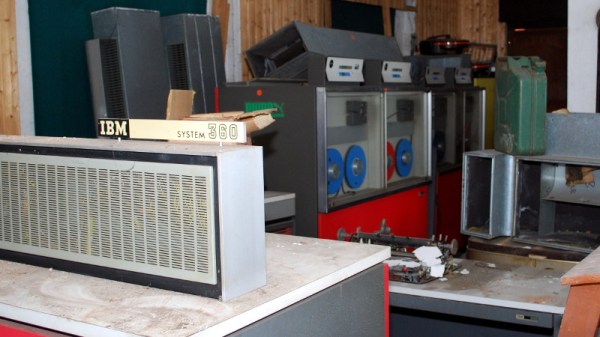
Arriving at the machine’s location they found a little bit more than they had expected. In an abandoned building on a side street in Nuremburg there was an intact machine room full of the IBM computer cabinets over a false floor with all the machine cabling in place, and the only usable access was through a street door which hadn’t been opened in decades and which was obstructed by the false floor itself. To cap it all they found they’d bought not one but two System/360s, and also unexpectedly a 1970s System/370 Model 125. Clearly this was more than a job for a quick in-and-out with a Sprinter.

What followed became a lengthy saga of repeated trips, van hire, constructing ramps, and moving heavy computer parts to a hastily rented storage unit. Decabling a computer of this size is no easy task at the best of times, and these cables had spent many decades in a neglected machine room. It’s a fascinating read, and a very well-documented one with plenty of photos. The machines now sit in their storage units awaiting a return to the UK, and the trio are soliciting any help they can find to make that happen. So if you happen to own a European haulage company with spare capacity on your Germany — UK route or if you can help them in any way, donate or get in touch with them. We think this project has much more to offer, so we’ll be following their progress with interest.

These three intrepid computer hunters were brought together at The National Museum Of Computing at Bletchley, UK. If you find yourself within range it is an essential place to visit, we did so in 2016.

A Trash-Steam-Machine-80

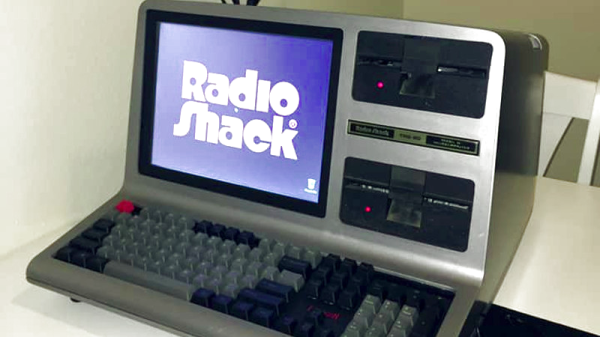
Sometimes for a retrocomputing enthusiast it can be challenging to see a surviving machine gutted and used for another purpose. But in the case of [Tom Pick]’s Radio Shack TRS-80 based Steam Machine PC we can forgive him, because it began with a very unpromising machine that had most definitely seen better days.

The TRS-80 in question is a Model III, the all-in-one console device with a numerical keypad, CRT monitor, and dual 5.25″ floppy drives built in. This provided plenty of space for the components of a modern PC with a 12″ LCD monitor. The PC itself is a run-of-the mill 2.6 GHz Pentium and nothing exceptional, but its input devices are of note. The keyboard is a Red Dragon mechanical item which has been made to look the part in place of the old Radio Shack item with a set of custom colour-coded keycaps, while the pointing device in a particularly neat touch is a modern Radio Shack-branded mouse. The boot screen is the proper Radio Shack logo from the TRS-80’s heyday, meaning that if you didn’t know any differently you might think this was meant to be. Sadly the two floppy drives are unconnected, though we’re sure it would be possible to make a modern PC see them for a bit of 360k storage goodness.

We don’t see as many projects featuring the TRS-80 series as we should, and the model III is a particular rarity. Far more common in these pages is the portable Model 100, most recently gaining a cellular connection.

History of Sony 1970s

Retrotechtacular: History Of Sony Mini Doc Bursts With 1970s Style

The 1970s, it was a time when cameras needed film, phones had cords, and televisions masqueraded as furniture. A time where hi-fi systems were judged by the volume knob feel, and thanks to YouTube user [nefesh22] we have a behind-the-scenes glimpse of what the era was like from the Sony corporate perspective in this mini documentary of the company’s history below. The film was originally created for internal use at Sony’s US manufacturing facilities in San Diego, however, now it now can be watched by anyone with an internet connection.

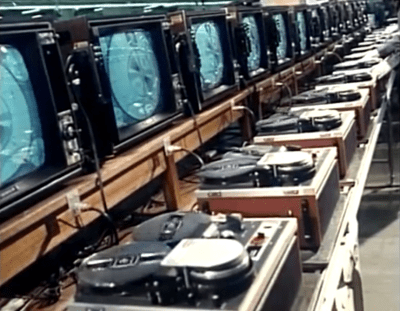
Sony CRT Testing Rig 1970s

Sony’s corporate ethos of allowing its engineers to drive business innovation is on full display here. For instance how in 1950 Sony introduced the first magnetic tape recorder, the G-Type, in Japan and followed that up with the first portable television, the TV8-301, a decade later. Throughout the 1970s Sony became an innovator in the video space. In fact, the Sony Trinitron brand of color TVs garnered so much notoriety in the television industry that the company was awarded an Emmy in 1973. Though the most telling feature is the documentary’s focus on the 3/4-inch U-Matic videocassette format, a precursor to VHS and Sony’s own Betamax videotapes. Highlighting the “superiority” of those VTR systems of the day really does date the film as those hulking decks failed to penetrate the market beyond early adopters and media companies.

It’s interesting to see how hands-on quality assurance testing used to be. Whether it’s glancing at NPN transistors under a microscope, dialing in the focus on a Super 8 camera, or a quick wave of the degaussing wand before a tube leaves the line, each of the QA tasks were carried out by individual employees rather than the automated methods of today. On an unrelated note, the brief overview of the Sony’s on-site “fiefdom” for its young workforce is a reminder that some ideas may be better left in the past… Google’s Mountain View campus anyone? If anything is to be gleaned from this retrotechtacular retrospective is that we could all use a little more wood-grain in our electronics these days.

Continue reading “Retrotechtacular: History Of Sony Mini Doc Bursts With 1970s Style”

A Quite Obscure C128 Video Mode Hack

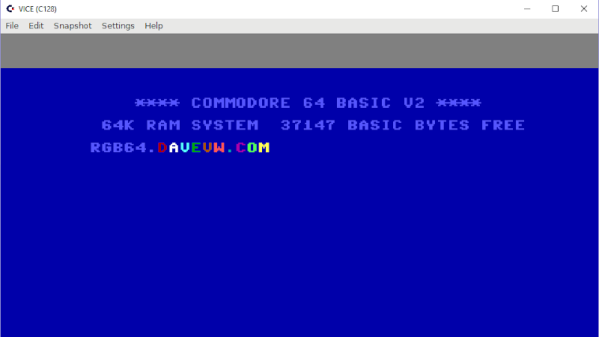
30 years ago, [Dave] found himself up a C128D creek without a paddle. His main monitor was on the fritz, and he needed to use his C128D in 40-column mode to run old C64 programs for development purposes. Normally this is only possible through the low quality composite out, but no composite monitor was available. Needs must, so he got to coding a workaround that would allow the C128D to output in 40 column mode through the higher-quality RGBI output. 

It’s a proper old-school hack in the spirit of the 8-bit era. The C64 ROM is copied into RAM, where it’s then modified to instead update a 40-column image that’s sent to the RGBI display hardware. The original C64 character ROM is also copied over to ensure everything displays correctly.

It’s not bulletproof, and a few pokes to the wrong memory locations have a high likelihood of crashing the system, seeing as the ROM is now in RAM. However, it does allow the user to enable FAST mode and use all the C128 extended keys. [Dave] recommends experimenting in an emulator first, lest you scare your vintage monitor with angry signals it can’t understand.

The C128 was Commdore’s last 8-bit computer on the market, and there’s a heck of a story behind its creation.

Vintage Terminal Converted For Galactic Use In Time For May The Fourth

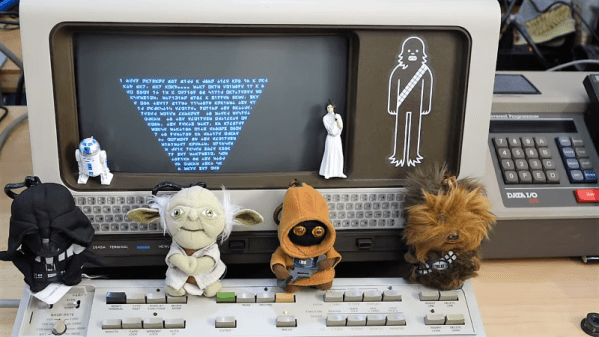
“Not as clumsy or random as Windows. An elegant terminal, for a more civilized age.” [Ben Kenobi] might well have said that about the Hewlett-Packard 264x-series of serial terminals, in use starting at just about the time the original installment of the Star Wars franchise was released.  With their wide-screen CRTs and toaster-oven aesthetic, they were oddballs in the terminal market, and [CuriousMarc] has gone and made one even odder by converting an H-P 2645A to display the Aurebesh character set from the movies.

A look under the hood of this lovely bit of retrocomputing history makes one think the designers almost foresaw the need to add support for a made-up language nearly half a century later. The terminal has a backplane and bus for pluggable cards, one of which carries the ROMs that [Marc] extracted and reprogrammed with the Aurebesh characters. He had a little trouble at first, needing to bodge the chip select and forgetting that he had made other “special modifications” to the terminal. The video below shows the results, along with some fatherly mortification of his daughters and a suitable tribute to the lately late [Peter Mayhew], he who donned the Wookiee suit and made a seven-foot space Sasquatch lovable.

Need more for you “May the Fourth” fix? How about a clumsy and random blaster, a cosplay speeder bike, or a fleet of droids?

Continue reading “Vintage Terminal Converted For Galactic Use In Time For May The Fourth”

Add A Bit Of Soviet-Era Super-Computing To Your FPGA

The MESM-6 project is focused on bringing the 1960s Soviet BESM-6 computer to the modern age of FPGAs and HDLs. At the moment the team behind this preservation effort consists out of [Evgeniy Khaluev], [Serge Vakulenko] and [Leo Broukhis], who are covering the efforts on the Russian-language project page.

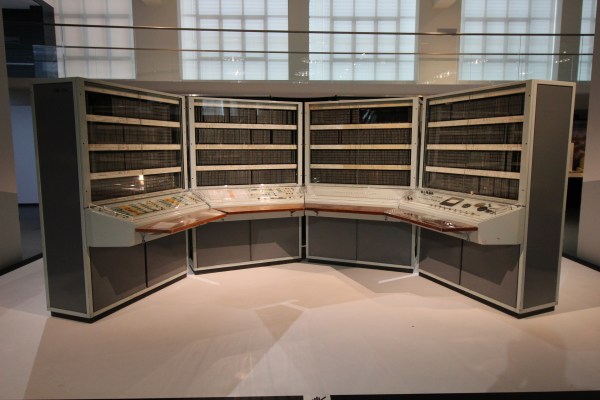
The BESM-6 (in Russian: БЭСМ-6, ‘Bolshaya Elektronno-Schetnaya Mashina’ or ‘large electronic computing machine’) was a highly performing Soviet super computer that was first launched in 1968 and in production for the next 19 years. Its system clock ran at 9 MHz using an astounding number of discrete components, like 60,000 transistors and 170,000 diodes, capable of addressing 192 kB of memory in total. Of the 355 built, a few survive to this day, with one on display at the London Science Museum (pictured above). Many more images and information can be found on its Russian Wikipedia page.

For those not gifted with knowledge of the Russian language, the machine-translated summary reveals that the project goal is to make a softcore in SystemVerilog that is compatible with user mode BESM-6, using the same Pascal compiler as originally used with that system. Further goals include at least 24 kB of data memory, 96 kB of command memory and the addition of modern peripherals such as SPI and I2C.

The system is meant to be integrated with the Arduino IDE, using the Pascal compiler to make it highly accessible to anyone with an interest in programming a system like this. Considering the MIT license for the project, one could conceivably use a bit of Soviet-era computing might in one’s future FPGA efforts.

If after watching the BESM-6 video — included below — you feel inspired to start your own Soviet-computing project, we’d like to wish you luck the Russian way: Ни пуха ни пера!

Continue reading “Add A Bit Of Soviet-Era Super-Computing To Your FPGA”

Custom Monitor For Pi-Powered Commodore 64

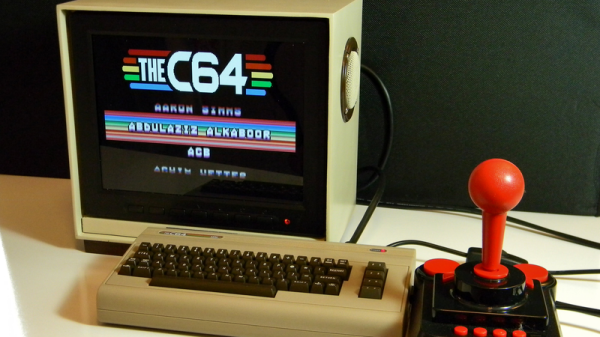
Classic games never seem to have gone out of style and with the emulation powers of the Raspberry Pi, there seems to be no end of projects folks have been coming up with. [Chris Mills] project is a great looking monitor to get his Commodore 64 fix by combining the retro looks of a home-made 64-style monitor with the Raspberry Pi.

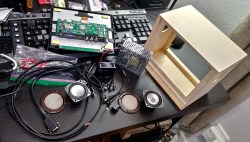
[Chris] is only interested in Commodore 64 emulation, at least with this project, and wanted something that would fit on a desk without taking up too much room. An eight inch LCD security monitor fit the bill perfectly. [Chris] ended up building a wooden enclosure for the monitor to give it that Commodore look. The monitor, power supply and cable connections fit inside along with speakers; each of these having their inputs on the back. A fan vents in the back as well and the Pi sits outside running the Combian 64 emulation software.

[Chris] has put up some galleries of build pics. The logo from the old Commodore logo is a nice touch. Read over the Hackaday site and you could build your own Commodore 64, or use the Commodore 64 itself to house the Raspberry Pi if you wanted.