Automatic Coil Winder Gets It Done With Simple Hardware And Software

We’ve grown to expect seeing mechatronics project incorporate a standard complement of components, things like stepper motors, Arduinos, lead screws, timing belts and pulleys, and aluminum extrusions. So when a project comes along that breaks that mold, even just a little, we sit up and take notice.

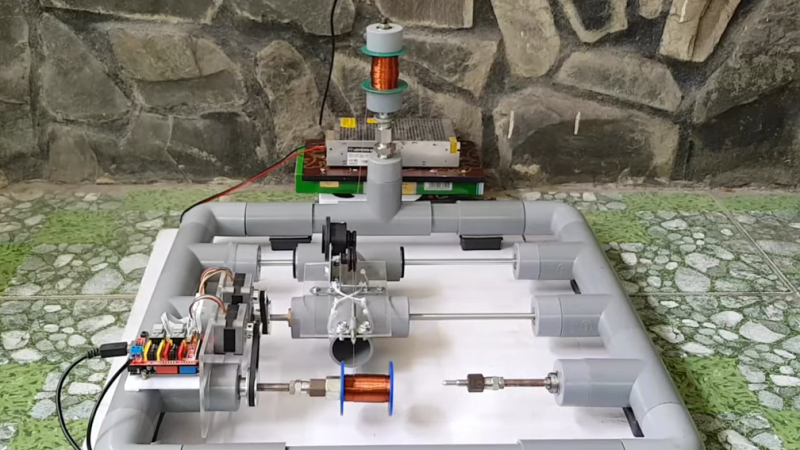
Departing somewhat from this hardware hacking lingua franca is [tuenhidiy]’s automatic coil winder, which instead of aluminum extrusions and 3D-printed connectors uses simple PVC pipe and fittings as a frame. Cheap, readily available, and easily worked, the PVC does a fine job here, and likely would on any project where forces are low and precision isn’t critical. The PVC frame holds two drive motors, one to wind the wire onto a form and one to drive a lead screw that moves the form back and forth. An Arduino with a CNC shield takes care of driving the motors, and the G-code needed to do so is generated by a simple spreadsheet that takes into account the number turns desired, the number of layers, the dimensions of the spool, and the diameters of the wire. The video below shows the machine going through its paces, with pretty neat and tidy results.

Being such a tedious task, this is far from the first coil winder we’ve seen. Some adhere to the standard design language, some take off in another direction entirely, but they’re all instructive and fun to watch in action.

Continue reading “Automatic Coil Winder Gets It Done With Simple Hardware And Software”

CNC Saves Water Cooling Setup

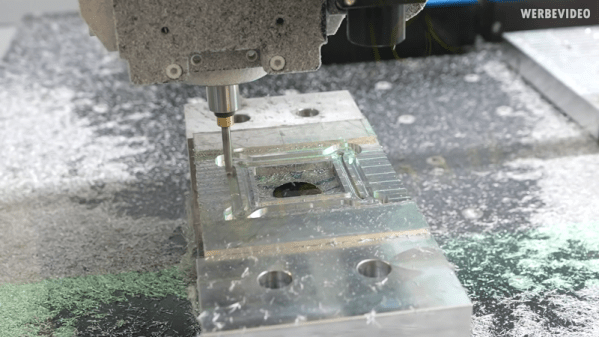
A classic problem. You have a new CPU and a 15-year old water cooling system. Of course, the bracket doesn’t fit. Time to buy a new cooler? Not if you are [der8auer]. You design a new bracket and mill it out of aluminum.

Honestly, it might seem overkill, but it makes sense. After all, no matter how new the CPU is, using water to cool it still works the same way, in principle.

Continue reading “CNC Saves Water Cooling Setup”

Tales From The Global Chip Shortage: Smoothieboard

The semiconductor shortage sparked by the pandemic is showing no signs of slowing down. Although auto manufacturers were some of the first affected, the shortage has now spread and is impacting all sorts of projects, including the Smoothieboard open-source CNC controllers.

[Chris Cecil] walks through the production woes they’ve had over the last few months. It began this spring with a batch of the V1.1 boards. The prices of some of their chips started jumping, and then they were informed that the microcontroller that serves as the brains of the Smoothieboard was only available for five times the old price. In the end, they placed a smaller order, and V1.1 Smoothieboards will likely be scarce until the microcontroller’s price returns to normal.

Getting V2 of the boards into production has been even more difficult. Just weeks before the final prototype, it was discovered that the LPC4330 microcontroller the V2 was built around was also sold out worldwide. With the shortage in mind, a hole was left in the layout of the final version of V2 so that they could finish the design around whatever microcontroller they were able to get. In the end, they were able to lock down a supply of STM32H745 controllers, which are actually substantially more capable than the original device.

If you’re interested in the origins of the chip shortage, this article from January is a good place to start. This isn’t the first time parts shortages have wreaked havoc on the world of electronics—does anyone remember the global resistor shortage of ’18?

3D Printed CNC Knee Mill

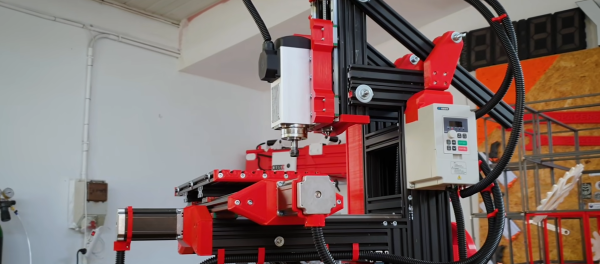
CNC mills will never match real heavy metal mills on hard materials, but that won’t stop people from pushing the limits of these DIY machines. One of the usual suspects, [Ivan Miranda] is at it again, this time building a knee mill from aluminum extrusions and 3D printed fittings. (Video after the break.)

Most DIY CNC milling machines we see use a gantry arrangement, where the bed is fixed while everything else moves around it. On most commercial metal milling machines, the table is the moving part, and are known as knee mills. In the case of [Ivan]’s mill, the table can move 187 mm on the X-axis and 163 mm on the Y-axis. The 1.5 kW spindle can move 87 mm in the Z-axis. All axes slide on linear rails and are driven by large stepper motors using ball screws. The table can also be adjusted in the Z-direction to accept larger workpieces, and the spindle can be tilted to mill at an angle.

To machine metal as [Ivan] intended, rigidity is the name of the game, and 3D printed parts and aluminum extrusion will never be as rigid as heavy blocks of steel. He says claims that the wobble seen on the video is due to the uneven table on which the mill was standing. Of course, a wobbly base won’t be doing him any favors. [Ivan] also had some trouble with earthing on the spindle. He nearly set his workshop on fire when he didn’t notice tiny sparks between the cutter and aluminum workpiece while he was cooling it with isopropyl alcohol. This was solved with the addition of the grounding wire.

While the machine does have limitations, it does look like it can machine functional metal parts. It could even machine metal upgrades for its 3D printed components. One possible way to improve rigidity would be to cast the frame in concrete. [Ivan] has built several other workshop tools, including a massive 3D printer and a camera crane. Continue reading “3D Printed CNC Knee Mill”

From Printer To Vinyl Cutter

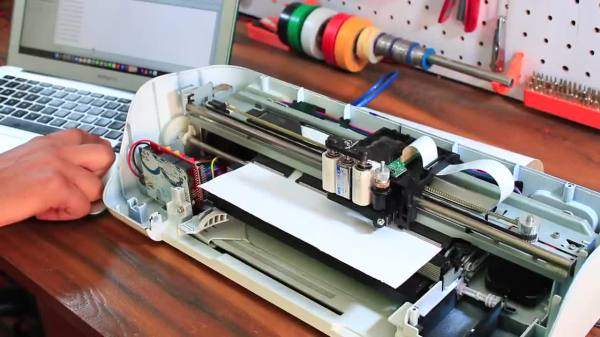
Some might look at a cheap inkjet printer and see a clunky device that costs more to replace the ink than to buy a new one. [Abhishek Verma] saw an old inkjet printer and instead saw a smooth gantry and feed mechanism, the perfect platform to build his own DIY vinyl cutter.

The printer was carefully disassembled. The feed mechanism was reworked to be driven by a stepper motor with some 3D printed adapter plates. A solenoid-based push/pull mechanism for the cutting blade was added with a 3D printed housing along with a relay module. An Arduino Uno takes in commands from a computer with the help of a CNC GRBL shield.

What we love about this build is the ingenuity and reuse of parts inside the old printer. For example, the old PCB was cut and connectors were re-used. From the outside, it’s hard to believe that HP didn’t manufacture this as a vinyl cutter.

If you don’t have a printer on hand, you can always use your CNC as a vinyl cutter. But if you don’t have a CNC, [Abhishek] shares all the STL files for his cutter as well as the schematic. Video after the break.

Continue reading “From Printer To Vinyl Cutter”

Discarded Plastic Laser-Cut And Reassembled

The longevity of plastic is both a blessing and a curse. On the one hand, it’s extremely durable, inexpensive, and easy to work with, but it also doesn’t biodegrade and lasts indefinitely in the environment when not disposed of properly. While this can mean devastating impacts to various ecosystems, it can also be a benefit if you happen to pick this plastic up and also happen to have a laser cutter around.

After cleaning and sorting plastic that they had found from various places, including scraps from a 3D printing facility, the folks at [dinalab] set about turning waste plastic into something that would be usable once more. After sorting it they shredded it and then melted it into sheets. They found that a sandwich press yielded the best results, as it kept the plastic at a low enough temperature to keep it from burning. Once its off of the press and properly cooled, the flat sheets of plastic can be sent to the laser cutter to be made into whatever useful thing they happen to need.

Not only does this process reuse plastic that would otherwise end up in the landfill (or worse, the ocean), it can also reuse plastic from itself since the scraps can be re-melted back into sheets. Plastic does lose some of its favorable material properties with repeated heat cycles, but we’d have to imagine this is negligible for the types of things that [dinalab] is creating. Of course, you can always skip the heat cycles entirely and turn waste plastic directly into 3D printer filament instead.

Continue reading “Discarded Plastic Laser-Cut And Reassembled”

Robotic Ball-Bouncing Platform Learns New Tricks

[T-Kuhn]’s Octo-Bouncer platform has learned some new tricks since we saw it last. If you haven’t seen it before, this device uses computer vision from a camera mounted underneath its thick, clear acrylic platform to track a ball in 3D space, and make the necessary (and minute) adjustments needed to control the ball’s movements with a robotic platform in real time.

We loved the Octo-Bouncer’s mesmerizing action when we saw it last, and it’s only gotten better. Not only is there a whole new custom ball detection algorithm that [T-Kuhn] explains in detail, there are also now visualizations of both the ball’s position as well as the plate movements. There’s still one small mystery, however. Every now and again, [T-Kuhn] says that the ball will bounce in an unexpected direction. It doesn’t seem to be a bug related to the platform itself, but [T-Kuhn] has a suspicion. Since contact between the ball and platform is where all the control comes from, and the ball and platform touch only very little during a bounce, it’s possible that bits of dust (or perhaps even tiny imperfections on the ball’s surface itself) might be to blame. Regardless, it doesn’t detract from the device’s mesmerizing performance.

Design files and source code are available on the project’s GitHub repository for those who’d like a closer look. It’s pretty trippy watching the demonstration video because there is so much going on at once; you can check it out just below the page break.

Continue reading “Robotic Ball-Bouncing Platform Learns New Tricks”