Three brown pancakes are sitting in a frying pan.

Optimizing Pancakes From Chemical Principles

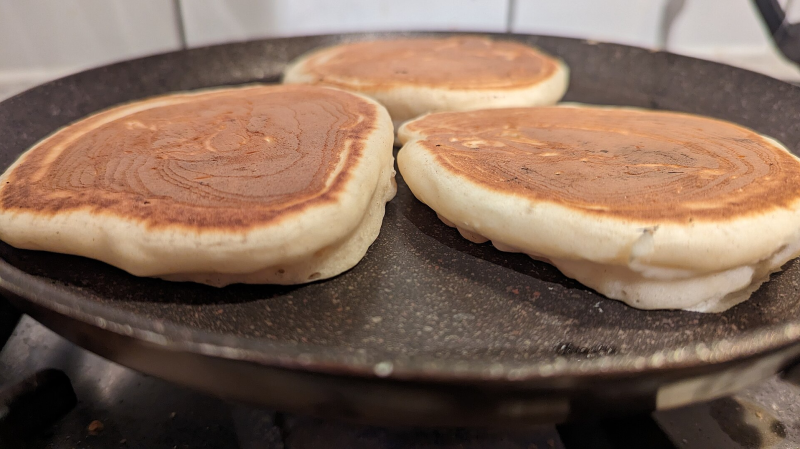
Although parents and teachers like to point out the deep link between cooking and chemistry, most people don’t deliberately apply any chemical principles beyond acid/base reactions to their recipes. Not so [Ben Kazez]: he’s written a thorough exploration of the chemical journey to the perfect pancake, and made a calculator for others to use with their own ingredients.

The goal is to optimize the pancakes along four dimensions: interior texture (light and smooth), a tangy flavour, rise, and a crisp, brown exterior layer. The tang comes from residual acids, and since lactic acid produces the best taste, dairy-based acid sources (such as Greek yoghurt or buttermilk) are preferable. Acids also react with baking soda to release carbon dioxide, making them a part of one of the four rising agents. The other three are carbon dioxide released when double-acting baking powder is heated, steam released from the batter, and air bubbles stabilized by egg white foam.

Dairy products, besides contributing acid, also provide a protein structure to keep the interior smooth. In a normal wheat-heavy pancake, two proteins (glutenin and gliadin) interact to form tough strands of gluten. Fats bind to hydrophobic amino acids in these proteins and shorten the gluten chains, hence the name shortening. Adding ricotta cheese also replaces some of this gluten network with a smoother structure of previously-denatured dairy proteins. Dairy products also contribute to the Maillard reaction between reducing sugars (such as lactose, glucose, and fructose) and amino acids, which causes the browning of the pancake’s surface. Besides being brown, the surface should be crisp; since amylose, found in corn starch, forms a brittle, glassy, crackly network when dehydrated, corn starch was added.

The result is a set of chemical equations which can be tuned to create perfect pancakes, combined in the calculator. This summary doesn’t do justice to the depth of the research here; [Ben] also investigated optimal batter resting times, fermentation, cooking fats, cooking surfaces, and spatula properties. If all this has you interested in more about dairy proteins, check out our article on cheesemaking.

Featured image: “Buttermilk pancakes from a recipe by Darina Allen” by [Didym]. 

Cookies, Baked The 3D Printer Way

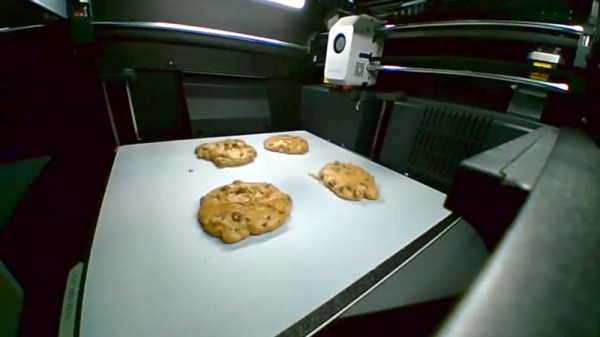
Imagine for a moment that the Cookie Monster is going to visit, but all the cookie baking utensils in your house have been mislaid. The horror! Fortunately [Startup Chuck] is here with a video showing the process of baking cookies in a 3D printer, and as an extra treat he’s using entirely 3D printed utensils too.

The utensils are comprehensive array of all you’d need for serious cookie production, even going as far as to print a mixing bowl and beater for a KitchenAid mixer. There are scoops aplenty, and something we’re particularly impressed with, a spatula with a TPU blade. We’re guessing that FDM prints might not be the best for cooking because all manner of food could get caught in those layer lines and go off, but let’s face it, this is a bit of fun rather than a forever cooking project. We like the AI generated spork for its near-flatness, reminding us of our AI-generated breakfast. Finally he even prints a cookie baking sheet using nylon filament.

An enclosed 3D printer makes a surprisingly effective low-temperature oven, with the heated bed as the element. It works, and makes recognizable cookies, though they’re not browned. As entertaining as this experiment may be, we can’t recommend following his example — at the very least, moisture and food ingredients in your printer probably aren’t conducive to good future printing.

Continue reading “Cookies, Baked The 3D Printer Way”

Know Your Food: Cheesemaking

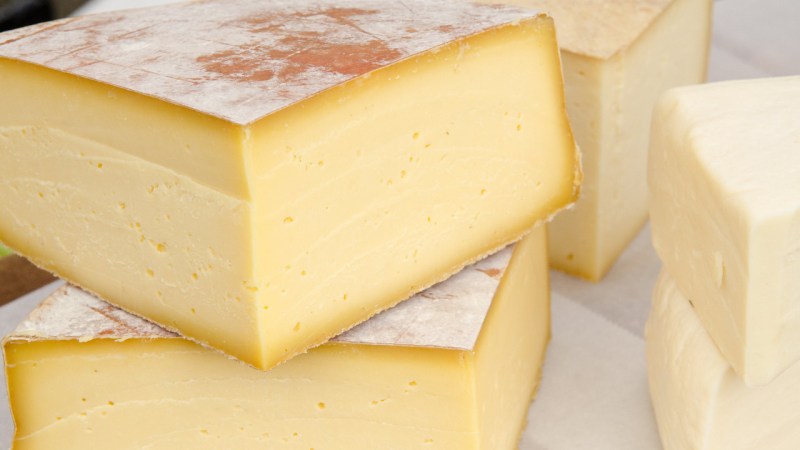
There’s a thing that people who grew up on farms all share: a connection with food production that isn’t some mystical rose-tinted woo from a TV chef, but instead a practical general knowledge from being there on the ground. A glance at a crop in a field and you immediately recognise what it is, if it’s ploughing time you’ll know the soil type, and there’s always either too little, or too much rain. For a given foodstuff you’ll know far too much about where it came from, because if your dad wasn’t involved in its production, the chances are someone he knew was. You take this for granted, after all doesn’t everyone have this general knowledge? Seemingly not.

Hackaday is not a cooking channel, but I know we’re all interested here in how things are made. Shouldn’t that also extend to what we eat? It’s fashionable to follow a back-to-nature line that all commercial foodstuffs are somehow over-processed junk, but without the requisite knowledge you’re flying blind there. To know both how common foodstuffs should be made, as well as how they are made industrially, should be an essential for everyone.

Continue reading “Know Your Food: Cheesemaking”

Cooking With Plasma (Not Fire)

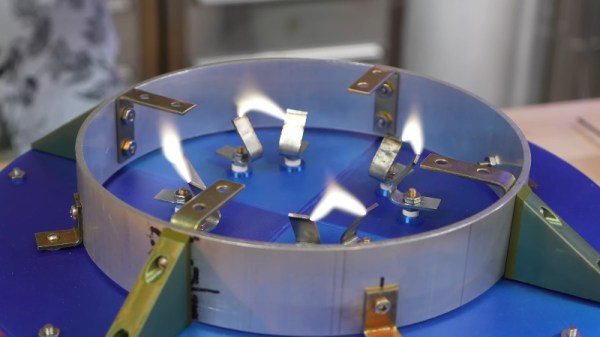
Cooking food with fire is arguably the technology that propelled humans to become the dominant species on Earth. It’s pretty straightforward to achieve, just requiring a fuel source, a supply of oxygen from the air, and a way to initiate the reaction; then it self-sustains. You wouldn’t think there’s much to improve, but what about cooking with plasma? [Jay] from the plasma channel is no stranger here, and he thinks that there may be something in this idea, certainly enough to actually build something.

Now, let’s be straight with you, this isn’t a new concept, and you can buy a plasma-based cooking appliance right now. But they are all AC-powered devices. What if you want to go camping? [Jay] attempts (and succeeds) in building a portable, rechargeable 600W plasma cooking device that can actually cook food, but it was not all plain sailing.

The existing off-the-shelf ZVS driver modules available were a bit weak and unreliable, and the required flyback coils were hard to find with the right specs, so he needed to get down to work building custom parts. First off, the coils. Custom formers were resin-printed and machine-wound with 4000 turns of fine wire, and then resin-sealed into the former. [Jay] takes care to explain that it is crucial to get all the air out of the windings, or else local flashover breakdown will occur and wreck the coil in a short time. We reckon the resulting coils look amazing in their own right!

Continue reading “Cooking With Plasma (Not Fire)”

Comparing 12 VDC Air Fryers With Regular 240 VAC Ones

That boiling water is a contentious topic of discussion is clear, but what about hot air? When you take a 12 VDC, 280 Watt-rated air fryer and pit it against a bog-standard 240 VAC, 1400 Watt unit, which one would you want to use when you’re doing some camping or other exciting off-the-grid opportunities? Unlike with boiling water the physics aren’t as clear-cut here, so [Cahn] did some testing to figure out exactly what the efficiency numbers look like

Since air fryers rely on the transfer of thermal energy from the resistive heating element into the food, any thermal energy that’s not immediately transferred is effectively wasted. This, combined with the relatively low power rating and thus much higher time demand of the low-voltage air fryer is enough to set one’s expectations pretty low.

As scientific test samples chicken nuggets were used with the test, following a preheating period for the 12 VDC unit. Both units managed to hit a safe temperature inside the nuggets after 20 minutes, thus successfully staving off food poisoning, but the browning with the 240 VAC air fryer was much better.

As for the efficiency, the 12 VDC unit required 150 Wh for 20 minutes plus the 10 minutes of preheating, with 45 minutes total at 225 Watt to get proper browning. Meanwhile the 240 VAC unit burned through 250 Wh in 20 minutes, with no pre-heating, though only 230 Wh with no inverter losses included. As a final test, the 12 VDC unit was run at 400 Watt using 14.6 VDC input, which did indeed get it up to temperature much faster.

Thus both are equivalent, just with the caveat that the low-voltage unit will take considerably more time to get the same result. This mirrors the results with boiling water, where most options mostly vary in how much time they require to get water up to a boiling temperature.

Continue reading “Comparing 12 VDC Air Fryers With Regular 240 VAC Ones”

Hacking Fermentation For Infinite Pickles From Pass-thru Bioreactor

Home-fermented foods are great– they’re healthier, more flavourful, and cheaper than store-bought alternatives. What they aren’t is convenient: you need to prep a big batch of veggies, let it sit, and then you have to store the excess pickles. If you’re not careful, you end up with ancient, over-fermented pickles at the bottom of the crock, or worse– run out of pickles! Surely a fate worse than death. [Cody] at Cody’s Lab has a solution: a continous-flow fermentation process that keeps just the right supply of pickles coming at all times. Our grandmothers who kept a crock for months in the cold room or root cellar might be confused, but this hack brings pickles into the Just-In-Time framework of the 21st century.

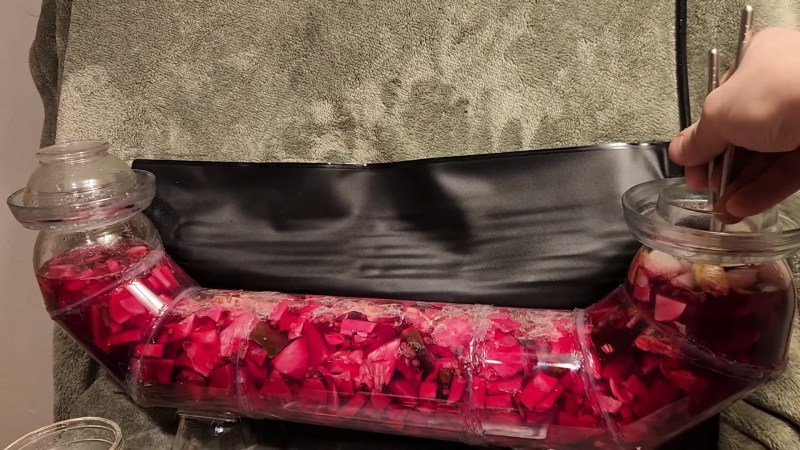
Specifically this is for lactic acid fermentation, the type that gets you kosher dills, saurkraut and kimchi along with a whole mess of other tangy, tasty vegetable treats. Vinegar pickles are a whole other thing. It’s done in a brine, as the lactic acid bacteria are salt tolerant in a way that most things that would rot your food and/or make you sick would not. You can reuse the brine over and over, which is what [Cody] is doing: he crafts a U-shaped crock out of old glass bottles and a couple of pickle jars. He cuts the jars into angled pipe segments that are held together with aquarium sealant, which is apparently food safe. It holds water and looks surprisingly good, in that it isn’t hideous.

The bioreactor gets loaded up with veggies on one end, plus lots of salt and spices to taste, plus some cultured brine from an old batch to kickstart everything. The starter isn’t necessary; it just gets things going faster. The initial packing is the hardest: after filling it the first time, one needs only press new veggies in at one end, while removing tasty treats at the other. A special packing tool [Cody]makes helps with that, but he plans on adding a larger feed side. Thanks to that kickstart, the pickles were ready to try after about a week– which means his tube is a bit long, for his desired dwell time. If you like more fermentation to your pickles, then you might like this size.

May be the first time pickles have been featured on Hackaday without turning them into LEDs. We’ve featured plenty of fermentation projects, with automation to help make the best brew or a build for better tempeh, but not a lot of vegetables.

Thanks to [cam72cam] for the tip!

Continue reading “Hacking Fermentation For Infinite Pickles From Pass-thru Bioreactor”

Improving Soda By Turning It Into Mead

Test tasting soda mead. (Credit: Golden Hive Mead, YouTube)

You can certainly just chug down that bottle of soda you purchased, but if you accept the premise that the preparation of food and drink is just a subset of chemistry, and that chemistry is fun, then it naturally follows that using soda as the basis for brewing up some mead makes perfect sense. Thus the [Golden Hive Mead] blokes over on YouTube decided to create some Coca Cola flavored mead.

Mead is essentially just water mixed with honey that is left to ferment after adding yeast, resulting in what is also called ‘honey wine’, with an ethanol content of usually between 3.5% and 20%. Since soda is mostly water and comes with its own supply of sugar for yeast to feast on, this isn’t such a crazy choice in that respect. Just make sure to remove the carbonation, as the CO2 makes the soda too acidic for the yeast to be happy.

Instead of straight honey, caramelized honey was used for extra flavor after which the brew was left to ferment for a while. For extra flavor notes aged oak, vanilla and cinnamon were added as well, to ensure that the fermentation didn’t erase those core notes of the coke. The result was apparently rather flavorful, with about a 10.5% ethanol content, receiving the full approval of both tame test tasters.

Continue reading “Improving Soda By Turning It Into Mead”