Tour A PCB Assembly Line From Your Armchair

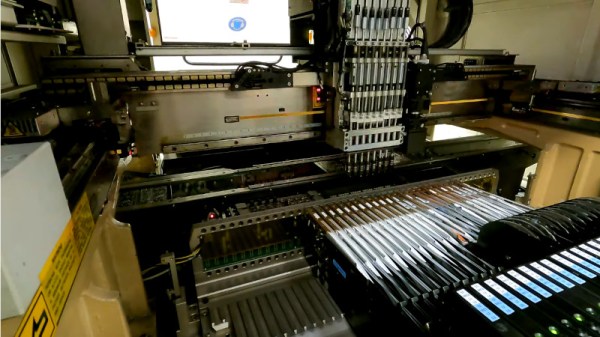
Those of us who build our own electronics should have some idea of the process used to assemble modern surface-mount printed circuit boards. Whether we hand-solder, apply paste with a syringe, use a hotplate, or go the whole hog with stencil and oven, the process of putting components on boards and soldering them is fairly straightforward. It’s the same in an industrial setting, though perhaps fewer of us will have seen an industrial pick-and-place line in action. [Martina] looks at just such a line for us, giving a very accessible introduction to the machines and how they are used. Have a look, in the video below the break.

It’s particularly interesting as someone used to the home-made versions of these machines, to see the optical self-alignment and the multiple pick-and-place tools which are beyond the simpler pick-and-place machines you’ll find in a hackerspace. Multiple machines in a line are also beyond hackerspaces, so the revelation that the first machine is deliberately run slowly to avoid the line backing up is a valuable one.

At the end of the line is the reflow oven itself, through which the boards pass on a belt through carefully graded hot air zones. Certainly a step up from a toaster oven with an Arduino controller!

Sadly not all of us will be lucky enough to have such a line at our disposal, but pick-and-place projects come up here quite often. We did a teardown on the feeders from a Siemens machine a couple of years ago.

Continue reading “Tour A PCB Assembly Line From Your Armchair” →
PCIe For Hackers: Extracting The Most

So, you now know the basics of approaching PCIe, and perhaps you have a PCIe-related goal in mind. Maybe you want to equip a single-board computer of yours with a bunch of cheap yet powerful PCIe WiFi cards for wardriving, perhaps add a second NVMe SSD to your laptop instead of that Ethernet controller you never use, or maybe, add a full-size GPU to your Raspberry Pi 4 through a nifty adapter. Whatever you want to do – let’s make sure there isn’t an area of PCIe that you aren’t familiar of.

Splitting A PCIe Port

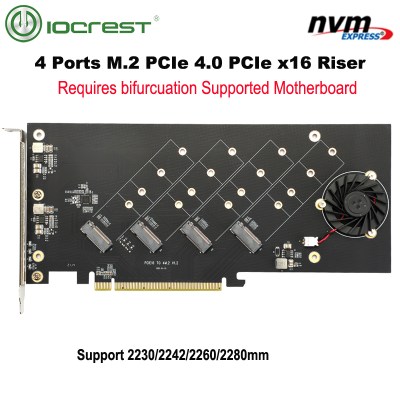
You might have heard the term “bifurcation” if you’ve been around PCIe, especially in mining or PC tinkering communities. This is splitting a PCIe slot into multiple PCIe links, and as you can imagine, it’s quite tasty of a feature for hackers; you don’t need any extra hardware, really, all you need is to add a buffer for REFCLK. See, it’s still needed by every single extra port you get – but you can’t physically just pull the same clock diffpair to all the slots at once, since that will result in stubs and, consequently, signal reflections; a REFCLK buffer chip takes the clock from the host and produces a number of identical copies of the REFCLK signal that you then pull standalone. You might have seen x16 to four NVMe slot cards online – invariably, somewhere in the corner of the card, you can spot the REFCLK buffer chip. In a perfect scenario, this is all you need to get more PCIe out of your PCIe.


Continue reading “PCIe For Hackers: Extracting The Most” →

Weird Electric Jet Skis Are Hitting The Waves

When it comes to reducing emissions from human sources, we’re at the point now where we need to take a broad-based approach. It’s not enough to simply make our cars more efficient, or start using cleaner power plants. We need to hit carbon zero, and thus everything has to change.

To that end, even recreational watercraft are going electric in this day and age. Several companies are developing motor-powered models that deliver all the fun without the emissions. But to do that, they’re taking to the air.

Continue reading “Weird Electric Jet Skis Are Hitting The Waves” →

History Of The SPARC CPU Architecture

[RetroBytes] nicely presents the curious history of the SPARC processor architecture. SPARC, short for Scalable Processor Architecture, defined some of the most commercially successful RISC processors during the 1980s and 1990s. SPARC was initially developed by Sun Microsystems, which most of us associate the SPARC but while most computer architectures are controlled by a single company, SPARC was championed by dozens of players.  The history of SPARC is not simply the history of Sun.

A Reduced Instruction Set Computer (RISC) design is based on an Instruction Set Architecture (ISA) that runs a limited number of simpler instructions than a Complex Instruction Set Computer (CISC) based on an ISA that comprises more, and more complex, instructions. With RISC leveraging simpler instructions, it generally requires a longer sequence of those simple instructions to complete the same task as fewer complex instructions in a CISC computer. The trade-off being the simple (more efficient) RISC instructions are usually run faster (at a higher clock rate) and in a highly pipelined fashion. Our overview of the modern ISA battles presents how the days of CISC are essentially over. Continue reading “History Of The SPARC CPU Architecture” →

Feeling The Heat: Railway Defect Detection

On the technology spectrum, railroads would certainly seem to skew toward the brutally simplistic side of things. A couple of strips of steel, some wooden ties and gravel ballast to keep everything in place, some rolling stock with flanged wheels on fixed axles, and you’ve got the basics that have been moving freight and passengers since at least the 18th century.

But that basic simplicity belies the true complexity of a railway, where even just keeping the trains on the track can be a daunting task. The forces that a fully loaded train can exert on not only the tracks but on itself are hard to get your head around, and the potential for disaster is often only a failed component away. This became painfully evident with the recent Norfolk Southern derailment in East Palestine, Ohio, which resulted in a hazardous materials incident the likes of which no community is ready to deal with.

Given the forces involved, keeping trains on the straight and narrow is no mean feat, and railway designers have come up with a web of sensors and systems to help them with the task of keeping an eye on what’s going on with the rolling stock of a train. Let’s take a look at some of the interesting engineering behind these wayside defect detectors.

Continue reading “Feeling The Heat: Railway Defect Detection” →

Europe’s Proposed Right-To-Repair Law: A Game Changer, Or Business As Usual?

Recently, the European Commission (EC) adopted a new proposal intended to enable and promote the repair of a range of consumer goods, including household devices like vacuum cleaners and washing machines, as well as electronic devices such as smartphones and televisions. Depending on how the European Parliament and Council vote in the next steps, this proposal may shape many details of how devices we regularly interact with work, and how they can be repaired when they no longer do.

As we have seen recently with the Digital Fair Repair Act in New York, which was signed into law last year, the devil is as always in the details. In the case of the New York bill, the original intent of enabling low-level repairs on defective devices got hamstrung by added exceptions and loopholes that essentially meant that entire industries and types of repairs were excluded. Another example of ‘right to repair’ being essentially gamed involves Apple’s much-maligned ‘self repair’ program, that is both limited and expensive.

So what are the chances that the EU will succeed where the US has not?

Continue reading “Europe’s Proposed Right-To-Repair Law: A Game Changer, Or Business As Usual?” →

Gordon Moore, 1929 — 2023

The news emerged yesterday that Gordon Moore, semiconductor pioneer, one of the founders of both Fairchild Semiconductor and Intel, and the originator of the famous Moore’s Law, has died. His continuing influence over all aspects of the technology which makes our hardware world cannot be overstated, and his legacy will remain with us for many decades to come.

A member of the so-called “Traitorous Eight” who left Shockley Semiconductor in 1957 to form Fairchild Semiconductor, he and his cohort laid the seeds for what became Silicon Valley and the numerous companies, technologies, and products which have flowed from that. His name is probably most familiar to us through “Moore’s Law,” the rate of semiconductor development he first postulated in 1965 and revisited a decade later, that establishes a doubling of integrated circuit component density every two years. It’s a law that has seemed near its end multiple times over the decades since, but successive advancements in semiconductor fabrication technology have arrived in time to maintain it. Whether it will continue to hold from the early 2020s onwards remains a hotly contested topic, but we’re guessing its days aren’t quite over yet.

Perhaps Silicon Valley doesn’t hold the place in might once have in the world of semiconductors, as Uber-for-cats app startups vie for attention and other semiconductor design hubs worldwide steal its thunder. But it’s difficult to find a piece of electronic technology, whether it was designed in Mountain View, Cambridge, Shenzhen, or wherever, that doesn’t have Gordon Moore and the rest of those Fairchild founders in its DNA somewhere. Our world is richer for their work, and that’s what we’ll remember Gordon Moore for.

You can read our thoughts on Moore’s famous law. If you ever wondered how Silicon Valley became the place for electronics, the story is probably much older than you think.