Hacking When It Counts: Pigeon-Guided Missiles

The image of the crackpot inventor, disheveled, disorganized, and surrounded by the remains of his failures, is an enduring Hollywood trope. While a simple look around one’s shop will probably reveal how such stereotypes get started, the image is largely not a fair characterization of the creative mind and how it works, and does not properly respect those who struggle daily to push the state of the art into uncharted territory.

That said, there are plenty of wacky ideas that have come down the pike, most of which mercifully fade away before attracting undue attention. In times of war, though, the need for new and better ways to blow each other up tends to bring out the really nutty ideas and lower the barrier to revealing them publically, or at least to military officials.

Of all the zany plans that came from the fertile minds on each side of World War II, few seem as out there as a plan to use birds to pilot bombs to their targets. And yet such a plan was not only actively developed, it came from the fertile mind of one of the 20th century’s most brilliant psychologists, and very nearly resulted in a fieldable weapon that would let fly the birds of war.

Continue reading “Hacking When It Counts: Pigeon-Guided Missiles”
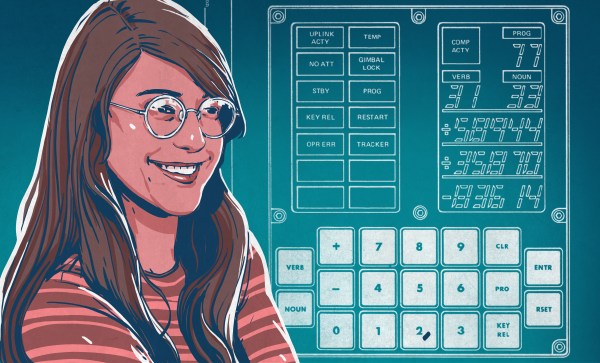
Margaret Hamilton Takes Software Engineering To The Moon And Beyond

If you were to create a short list of women who influenced software engineering, one of the first picks would be Margaret Hamilton. The Apollo 11 source code lists her title as “PROGRAMMING LEADER”. Today that title would probably be something along the line of “Lead software engineer”

Margaret Hamilton was born in rural Indiana in 1936. Her father was a philosopher and poet, who, along with grandfather, encouraged her love of math and sciences. She studied mathematics with a minor in philosophy, earning her BA from Earlham College in 1956. While at Earlham, her plan to continue on to grad school was delayed as she supported her husband working on his own degree from Harvard. Margaret took a job at MIT, working under Professor Edward Norton Lorenz on a computer program to predict the weather. Margaret cut her teeth on the desk-sized LGP-30 computer in Norton’s office.

Hamilton soon moved on to the SAGE program, writing software which would monitor radar data for incoming Russian bombers. Her work on SAGE put Margaret in the perfect position to jump to the new Apollo navigation software team.

The Apollo guidance computer software team was designed at MIT, with manufacturing done at Raytheon. To say this was a huge software project for the time would be an understatement. By 1968, over 350 engineers were working on software. 1400 man-years of software engineering were logged before Apollo 11 touched down on the lunar surface, and the project was lead by Margaret Hamilton.
Continue reading “Margaret Hamilton Takes Software Engineering To The Moon And Beyond”

Who Made The First Human Audio Recordings? Edison? Not So Fast!

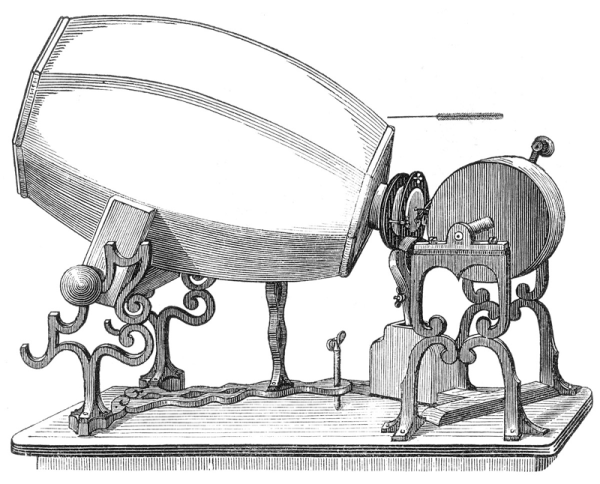
You probably learned in school that Thomas Edison was the first human voice recorded, reciting Mary Had a Little Lamb. As it turns out though, that’s not strictly true. Edison might have been the first person to play his voice back, but he wasn’t the first to deliberately record. That honor goes to a French inventor named Édouard-Léon Scott de Martinville. He wanted to study sound and created the phonautograph — a device which visualized sound on soot-covered paper. They were not made to be played back, but the information is there. These recordings were made around 1860. There’s a 9-part video series about how the recordings were made — and more interestingly — how they were played back using modern technology. Part 1 appears below.

We say around 1860 because there were some early recordings starting around 1857 that haven’t been recovered. Eventually, the recordings would have a tuning fork sound which allows modern playback since the known signal can estimate the speed of the hand-cranked cylinder. The date of the first recovered recording was today, April 9th, 158 years ago.

Continue reading “Who Made The First Human Audio Recordings? Edison? Not So Fast!”

Ask Hackaday: What’s In Your Digital Bugout Bag?

Your eyes pop open in the middle of the night, darting around the darkened bedroom as you wonder why you woke up. Had you heard something? Or was that a dream? The matter is settled with loud pounding on the front door. Heart racing as you see blue and red lights playing through the window, you open the door to see a grim-faced police officer standing there. “There’s been a hazardous materials accident on the highway,” he intones. “We need to completely evacuate this neighborhood. Gather what you need and be ready to leave in 15 minutes.”

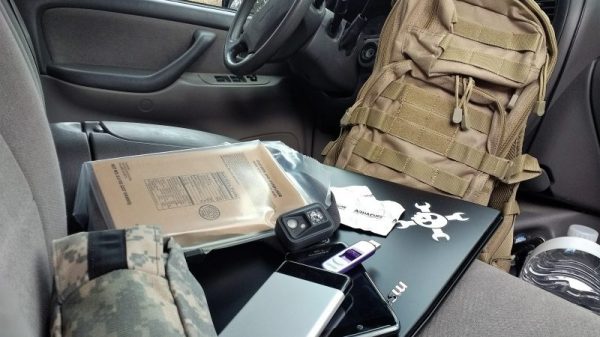
Most people will live their entire lives without a scenario like this playing out, but such things happen all the time. Whether the disaster du jour is man-made or natural, the potential to need to leave in a big hurry is very real, and it pays to equip yourself to survive such an ordeal. The primary tool for this is the so-called “bugout bag,” a small backpack for each family member that contains the essentials — clothing, food, medications — to survive for 72 hours away from home.

A bugout bag can turn a forced evacuation from a personal emergency into a minor inconvenience, as those at greatest risk well know — looking at you, Tornado Alley. But in our connected world, perhaps it pays to consider updating the bugout bag to include the essentials of our online lives, those cyber-needs that we’d be hard-pressed to live without for very long. What would a digital bugout bag look like?

Continue reading “Ask Hackaday: What’s In Your Digital Bugout Bag?”

Space Garbage Truck Takes Out The Trash

On April 2nd, 2018 a Falcon 9 rocketed skywards towards the International Space Station. The launch itself went off without a hitch, and the Dragon spacecraft delivered its payload of supplies and spare parts. But alongside the usual deliveries, CRS-14 brought a particularly interesting experiment to the International Space Station.

Developed by the University of Surrey, RemoveDEBRIS is a demonstration mission that aims to test a number of techniques for tackling the increasingly serious problem of “space junk”. Earth orbit is filled with old spacecraft and bits of various man-made hardware that have turned some areas of space into a literal minefield. While there have been plenty of ideas floated as to how to handle this growing issue, RemoveDEBRIS will be testing some of these methods under real-world conditions.

The RemoveDEBRIS spacecraft will do this by launching two CubeSats as test targets, which it will then (hopefully) eliminate in a practical demonstration of what’s known as Active Debris Removal (ADR) technology. If successful, these techniques could eventually become standard operating procedure on future missions.

Continue reading “Space Garbage Truck Takes Out The Trash”

Won’t Somebody, Please, Think Of The Transistors!

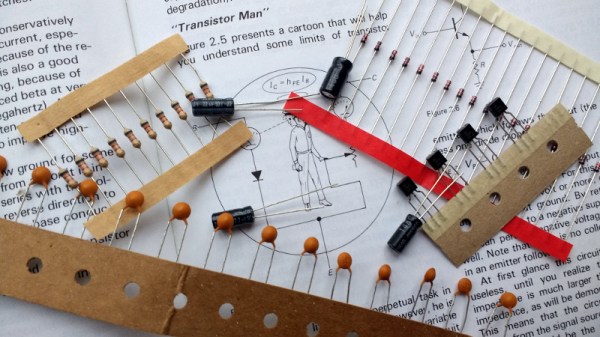
At what age did you begin learning about electronics? What was the state of the art available to you at the time and what kinds of things were you building? For each reader these answers can be wildly different. Our technology advances so quickly that each successive generation has a profoundly different learning experience. This makes it really hard to figure out what basic knowledge today will be most useful tomorrow.

Go on, guess the diode!

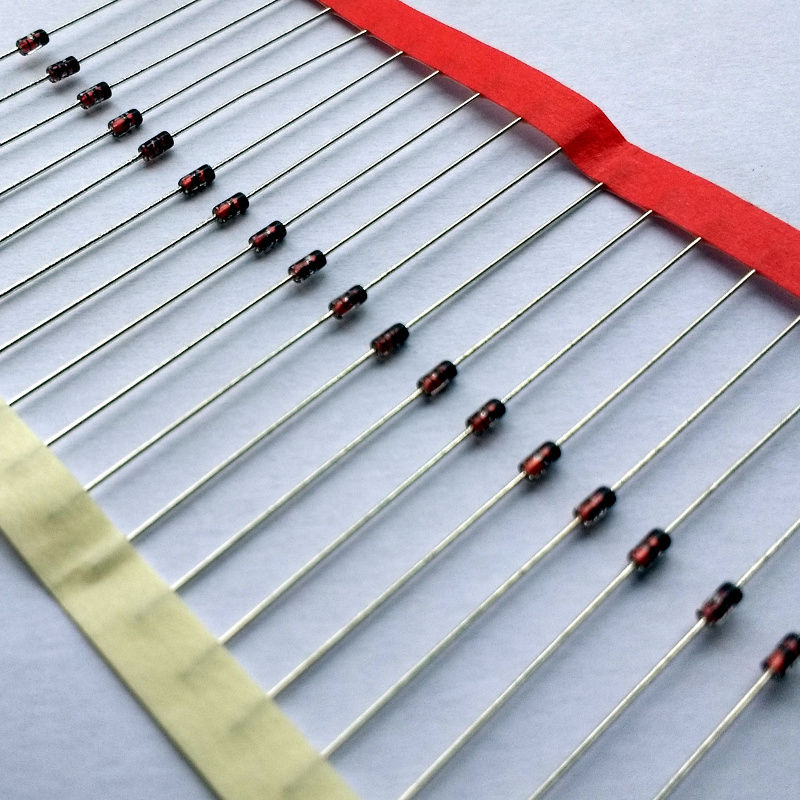
Do you know the forward voltage drop of a diode? Of course you do. Somewhere just below 0.7 volts, give or take a few millivolts, of course given that it is a silicon diode. If you send current through a 1N4148, you can be pretty certain that the cathode voltage will be that figure below the anode, every time. You probably also have a working knowledge that a germanium diode or a Schottky diode will have a lower forward voltage, and you’ll know in turn that a bipolar transistor will begin to turn on when the voltage between its base and emitter achieves that value. If you know Ohm’s Law, you can now set up a biasing network and without too many problems construct a transistor amplifier.

Continue reading “Won’t Somebody, Please, Think Of The Transistors!”

Circuit VR: The Dickson Charge Pump

There was a time when taking a low DC voltage — say a single battery — and converting it to a higher voltage was painful. Now, however, cheap and easy-to-use DC to DC converters are readily available. For some small tasks, though, these can seem like overkill. For example, consider a case where you need to supply a higher voltage for a MOSFET gate that doesn’t draw much current. Perhaps you need that higher voltage to trigger a microcontroller’s programming mode and nothing else. The current draw is minimal, and a full-blown DC to DC converter is overkill. For cases like that, it is tempting to use some voltage multiplication scheme. There are many, but for this post, I’m going to take you inside a Dickson charge pump. This is Circuit VR because not only are we going to discuss the circuit, we’ll look at an LT Spice simulation you can try yourself.

The Dickson is interesting because it doesn’t require any AC conversion or transformers. Instead, it uses diodes or other switching elements to transfer charge between capacitors in stages. Each stage will effectively increase the voltage by the supply voltage — in theory. Reality isn’t so kind, though, as we’ll see.

Continue reading “Circuit VR: The Dickson Charge Pump”