Years ago, while the GPLv3 was still being drafted, I got a chance to attend a presentation by Richard Stallman. He did his whole routine as St IGNUcius, and then at the end said he would be answering questions in a separate room off to the side. While the more causal nerds shuffled out of the presentation room, I went along with a small group of free software aficionados that followed our patron saint into the inner sanctum.
When my turn came to address the free software maestro, I asked what advantages the GPLv3 would have to a lowly hacker like myself? I was familiar with the clause about “Tivoization“, the idea that any device running GPLv3 code from the manufacturer should allow the user to be able to install their own software on it, but this didn’t seem like the kind of thing most individuals would ever need to worry about. Was there something in the new version of the GPL that would make it worth adopting in personal or hobby projects?
Yes, he really dresses up like this.
Interestingly, a few years after this a GPLv2 program of mine was picked up by a manufacturer and included in one of their products (never underestimate yourself, folks). So the Tivoization clause was actually something that did apply to me in the end, but that’s not the point of this story.
Mr. Stallman responded that he believed the biggest improvement GPLv3 made over v2 for the hobbyist programmer was the idea of “forgiveness” in terms of licensing compliance. Rather than take a hard line approach like the existing version of the GPL, the new version would have grace periods for license compliance. In this way, legitimate mistakes or misunderstandings of the requirements of the GPL could be resolved more easily.
Some things don’t sound like they should go together, but they do. Peanut butter and chocolate. Twinkies and deep frying. Bacon and maple syrup. Sometimes mixing things up can produce great results. [Dr. Christal Gordon’s] expertise falls into that category. She’s an electrical engineer, but she also studies neuroscience. This can lead to some interesting intellectual Reese’s peanut butter cups.
At the 2017 Hackaday Superconference, [Christal] spoke about sensor fusion. If you’ve done systems that have multiple sensors, you’ve probably run into that before even if you didn’t call it that. However, [Christal] brings the perspective of how biological systems fuse sensor data contrasted to how electronic systems perform similar tasks. You can see a video replay of her talk in the video below.
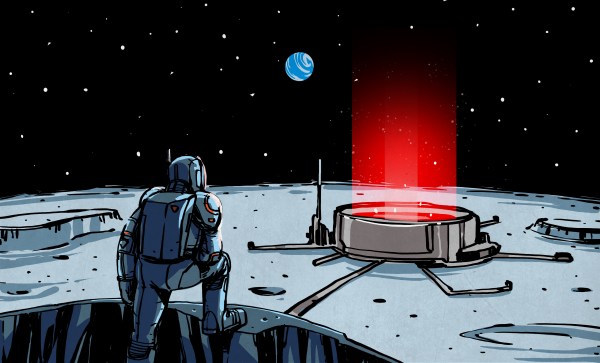
Invariably when we write about living on Mars, some ask why not go to the Moon instead? It’s much closer and has a generous selection of minerals. But its lack of an atmosphere adds to or exacerbates the problems we’d experience on Mars. Here, therefore, is a fun thought experiment about that age-old dream of living on the Moon.
Inhabiting Lava Tubes
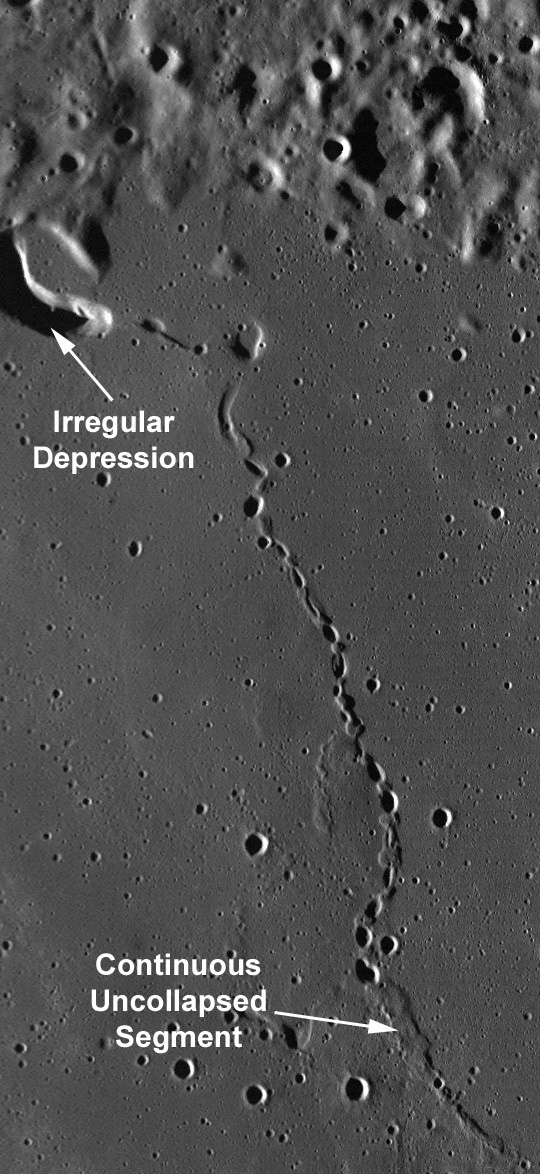
Lava tube with collapsed pits near Gruithuisen crater
The Moon has even less radiation protection than Mars, having practically no atmosphere. The lack of atmosphere also means that more micrometeorites make it to ground level. One way to handle these issues is to bury structures under meters of lunar regolith — loose soil. Another is to build the structures in lava tubes.
A lava tube is a tunnel created by lava. As the lava flows, the outer crust cools, forming a tube for more lava to flow through. After the lava has been exhausted, a tunnel is left behind. Visual evidence on the Moon can be a long bulge, sometimes punctuated by holes where the roof has collapsed, as is shown here of a lava tube northwest from Gruithuisen crater. If the tube is far enough underground, there may be no visible bulge, just a large circular hole in the ground. Some tubes are known to be more than 300 meters (980 feet) in diameter.
Lava tubes as much as 40 meters (130 feet) underground can also provide thermal stability with a temperature of around -20°C (-4°F). Having this stable, relatively warm temperature makes building structures and equipment easier. A single lunar day is on average 29.5 Earth days long, meaning that we’ll get around 2 weeks with sunlight followed by 2 weeks without. During those times the average temperatures on the surface at the equator range from 106°C (224°F) to -183°C (-298°F), which makes it difficult to find materials to withstand that range for those lengths of time.
It was the dawn of the personal computer age, a time when Apple IIs, Tandy TRS-80s, Commodore PETs, the Atari 400 and 800, and others had made significant inroads into schools and people’s homes. But IBM, whose name was synonymous with computers, was nowhere to be seen. And yet within a few years, the IBM PC would be the dominant player.
Those of us who were around at the time cherished one of those early non-IBM computers, and as the IBM PC came out, either respected it, looked down on it, or did both. But now, unless your desktop machine is a Mac, you probably own a computer that owes its basic design to the first IBM PC.
The Slow Moving Elephant
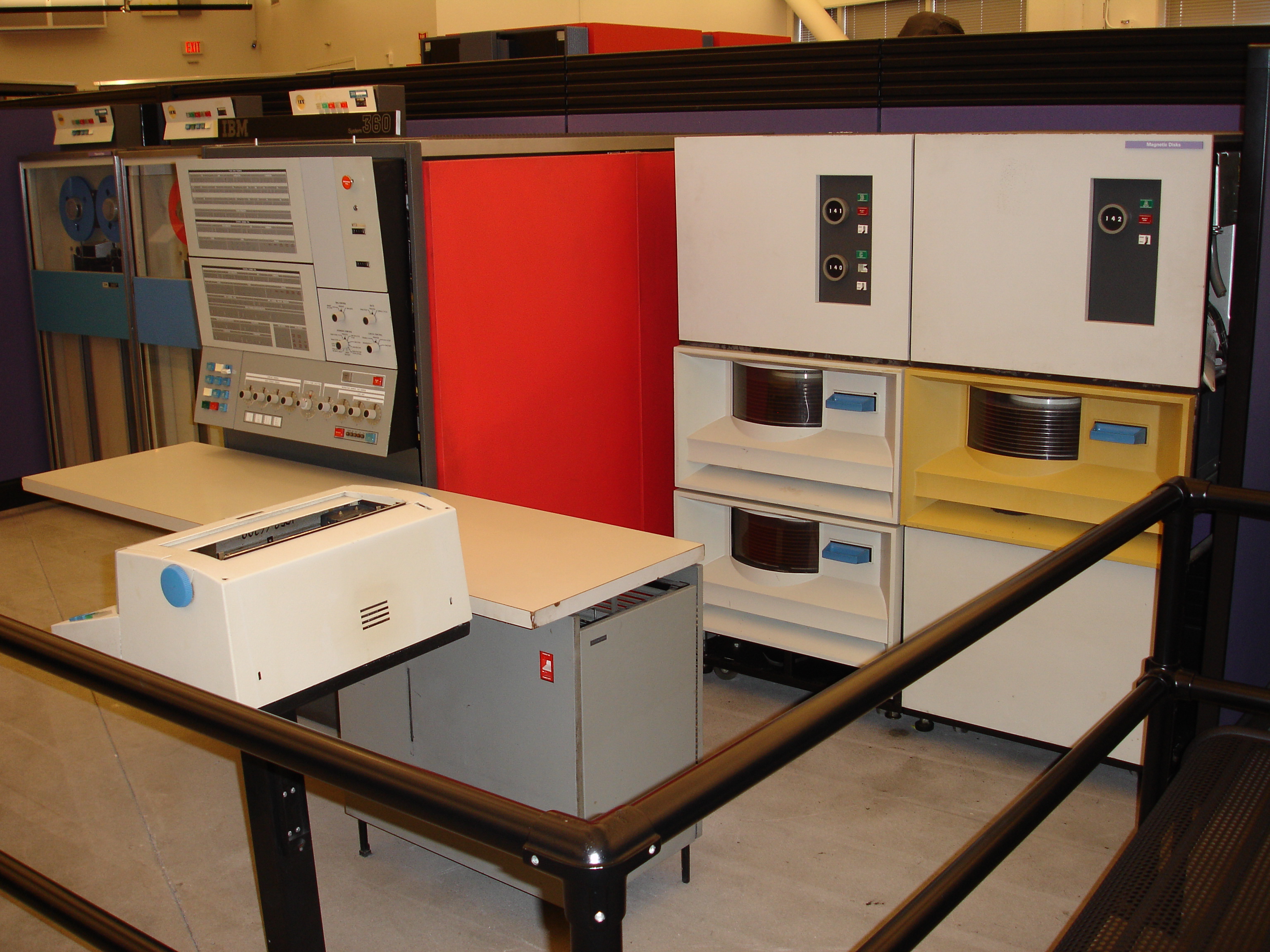
IBM System/360 Model 30 mainframe by Dave Ross CC BY 2.0
In the 1960s and 1970s, the room-filling mainframe was the leading computing platform and the IBM System/360 held a strong position in that field. But sales in 1979 in the personal computer market were $150 million and were projected to increase 40% in 1980. That was enough for IBM to take notice. And they’d have to come up with something fast.
Fast, however, wasn’t something people felt IBM could do. Decisions were made through committees, resulting in such a slow decision process that one employee observed, “that it would take at least nine months to ship an empty box.” And one analyst famously said, “IBM bringing out a personal computer would be like teaching an elephant to tap dance.”
And yet, in just a few short years, IBM PCs dominated the personal computer market and the majority of today’s desktops can trace their design back to the first IBM PC. With even more built-in barriers which we cover below, how did the slow-moving elephant make this happen?
If you have a car parked outside as you are reading this, the overwhelming probability is that it has a reciprocating piston engine powered by either petrol(gasoline), or diesel fuel. A few of the more forward-looking among you may own a hybrid or even an electric car, and fewer still may have a piston engine car powered by LPG or methane, but that is likely to be the sum of the Hackaday reader motoring experience.
We have become used to understanding that perhaps the era of the petroleum-fueled piston engine will draw to a close and that in future decades we’ll be driving electric, or maybe hydrogen. But visions of the future do not always materialize as we expect them. For proof of that, we only need to cast our minds back to the 1950s. Motorists in the decade following the Second World War would have confidently predicted a future of driving cars powered by jet engines. For a while, as manufacturers produced a series of prototypes, it looked like a safe bet.
The Chrysler gas turbine car from [Bryan]’s article. CZmarlin [Public domain].Back in August, my colleague [Bryan] wrote a feature: “The Last Interesting Chrysler Had A Gas Turbine Engine“, in which he detailed the story of one of the more famous gas turbine cars. But the beautifully styled Chrysler was not the only gas turbine car making waves at the time, because meanwhile on the other side of the Atlantic a series of prototypes were taking the gas turbine in a slightly different direction.
Rover was a British carmaker that was known for making sensible and respectable saloon cars. They passed through a series of incarnations into the nationalized British Leyland empire, eventually passing into the hands of British Aerospace, then BMW, and finally a consortium of businessmen under whose ownership they met an ignominious end. If you have ever wondered why the BMW 1-series has such ungainly styling cues, you are looking at the vestiges of a Rover that never made it to the forecourt. The very successful Land Rover marque was originally a Rover product, but beyond that sector, they are not remembered as particularly exciting or technically advanced.
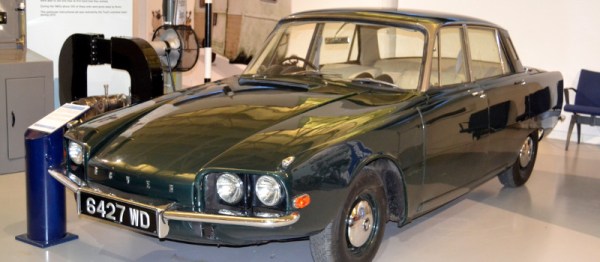
The Rover JET1 prototype. Allen Watkin [CC BY-SA 2.0].At the close of the Second World War though, Rover found themselves in an interesting position. One of their contributions to war production had been the gas turbine engines found in the first generation of British jet aircraft, and as part of their transition to peacetime production they began to investigate civilian applications for the technology. Thus the first ever gas turbine car was a Rover, the 1950 JET1. Bearing the staid and respectable styling of a 1950s bank manager’s transport rather than the space-age look you might expect of the first ever gas turbine car, it nonetheless became the first holder of the world speed record for a gas turbine powered car when in 1952 it achieved a speed of 152.691 MPH.
The JET1 was soon followed by a series of further jet-powered prototypes culminating in 1956’s T3 and 1961’s T4. Both of these were practical everyday cars, the T3, a sports coupé, and the T4, an executive saloon car whose styling would appear in the 1963 petrol-engined P6 model. There was also an experimental BMC truck fitted with the engine. The P6 executive car was produced until 1977, and all models were designed to have space for a future gas turbine option by having a very unusual front suspension layout with a pivot allowing the spring and damper to be placed longitudinally in the front wing.
The Rover-BRM racing car at Gaydon. David Merrett [CC BY 2.0].It was not only prototypes for production cars with gas turbines that came from Rover in the 1960s though, for in 1963 they put their gas turbine into a BRM racing chassis and entered it into the Le Mans 24 hour endurance race. It returned in the 1964 season fitted with a novel rotating ceramic honeycomb heat exchanger to improve its efficiency, racing for a final season in 1965.
The fate of the gas-turbine Rovers would follow that of their equivalent cars from other manufacturers including the Chrysler covered by [Bryan]. Technical difficulties were never fully overcome, the increasing cost of fuel made gas turbine cars uneconomic to run, and meanwhile by the 1960s the piston engine had improved immeasurably over what had been available when the JET1 had been produced. The Rover P6 never received its gas turbine, and the entire programme was abandoned. Today all the surviving cars are in museums, the JET1 prototype in the Science Museum in London, and the T3, T4, and Rover-BRM racing car at the Heritage Motor Centre at Gaydon. The truck survives in private hands, having been restored, and is a regular sight at summer time shows.
As a footnote to the Rover story, in response to the development of JET1 at the start of the 1950s, their rival and later British Leyland stablemate Austin developed their own gas turbine car. If international readers find Jet1’s styling a bit quaint compared to the American jet cars, it is positively space-age when compared to the stately home styling of the Sheerline limousine to which Austin fitted their gas turbine.
A previous post discussed the creation of the V-2 rocket, the first man-made object to reach space. Designed and built at the Peenemünde Army Research Center during World War II, the V-2 was intended to be a weapon of mass destruction, but ended up being far more effective as a tool of discovery than it ever did on the battlefield. In fact, historians now estimate that more people died during the development and construction of the V-2 than did in the actual attacks carried out with it. But even though it failed to win the war for Germany, it still managed to change the world in another way: as it served as the basic blueprint for all subsequent rockets right up to modern-day vehicles.
But the V-2 wasn’t the only rocket-powered vehicle that the Germans were working on, a whole series of follow-up vehicles were in the design phase when the Allies took Berlin in 1945. Some were weapons, but not all. Pioneers like Walter Dornberger and Wernher von Braun saw that rocketry had more to offer mankind than a new way to deliver warheads to the enemy, and the team at Peenemünde had begun laying the groundwork for a series of rockets that could have put mankind into space years before the Soviets.
In the early 20th century, Guinness breweries in Dublin had a policy of hiring the best graduates from Oxford and Cambridge to improve their industrial processes. At the time, it was considered a trade secret that they were using statistical methods to improve their process and product.
One problem they were having was that the z-test (a commonly used test at the time) required large sample sizes, and sufficient data was often unavailable. By studying the properties of small sample sizes, William Sealy Gosset developed a statistical test that required fewer samples to produce a reasonable result. As the story goes though, chemists at Guinness were forbidden from publishing their findings.
So he did what many of us would do: realizing the finding was important to disseminate, he adopted a pseudonym (‘Student’) and published it. Even though we now know who developed the test, it’s still called “Student’s t-test” and it remains widely used across scientific disciplines.
It’s a cute little story of math, anonymity, and beer… but what can we do with it? As it turns out, it’s something we could probably all be using more often, given the number of Internet-connected sensors we’ve been playing with. Today our goal is to cover hypothesis testing and the basic z-test, as these are fundamental to understanding how the t-test works. We’ll return to the t-test soon — with real data. Continue reading “Statistics And Hacking: An Introduction To Hypothesis Testing”→





![The Chrysler gas turbine car from [Brian]'s article. CZmarlin [Public domain].](https://hackaday.com/wp-content/uploads/2017/08/turbine.jpg)
![The Rover Jet1 prototype. Allen Watkin [CC BY-SA 2.0].](https://hackaday.com/wp-content/uploads/2017/11/rover_sort_of-_2398190117.jpg)
![The Rover-BRM racing car at Gaydon. David Merrett [CC BY 2.0].](https://hackaday.com/wp-content/uploads/2017/11/1024px-rover_brm_-_gas_turbine_heritage_motor_centre_gaydon_1.jpg)