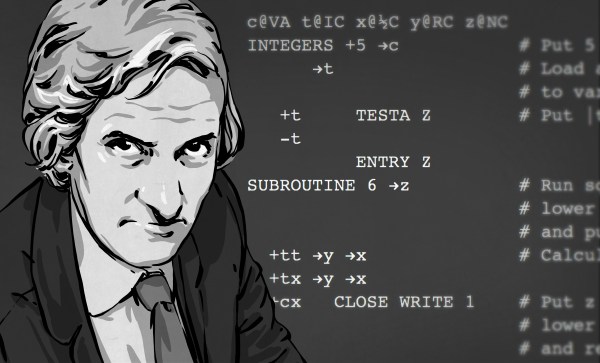
Ken Thompson and Dennis Ritchie at a PDP-11. Peter Hamer [CC BY-SA 2.0]Last week the computing world celebrated an important anniversary: the UNIX operating system turned 50 years old. What was originally developed in 1969 as a lighter weight timesharing system for a DEC minicomputer at Bell Labs has exerted a huge influence over every place that we encounter computing, from our personal and embedded devices to the unseen servers in the cloud. But in a story that has seen countless twists and turns over those five decades just what is UNIX these days?
The official answer to that question is simple. UNIX® is any operating system descended from that original Bell Labs software developed by Thompson, Ritchie et al in 1969 and bearing a licence from Bell Labs or its successor organisations in ownership of the UNIX® name. Thus, for example, HP-UX as shipped on Hewlett Packard’s enterprise machinery is one of several commercially available UNIXes, while the Ubuntu Linux distribution on which this is being written is not.
When You Could Write Off In The Mail For UNIX On A Tape
The real answer is considerably less clear, and depends upon how much you view UNIX as an ecosystem and how much instead depends upon heritage or specification compliance, and even the user experience. Names such as GNU, Linux, BSD, and MINIX enter the fray, and you could be forgiven for asking: would the real UNIX please stand up?
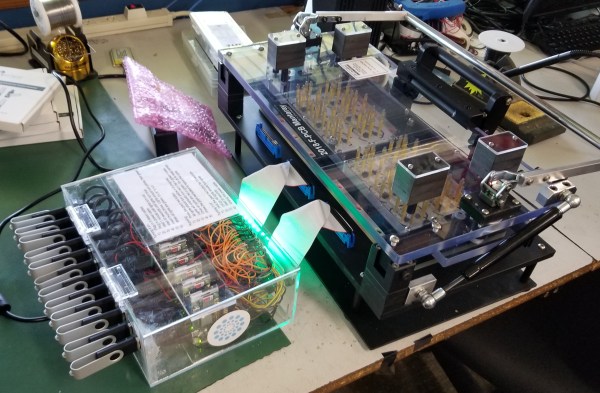
Look upon this conference badge and kiss your free time goodbye. The 2019 Hackaday Superconference badge is an ECP5 FPGA running a RISC-V core in a Game Boy form factor complete with cartridge slot that is more open than anything we’ve ever seen before: multiple open-source CPU designs were embedded in an open system, developed using the cutting-edge in open-source FPGA tools, and running (naturally) open-source software on top. It’s a 3,000-in-one activity kit for hardware people, software people, and everyone in between.
The brainchild of Jeroen Domburg (aka Sprite_TM), this design has been in the works since the beginning of this year. For more than 500 people headed to Supercon next week, this is a source of both geeky entertainment and learning for three action-packed days and well beyond. Let’s take a look at what’s on the badge, what you need to know to hack it, and how the design serves as a powerful development tool long after the badge hacking ceremonies have wrapped up.
The best part about the term “Artificial Intelligence” is that nobody can really tell you what it exactly means. The main reason for this stems from the term “intelligence”, with definitions ranging from the ability to practice logical reasoning to the ability to perform cognitive tasks or dream up symphonies. When it comes to human intelligence, properties such as self-awareness, complex cognitive feats, and the ability to plan and motivate oneself are generally considered to be defining features. But frankly, what is and isn’t “intelligence” is open to debate.
What isn’t open to debate is that AI is a marketing goldmine. The vagueness has allowed for marketing departments around the world to go all AI-happy, declaring that their product is AI-enabled and insisting that their speech assistant responds ‘intelligently’ to one’s queries. One might begin to believe that we’re on the cusp of a fantastic future inhabited by androids and strong AIs attending to our every whim.
In this article we’ll be looking at the reality behind these claims and ponder humanity’s progress towards becoming a Type I civilization. But this is Hackaday, so we’re also going to dig into the guts of some AI chips, including the Kendryte K210 and see how the hardware of today fits into our Glorious Future. Continue reading “How Smart Are AI Chips, Really?”→
The cult classic movie Office Space is a scathing critique of life for software engineers in a cubicle farm, and it did get a lot of things right even if it didn’t always mean to. One of those is the character of Tom Smykowski whose job is to “deal with the customers so the engineers don’t have to”. The movie treats Tom and his job as a punchline in a way, but his role is actually very important for most real businesses that rely on engineers or programmers for their core products.
Engineers can have difficulty relating to customers, and often don’t have the time (or even willingness) to handle the logistics of interacting with them in the first place. Customers may get frustrated understanding engineers or communicating their ideas clearly to them. A person like Tom Smykowski is often necessary to bridge the gap and smooth out the rough edges on both sides, but in the Linux world there are very few Toms to rely on. The customers, or users, have to deal directly with the engineers in many situations, and it’s not working out very well for either group. Linux has a marketing problem, and it needs a marketing solution if it ever wants to increase its market share in the PC realm. Continue reading “Linux’s Marketing Problem”→
Ecclesiastes 1:9 reads “What has been will be again, what has done will be done again; there is nothing new under the sun.” Or in other words, 5G is mostly marketing nonsense; like 4G, 3G, and 2G was before it. Let’s not forget LTE, 4G LTE, Advance 4G, and Edge.
Just a normal everyday antenna array in a Seattle parking garage.
Technically, 5G means that providers could, if they wanted to, install some EHF antennas; the same kind we’ve been using forever to do point to point microwave internet in cities. These frequencies are too lazy to pass through a wall, so we’d have to install these antennas in a grid at ground level. The promised result is that we’ll all get slightly lower latency tiered internet connections that won’t live up to the hype at all. From a customer perspective, about the only thing it will do is let us hit the 8Gb ceiling twice as faster on our “unlimited” plans before they throttle us. It might be nice on a laptop, but it would be a historically ridiculous assumption that Verizon is going to let us tether devices to their shiny new network without charging us a million Yen for the privilege.
So, what’s the deal? From a practical standpoint we’ve already maxed out what a phone needs. For example, here’s a dirty secret of the phone world: you can’t tell the difference between 1080p and 720p video on a tiny screen. I know of more than one company where the 1080p on their app really means 640 or 720 displayed on the device and 1080p is recorded on the cloud somewhere for download. Not a single user has noticed or complained. Oh, maybe if you’re looking hard you can feel that one picture is sharper than the other, but past that what are you doing? Likewise, what’s the point of 60fps 8k video on a phone? Or even a laptop for that matter?
Are we really going to max out a mobile webpage? Since our device’s ability to present information exceeds our ability to process it, is there a theoretical maximum to the size of an app? Even if we had Gbit internet to every phone in the world, from a user standpoint it would be a marginal improvement at best. Unless you’re a professional mobile game player (is that a thing yet?) latency is meaningless to you. The buffer buffs the experience until it shines.
So why should we care about billion dollar corporations racing to have the best network for sending low resolution advertising gifs to our disctracto cubes? Because 5G is for robots.
Your job might be tough, but spare a thought for any of the engineers involved in the Mars InSight lander mission when they learned that one of the flagship instruments aboard the lander, indeed the very instrument for which the entire mission was named, appeared to be a dud. That’s a bad day at work by anyone’s standards, and it happened over the summer when it was reported that the Mars Interior Exploration using Seismic Investigations, Geodesy and Heat Transport lander’s Heat Flow and Physical Properties Package (HP³), commonly known as “The Mole”, was not drilling itself into the Martian regolith as planned.
But now, after months of brainstorming and painstaking testing on Earth and on Mars, it looks as if the mole is working again. NASA has announced that, with a little help from the lander’s backhoe bucket, the HP³ penetrator has dug itself 2 cm into the soil. It’s a far cry from the 5-meter planned depth for its heat-transfer experiments, but it’s progress, and the clever hack that got the probe that far might just go on to salvage a huge chunk of the science planned for the $828 million program.
Hackers from all over Europe descended upon Rome last weekend for the Maker Faire that calls itself the “European Edition”. This three-day event is one of the largest Maker Faires in the world — they had 27,000 school students from all over Italy and Europe attend on Friday alone.
This was held at Fiera Roma, a gigantic conference complex two train stops south of the Rome airport — kind of in the middle of nowhere. I was told anecdotally that this is the largest event the complex hosts but have no data to back up that claim. One thing’s for certain, three days just wasn’t enough for me to enjoy everything at the show. There was a huge concentration of really talented hardware hackers on hand, many who you’ll recognize as creators of awesome projects regularly seen around Hackaday.
Here’s a whirlwind tour of some of my favorites. On that list are a POV holographic display, giant cast-resin LEDs, an optical-pump ruby laser built out of parts from AliExpress, blinky goodness in cube-form, and the Italian audience’s appreciation for science lectures (in this case space-related). Let’s take a look.