Teardown: LED Bulb Yields Tiny UPS

Occasionally you run across a product that you just know is simply too good to be true. You might not know why, but you’ve got a hunch that what the bombastic phrasing on the package is telling you just doesn’t quite align with reality. That’s the feeling I got recently when I spotted the “LED intellibulb Battery Backup” bulb by Feit Electric. For around $12 USD at Home Depot, the box promises the purchaser will “Never be in the dark again”, and that the bulb will continue to work normally for up to 3.5 hours when the power is out. If I could repurpose that to make a tiny UPS for a microcontroller project of my own, it could be even more useful.
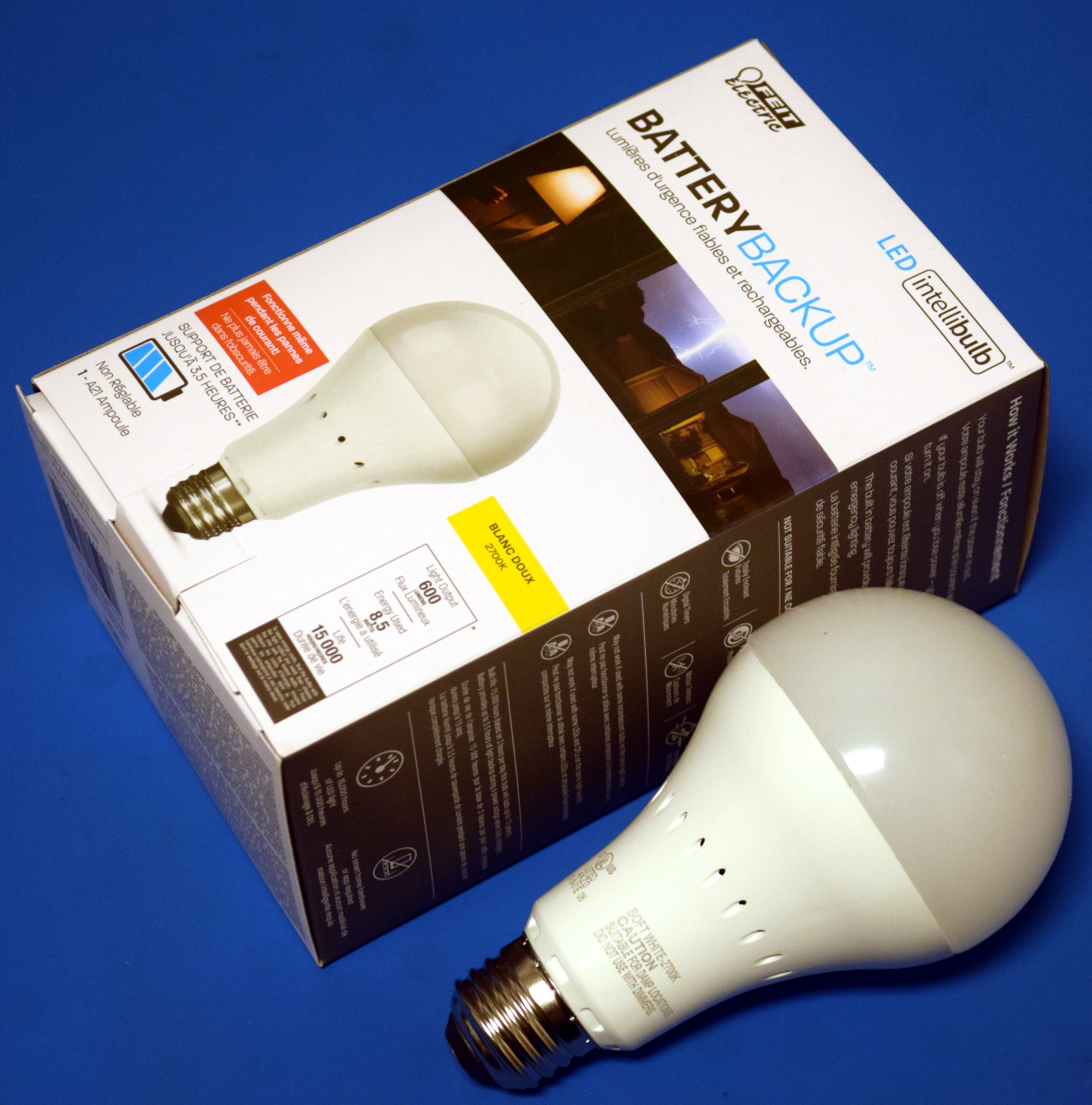
Now an LED light bulb with a battery in the base isn’t exactly rocket science, we can understand the product conceptually at a glance. But as they say, the devil is in the details. The box claims the bulb consumes 8.5 watts, but a battery with enough capacity to run such a load for 3.5 hours would be far too large to fit inside of a light bulb. Obviously there’s more to the story.

On the side of the box, in the smallest font used on the whole package, we get our clue. The bulb drops down to 200 lumens when in battery backup mode, or roughly as bright as a cheap LED flashlight. Now things are starting to come together. Without even opening the device, we can be fairly sure it will contain two separate arrays of LEDs: one low set for battery, and a brighter set to run when the bulb has AC power.

Still, I tend to be of the opinion that anything less than $20 or so is worth cracking open to see what makes it tick. Even if the product itself is underwhelming, there’s a chance the internal components could be useful or interesting. With that in mind, let’s see what’s inside a battery backup light bulb, and what we might be able to do with it.

Continue reading “Teardown: LED Bulb Yields Tiny UPS”

What Does ‘Crypto’ Actually Mean?

This article is about crypto. It’s in the title, and the first sentence, yet the topic still remains hidden.

At Hackaday, we are deeply concerned with language. Part of this is the fact that we are a purely text-based publication, yes, but a better reason is right there in the masthead. This is Hackaday, and for more than a decade, we have countered to the notion that ‘hackers’ are only bad actors. We have railed against co-opted language for our entire existence, and our more successful stories are entirely about the use and abuse of language.

Part of this is due to the nature of the Internet. Pedantry is an acceptable substitute for wisdom, it seems, and choosing the right word isn’t just a matter of semantics — it’s a compiler error. The wrong word shuts down all discussion. Use the phrase, ‘fused deposition modeling’ when describing a filament-based 3D printer, and some will inevitably reach for their pitchforks and torches; the correct phrase is, ‘fused filament fabrication’, the term preferred by the RepRap community because it is legally unencumbered by patents. That’s actually a neat tidbit, but the phrase describing a technology is covered by a trademark, and not by a patent.

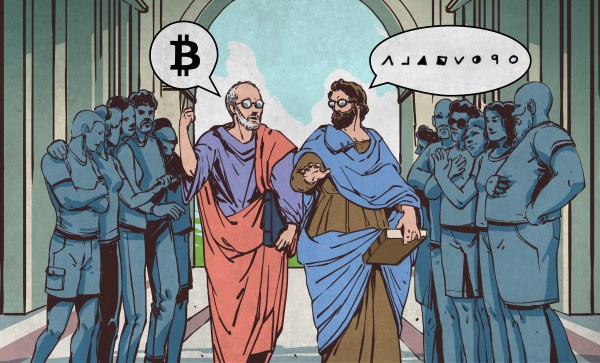
The technical side of the Internet, or at least the subpopulation concerned about backdoors, 0-days, and commitments to hodl, is now at a semantic crossroads. ‘Crypto’ is starting to mean ‘cryptocurrency’. The netsec and technology-minded populations of the Internet are now deeply concerned over language. Cryptocurrency enthusiasts have usurped the word ‘crypto’, and the folks that were hacking around with DES thirty years ago aren’t happy. A DH key exchange has nothing to do with virtual cats bought with Etherium, and there’s no way anyone losing money to ICO scams could come up with an encryption protocol as elegant as ROT-13.

But language changes. Now, cryptographers are dealing with the same problem hackers had in the 90s, and this time there’s nothing as cool as rollerblading into the Gibson to fall back on. Does ‘crypto’ mean ‘cryptography’, or does ‘crypto’ mean cryptocurrency? If frequency of usage determines the correct definition, a quick perusal of the press releases in my email quickly reveals a winner. It’s cryptocurrency by a mile. However, cryptography has been around much, much longer than cryptocurrency. What’s the right definition of ‘crypto’? Does it mean cryptography, or does it mean cryptocurrency?

Continue reading “What Does ‘Crypto’ Actually Mean?”

ETextile Spring Break Tackles Signal Blocking, Audio Generation, And Radio Transmissions

Finding a killer application for e-textiles is the realm of the hacker and within that realm, anything goes. Whether it’s protecting your digital privacy with signal shielding, generating audio with a wearable BeagleBone or 555 timer, or making your favorite garment into an antenna, the eTextile Spring Break is testing out ways to combine electronics and fabric.

You may be asking yourself “What are e-textiles good for?”. Well, that’s an excellent question and likely the most common one facing the industry today. I’m afraid I won’t be able to give a definitive answer. As an e-textile practitioner, I too am constantly posing this question to myself. There’s an inherently personal nature to fabric worn on the body and to our electronic devices that makes this answer elusive. Instead of trying to fabricate some narrow definition, what I offer is a look at topics of interest, material experimentation, and technical exploration through the lens of a week-long event held recently in New York called eTextile Spring Break.

Continue reading “ETextile Spring Break Tackles Signal Blocking, Audio Generation, And Radio Transmissions”

Life On Contract: Lowering Your Cost Without Dropping Your Price

Last time in Life on Contract, I discussed ways to figure out a starting point on how much to charge for your services. However, sometimes you and a client may wish to work together but for some reason they cannot (or do not wish to) pay what you have decided to charge. If you are inexperienced, it can be tempting to assume you have overpriced yourself and discount down to what they are willing to pay. But if your price is a number you have chosen for reasons you can explain, dropping it is not something you should do unless you have thought about it carefully.

Instead of just agreeing to do the same work but for less money, it is often possible to offer a lower overall cost without cheapening the value of your work. I’ll share a process I use to find opportunities to make this happen.

It Should be Win-Win, Not Hard Sell

The best case scenario is a client wants your service, your cost is within their budget, and everyone agrees to work together. Tragically, the process isn’t always that smooth. If cost is an issue, the alternative to lowering your price is to fine-tune what you provide to better fit the actual needs. To do that, you will need two things:

  1. A detailed understanding of your own time and costs for the work.
  2. Knowledge of what things your client considers most important.

By intimately knowing your own costs, you can figure out where to make savings without scrimping on the things your client considers important.
Continue reading “Life On Contract: Lowering Your Cost Without Dropping Your Price”

When 4 + 1 Equals 8: An Advanced Take On Pointers In C

In our first part on pointers, we covered the basics and common pitfalls of pointers in C. If we had to break it down into one sentence, the main principle of pointers is that they are simply data types storing a memory address, and as long as we make sure that we have enough memory allocated at that address, everything is going to be fine.

In this second part, we are going to continue with some more advanced pointer topics, including pointer arithmetic, pointers with another pointer as underlying data type, and the relationship between arrays and pointers. But first, there is one particular pointer we haven’t talked about yet.

The one proverbial exception to the rule that pointers are just memory addresses is the most (in)famous pointer of all: the NULL pointer. Commonly defined as preprocessor macro (void *) 0, we can assign NULL like any other pointer.

Continue reading “When 4 + 1 Equals 8: An Advanced Take On Pointers In C”

Fix Your Insecure Amazon Fire TV Stick

I recently spent a largely sleepless night at a hotel, and out of equal parts curiosity and boredom, decided to kill some time scanning the guest network to see what my fellow travelers might be up to. As you’d probably expect, I saw a veritable sea of Samsung and Apple devices. But buried among the seemingly endless number of smartphones charging next to their sleeping owners, I found something rather interesting. I was as picking up a number of Amazon-made devices, all of which had port 5555 open.

As a habitual Android tinkerer, this struck me as very odd. Port 5555 is used for Android Debug Bridge (ADB), a development tool used to control and perform various administrative tasks on an Android device over the network or (more commonly) locally over USB. The number of users who would have legitimately needed to enable network ADB on their devices is surely rather low, so to see a half dozen of them on the network at the same time seemed improbable to say the least.

Why would so many devices manufactured by Amazon all have network ADB enabled? I realized there must be a connection, and it didn’t take long to figure it out.

Continue reading “Fix Your Insecure Amazon Fire TV Stick”

Beatrice Tinsley And The Evolution Of Galaxies

It seems almost absurd now, but cosmologists once assumed that galaxies of a given type were all the same and didn’t change. Because of this assumption, galaxies were used as a redshift or light-based yardstick to measure distances in the universe. But what if some galaxies were intrinsically redder than others? Little to no thought was given to their origins, compositions, or evolution until Beatrice Tinsley came along.

Beatrice saw galaxies as changing bodies of stars. She believed that they grew, evolved, and died because they’re made of stars, and that’s what their star populations did. To lump all galaxies together and use them as a standard candle was an oversimplification. Beatrice created the first computer model of a galaxy to prove her point and in doing so, she founded the field of galaxy evolution.

If you’ve never heard of Beatrice, don’t feel bad. Just as her career was really beginning to take off, she developed cancer and died shortly after her 40th birthday. Though her life was short, her influence on cosmology is long-reaching. Continue reading “Beatrice Tinsley And The Evolution Of Galaxies”