Humans are very good at anthropomorphising things. That is, giving them human characteristics, like ourselves. We do it with animals—see just about any cartoon—and we even do it with our own planet—see Mother Nature. But we often extend that courtesy even further, giving names to our cars and putting faces on our computers as well.
When thoughts turn to the modernization and decarbonization of our transportation infrastructure, one imagines it to be dominated by exotic materials. EV motors and wind turbine generators need magnets made with rare earth metals (which turn out to be not all that rare), batteries for cars and grid storage need lithium and cobalt, and of course an abundance of extremely pure silicon is needed to provide the computational power that makes everything work. Throw in healthy pinches of graphene, carbon fiber composites and ceramics, and minerals like molybdenum, and the recipe starts looking pretty exotic.
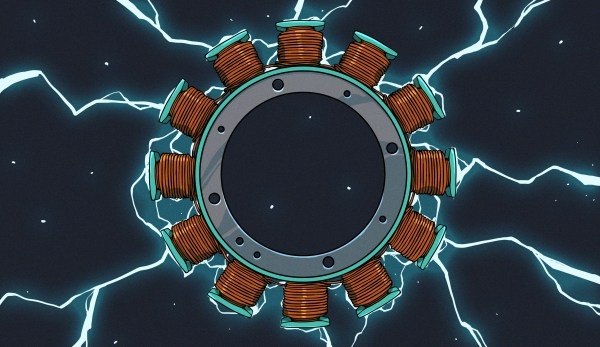
As necessary as they are, all these exotic materials are worthless without a foundation of more familiar materials, ones that humans have been extracting and exploiting for eons. Mine all the neodymium you want, but without materials like copper for motor and generator windings, your EV is going nowhere and wind turbines are just big lawn ornaments. But just as important is iron, specifically as the alloy steel, which not only forms the structural elements of nearly everything mechanical but also appears in the stators and rotors of motors and generators, as well as the cores of the giant transformers that the electrical grid is built from.
Not just any steel will do for electrical use, though; special formulations, collectively known as electrical steel, are needed to build these electromagnetic devices. Electrical steel is simple in concept but complex in detail, and has become absolutely vital to the functioning of modern society. So it pays to take a look at what electrical steel is and how it works, and why we’re going nowhere without it.
About two decades ago there was a quiet revolution in electronics which went unnoticed by many, but which overturned a hundred years of accepted practice. You’d have noticed it if you had a mobile phone, the charger for your Nokia dumbphone around the year 2000 would have been a weighty device, while the one for your feature phone five years later would have been about the same size but relatively light as a feather. The electronics industry abandoned the mains transformer from their wall wart power supplies and other places in favour of the much lighter and efficient switch mode power supply. Small mains transformers which had been ubiquitous in electronics projects for many years, slowly followed suit.
Coils Of Wire, Doing Magic With Electrons
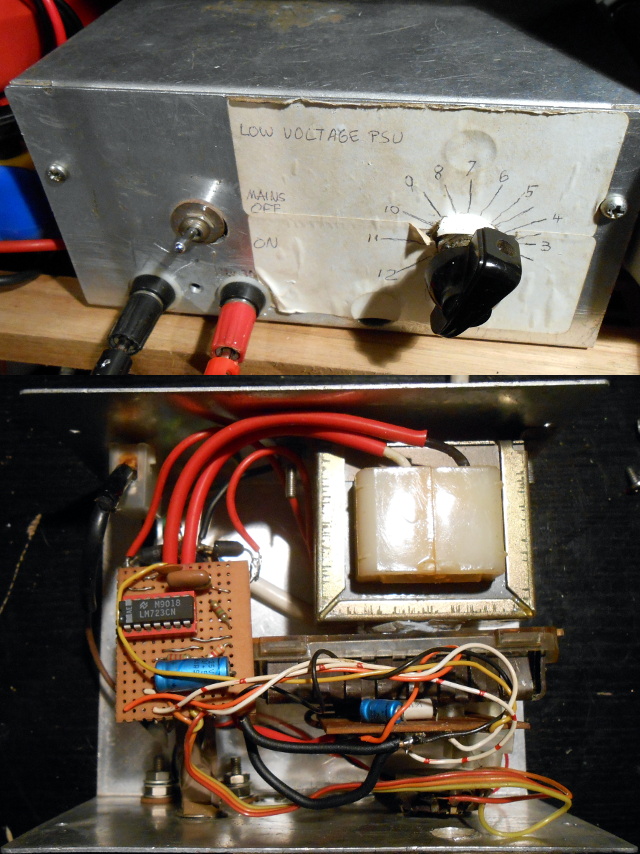
This was a state of the art project for a future Hackaday scribe back in 1990.
A transformer works through transferring alternating electrical current into magnetic flux by means of a coil of wire, and then converting the flux back to electric current in a second coil. The flux is channeled through a ferromagnetic transformer core made of iron in the case of a mains transformer, and the ratio of input voltage to output voltage is the same as the turns ratio between the two. They provide a safe isolation between their two sides, and in the case of a mains transformer they often have a voltage regulating function as their core material is selected to saturate should the input voltage become too high. The efficiency of a transformer depends on a range of factors including its core material and the frequency of operation, with transformer size decreasing with frequency as efficiency increases.
When energy efficiency rules were introduced over recent decades they would signal the demise of the mains transformer, as the greater efficiency of a switch-mode supply became the easiest way to achieve the energy savings. In a sense the mains transformer never went away, as it morphed into the small ferrite-cored part running at a higher frequency in the switch-mode circuitry, but it’s fair to say that the iron-cored transformers of old are now a rare sight. Does this matter? It’s time to unpack some of the issues surrounding a small power supply. Continue reading “Parts We Miss: The Mains Transformer”→
Defending an area against incoming missiles is a difficult task. Missiles are incredibly fast and present a small target. Assuming you know they’re coming, you have to be able to track them accurately if you’re to have any hope of stopping them. Then, you need some kind of wonderous missile of your own that’s fast enough and maneuverable enough to take them out.
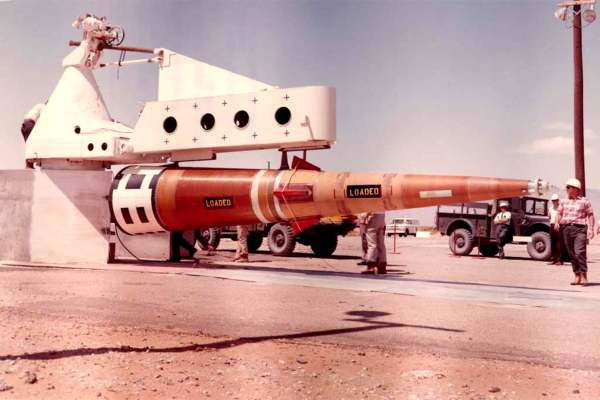
It’s a task that at times can seem overwhelmingly impossible. And yet, the devastating consequences of a potential nuclear attack are so great that the US military had a red hot go anyway. In the 1970s, America’s best attempt to thwart incoming Soviet ICBMs led to the development of the Sprint ABM—a missile made up entirely of improbable numbers.
If you’ve been involved with electronics and hardware hacking for awhile, there’s an excellent chance you’ve heard of the Bus Pirate. First introduced on the pages of Hackaday back in 2008 by creator Ian Lesnet, the open hardware multi-tool was designed not only as away to easily tap into a wide array of communication protocols, but to provide various functions that would be useful during hardware development or reverse engineering. The Bus Pirate could talk to your I2C and SPI devices, while also being able to measure frequencies, check voltages, program chips, and even function as a logic analyzer or oscilloscope.
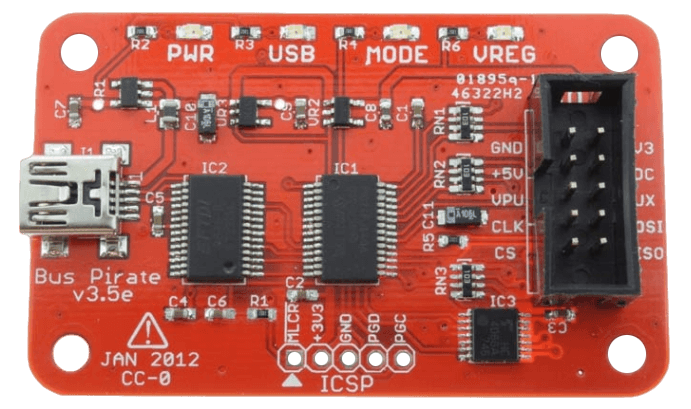
Bus Pirate 3, circa 2012
The Bus Pirate provided an incredible number of tools at a hobbyist-friendly price, and it wasn’t long before the device became so popular that it achieved a milestone which only a few hardware hacking gadgets can boast: its sales started to get undercut by cheap overseas clones. Of course, as an open hardware device, this wasn’t really a problem. If other companies wanted to crank out cheap Bus Pirates, that’s fine. It freed Ian up to research a next-generation version of the device.
But it turns out that was easier said than done. It’s around this point that the Bus Pirate enters what might be considered its Duke Nukem Forever phase. It took 15 years to release the sequel to 1996’s Duke Nukem 3D because the state-of-the-art in video games kept changing, and the developers didn’t want to be behind the curve. Similarly, Ian and his team spent years developing and redeveloping versions of the Bus Pirate that utilized different hardware platforms, such as the STM32 and ICE40 FPGA. But each time, there would be problems sourcing components, or something newer and more interesting would be released.
But then in 2021 the Raspberry Pi Pico hit the scene, and soon after, the bare RP2040 chip. Not only were the vast I/O capabilities of the new microcontroller a perfect fit for the Bus Pirate, but the chip was cheap and widely available. Finally, after years of false starts, the Bus Pirate 5 was born.
I was able to grab one of the first all-new Bus Pirates off the production line in January, and have been spending the last week or so playing around with it. While there’s definitely room for improvement on the software side of things, the hardware is extremely promising, and I’m very excited to be see how this new chapter in the Bus Pirate story plays out.
We have all heard the statistics on how safe air travel is, with more people dying and getting injured on their way to and from the airport than while traveling by airplane. Things weren’t always this way, of course. Throughout the early days of commercial air travel and well into the 1980s there were many crashes that served as harsh lessons on basic air safety. The most tragic ones are probably those with a human cause, whether it was due to improper maintenance or pilot error, as we generally assume that we have a human element in the chain of events explicitly to prevent tragedies like these.
Among the worst pilot errors we find the phenomenon of controlled flight into terrain (CFIT), which usually sees the pilot losing track of his bearings due to a variety of reasons before a usually high-speed and fatal crash. When it comes to keeping airplanes off the ground until they’re at their destination, here ground proximity warning systems (GPWS) and successors have added a layer of safety, along with stall warnings and other automatic warning signals provided by the avionics.
With the recent passing of C. Donald Bateman – who has been credited with designing the GPWS – it seems like a good time to appreciate the technology that makes flying into the relatively safe experience that it is today.
Last week I was sitting in a waiting room when the news came across my phone that Ingenuity, the helicopter that NASA put on Mars three years ago, would fly no more. The news hit me hard, and I moaned when I saw the headline; my wife, sitting next to me, thought for sure that my utterance meant someone had died. While she wasn’t quite right, she wasn’t wrong either, at least in my mind.
As soon as I got back to my desk I wrote up a short article on the end of Ingenuity‘s tenure as the only off-Earth flying machine — we like to have our readers hear news like this from Hackaday first if at all possible. To my surprise, a fair number of the comments that the article generated seemed to decry the anthropomorphization of technology in general and Ingenuity in particular, with undue harshness directed at what some deemed the overly emotional response by some of the NASA/JPL team members.
Granted, some of the goodbyes in that video are a little cringe, but still, as someone who seems to easily and eagerly form attachments to technology, the disdain for an emotional response to the loss of Ingenuity perplexed me. That got me thinking about what role anthropomorphization might play in our relationship with technology, and see if there’s maybe a reason — or at least a plausible excuse — for my emotional response to the demise of a machine.