SOLID Promises A New Approach To How The Web Works

As it stands on the modern Internet, your data is no longer your own. Your emails, photos, and posts all live on servers owned by large corporations. Their policies give them access to your data, which is mined to generate advertising revenue. And if you want your data back, there are innumerable hoops to jump through. Want it deleted entirely? Good luck.

Tim Berners-Lee, original creator of the World Wide Web, is behind the project.

Sir Tim Berners-Lee, as the original creator of what became the Web, has drawn issue with the current state of play. To move the ball on the issue, he’s been working on a design for decentralized internet and the efforts have led to the establishment of the Solid project. The goal is to rectify online privacy and ownership issues and give users greater control over their personal data.

The big question is how do you do that? When SOLID was announced last year there were few if any details on the approach taken by the program. But since then, more details have surface and you can even take an early version of the program for a spin. Let’s take a look.

Continue reading “SOLID Promises A New Approach To How The Web Works”

Laser Artistry Hack Chat

Join us on Wednesday, April 1 at noon Pacific for the Laser Artistry Hack Chat with Seb Lee-Delisle!

It’s hard to forget the first time you see a laser light show. A staple at concerts starting in the 1980s, seeing a green laser lance out over the heads of tens of thousands of screaming fans to trace out an animated figure or pulsating geometric shapes was pure fascination, and wondering how it was all done was half the fun. As we all know now, it was all done with mirrors, tiny and connected to low-inertia galvanometers capable of the twitchiest of movements, yet precise enough to position the beam of light exactly where it needed to be to create the desired illusion. It was engineering, science, and art all wrapped up into one package.

Fast forward to the present day, and laser show technology has certainly advanced. Bulky laser tubes have been replaced by solid-state devices, more colors are available, and galvo designs have improved. The art and artistry of the laserist have grown with the tech, which is where our guest Seb Lee-Delisle comes into his own. We’ve featured some of Seb’s work before, like an Asteroids laser vector display and enormous public laser displays. And now he’ll stop by to talk about how the art and the tech combine in his hands to produce something much greater than the sum of its parts.

join-hack-chatOur Hack Chats are live community events in the Hackaday.io Hack Chat group messaging. This week we’ll be sitting down on Wednesday, April 1 at 12:00 PM Pacific time. If time zones have got you down, we have a handy time zone converter.

Click that speech bubble to the right, and you’ll be taken directly to the Hack Chat group on Hackaday.io. You don’t have to wait until Wednesday; join whenever you want and you can see what the community is talking about.

Continue reading “Laser Artistry Hack Chat”

Hackaday Links Column Banner

Hackaday Links: March 29, 2020

It turns out that whacking busted things to fix them works as well on Mars as it does on Earth, as NASA managed to fix its wonky “mole” with a little help from the InSight lander’s robotic arm. Calling it “percussive maintenance” is perhaps a touch overwrought; as we explained last week, NASA prepped carefully for this last-ditch effort to salvage the HP³ experiment, and it was really more of a gentle nudge that a solid smack with the spacecraft’s backhoe bucket. From the before and after pictures, it still looks like the mole is a little off-kilter, and there was talk that the shovel fix was only the first step in a more involved repair. We’ll keep an ear open for more details — this kind of stuff is fascinating, and beats the news from Earth these days by a long shot.

Of course, the COVID-19 pandemic news isn’t all bad. Yes, the death toll is rising, the number of cases is still growing exponentially, and billions of people are living in fear and isolation. But ironically, we’re getting good at community again, and the hacker community is no exception. People really want to pitch in and do something to help, and we’ve put together some resources to help. Check out our Hackaday How You Can Help spreadsheet, a comprehensive list of what efforts are currently looking for help, plus what’s out there in terms of Discord and Slack channels, lists of materials you might need if you choose to volunteer to build something, and even a list of recent COVID-19 Hackaday articles if you need inspiration. You’ll also want to check out our calendar of free events and classes, which might be a great way to use the isolation time to better your lot.

Individual hackers aren’t the only ones pitching in, of course. Maybe of the companies in the hacker and maker space are doing what they can to help, too. Ponoko is offering heavy discounts for hardware startups to help them survive the current economic pinch. They’ve also enlisted other companies, like Adafruit and PCBWay, to join with them in offering similar breaks to certain customers.

More good news from the fight against COVID-19. Folding@Home, the distributed computing network that is currently working on folding models from many of the SARS-CoV-2 virus proteins, has broken the exaFLOP barrier and is now the most powerful computer ever built. True, not every core is active at any given time, but the 4.6 million cores and 400,000-plus GPUs in the network pushed it over from the petaFLOP range of computers like IBM’s Summit, until recently the most powerful supercomputer ever built. Also good news is that Team Hackaday is forming a large chunk of the soul of this new machine, with 3,900 users and almost a million work units completed. Got an old machine around? Read Mike Sczcys’ article on getting started and join Team Hackaday.

And finally, just because we all need a little joy in our lives right now, and because many of you are going through sports withdrawal, we present what could prove to be the new spectator sports sensation: marble racing. Longtime readers will no doubt recognize the mad genius of Martin and his Marble Machine X, the magnificent marble-dropping music machine that’s intended as a follow-up to the original Marble Machine. It’s also a great racetrack, and Martin does an amazing job doing both the color and turn-by-turn commentary in the mock race. It’s hugely entertaining, and a great tour of the 15,000-piece contraption. And when you’re done with the race, it’s nice to go back to listen to the original Marble Machine tune — it’s a happy little song for these trying times.


Hackaday Podcast 060: Counting Bees, DogBox Transmissions, And The Lowdown On Vents, BiPAP, And PCR

Hackaday editors Elliot Williams and Mike Szczys recount the past week in hardware hacking. There’s a new king of supercomputing and it’s everyone! Have you ever tried to count bees? Precision is just a cleverly threaded bolt away. And we dig into some of the technical details of the coronavirus response with a close look at PCR testing for the virus, and why ventilators are so difficult to build.

Take a look at the links below if you want to follow along, and as always tell us what you think about this episode in the comments!

Take a look at the links below if you want to follow along, and as always, tell us what you think about this episode in the comments!

Direct download (60 MB or so.)

Continue reading “Hackaday Podcast 060: Counting Bees, DogBox Transmissions, And The Lowdown On Vents, BiPAP, And PCR”

This Week In Security: 0-Days, Pwn2Own, IOS And Tesla

LILIN DVRs and cameras are being actively exploited by a surprisingly sophisticated botnet campaign. There are three separate 0-day vulnerabilities being exploited in an ongoing campaigns. If you have a device built by LILIN, go check for firmware updates, and if your device is exposed to the internet, entertain the possibility that it was compromised.

The vulnerabilities include a hardcoded username/password, command injection in the FTP and NTP server fields, and an arbitrary file read vulnerability. Just the first vulnerability is enough to convince me to avoid black-box DVRs, and keep my IP cameras segregated from the wider internet.

Continue reading “This Week In Security: 0-Days, Pwn2Own, IOS And Tesla”

Geofence Warrant Sends Bicyclist’s Privacy Over The Handlebars

About a year ago, Zachary McCoy took a bike ride around his neighborhood in Gainesville, Florida. It may have been forgettable to him, but not to history. Because McCoy used an app to track his mileage, the route was forever etched in the Google-verse and attached to his name.

On the day of this ill-fated bike ride, McCoy passed a certain neighbor’s house three times. While this normally wouldn’t raise alarm, the neighbor happened to be the victim of a burglary that day, and had thousands of dollars worth of jewelry stolen. The Gainesville police had zero leads after a four-day investigation, so they went to the county to get a geofence warrant. Thanks to all the location data McCoy had willingly generated, he became the prime suspect.

Continue reading “Geofence Warrant Sends Bicyclist’s Privacy Over The Handlebars”

Wind Farms In The Night: On-Demand Warning Lights Are Coming

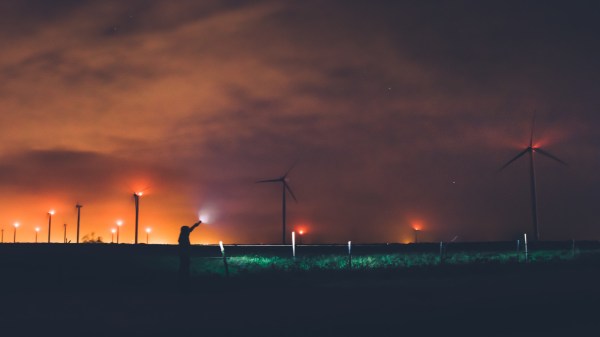
There appears to be no shortage of reasons to hate on wind farms. That’s especially the case if you live close by one, and as studies have shown, their general acceptance indeed grows with their distance. Whatever your favorite flavor of renewable energy might be, that’s at least something it has in common with nuclear or fossil power plants: not in my back yard. The difference is of course that it requires a lot more wind turbines to achieve the same output, therefore affecting a lot more back yards in total — in constantly increasing numbers globally.

Personally, as someone who encounters them occasionally from the distance, I find wind turbines mostly to be an eyesore, particularly in scenic mountainous landscapes. They can add a futuristic vibe to some otherwise boring flatlands. In other words, I can not judge the claims actual residents have on their impact on humans or the environment. So let’s leave opinions and emotions out of it and look at the facts and tech of one issue in particular: light pollution.

This might not be the first issue that comes to mind when thinking about wind farms. But wind turbines are tall enough to require warning lights for air traffic safety, and can be seen for miles, blinking away in the night sky. From a pure efficiency standpoint, this doesn’t seem reasonable, considering how often an aircraft is actually passing by on average. Most of the time, those lights simply blink for nothing, lighting up the countryside. Can we change this?

Continue reading “Wind Farms In The Night: On-Demand Warning Lights Are Coming”