Backpack COVID-19 lab

HDD Centrifuge Puts COVID-19 Testing Lab In A Backpack

Throughout this two-year global COVID-19 nightmare, one thing that has been sorely lacking is access to testing. “Flu-like symptoms” covers a lot of ground, and knowing if a sore throat is just a sore throat or something more is important enough that we’ve collectively plowed billions into testing. Unfortunately, the testing infrastructure remains unevenly distributed, which is a problem this backpack SARS-CoV-2 testing lab aims to address.

The portable lab, developed by [E. Emily Lin] and colleagues at the Queen Mary University of London, uses a technique called LAMP, for loop-mediated isothermal amplification. LAMP probably deserves an article of its own to explain the process, but suffice it to say that like PCR, LAMP amplifies nucleic acid sequences, but does so without the need for expensive thermal cycling equipment. The kit contains a microcentrifuge that’s fashioned from an e-waste hard drive, a 3D printed rotor, and an Arduino to drive the motor and control the speed. The centrifuge is designed to run on any 12 VDC source, meaning the lab can be powered by a car battery or solar panel if necessary. Readout relies on the trusty Mark I eyeball and a pH-indicating buffer that changes color depending on how much SARS-CoV-2 virus was in the sample.

Granted, the method used here still requires more skill to perform than a simple “spit on a stick” rapid antigen test, and it’s somewhat more subjective than the “gold standard” quantitative polymerase chain reaction (qPCR) assay. But the method is easily learned, and the kit’s portability, simple design, and low-cost construction could make it an important tool in attacking this pandemic, or the next one.

Thanks to [Christian Himmler] for the tip.

Monitor For Bedridden Patients Aims To Improve Care

One of the joys of being a Maker and Hacker is solving problems and filling needs. When you can do both, well, that’s something special. [rodrigo.mejiasz]’s project surely fits into that special category of solving a problem and filling a dire need with his Bedridden Patient Monitor.

While [Rodrigo]’s project page does not specify his motivation for creating this project, one only needs to look as far as their local hospital ward or senior care facility to understand why this device is so wonderful. Healthcare workers and caregivers are stretched paper thin, and their attention is being constantly interrupted.

This is where the Bedridden Patient Monitor comes in. A healthy person can reposition themselves if they are uncomfortable, but bedridden patients cannot. It’s not just that a bedridden patient is unable to get out of bed, but that they are unable to move themselves without assistance. The result is a great amount of pain. And if left unchecked, pressure sores can be the result. These are not only extremely unpleasant, but an added danger to a patients health.

The Bedridden Patient Monitor steps in and provides not just an egg-timer like alert, but helps caregivers track a patients position in bed across even several working shifts. This ensures a continuity of care that might otherwise be easy to miss.

The beauty of this build is in its application but also its simplicity: it’s just an Arduino Mega, a TFT shield with its Micro SD card, and the touch screen itself. A few LED’s and a buzzer take care of alerts. A thoughtfully configured interface makes the devices use obvious so that staff can make immediate use of the monitor.

Makers have a long history diving into the medical field, such as this stab wound treatment device that won the Dyson award in 2021.

Continue reading “Monitor For Bedridden Patients Aims To Improve Care”

Portable VO2 max measurment mask

Printable Portable Mask Gives You The Numbers On Your Workout

We’re currently in the midst of New Year’s Resolutions season, which means an abundance of spanking new treadmills and exercise bikes. And one thing becomes quickly obvious while using those machines: the instruments on them are, at best, only approximately useful for measuring things like your pulse rate, and in the case of estimating the calories burned by your workout, are sometimes wildly optimistic.

If precision quantification of your workout is your goal, you’ll need to monitor your “VO2 max”, a task for which this portable, printable mask is specifically designed. This is [Robert Werner]’s second stab at a design that senses both pressure differential and O2 concentration to calculate the maximum rate of oxygen usage during exercise. This one uses a commercially available respirator, of the kind used for painting or pesticide application, as the foundation for the build. The respirator’s filter elements are removed from the inlets to provide free flow of air into the mask, while a 3D printed venturi tube is fitted to its exhaust port. The tube houses the pressure and O2 sensors, as well as a LiPo battery pack and an ESP32. The microcontroller infers the volume of exhaled air from the pressure difference, measures its O2 content, and calculates the VO2 max, which is sent via Bluetooth to a smartphone running an exercise tracking app like Zwift or Strava.

[Robert] reports that his $100 instrument compares quite well to VO2 max measurements taken with a $10,000 physiology lab setup, which is pretty impressive. The nice thing about the design of this mask is how portable it is, and how you can take your exercise routine out into the world — especially handy if your fancy exercise bike gets bricked.

Smart Sutures Become WiSe

A team at the Wireless Bioelectronics Lab at the National University of Singapore led by [Dr John Ho] announced the results of their new Wireless Sensing (WiSe) smart sutures program last month. Their system consists of a specially prepared patch of polymer gel (the sensor) which is sewn into the wound using a silk suture coated with a conductive polymer. An external reader scans the sensor to monitor the status of the wound.

The concept is not unlike a NFC public transportation card, although with simplified electronics. There is no microcontroller or digital data being transferred. Rather, the sensor behaves like a tuned tank. The gel on the sensor was designed to degrade if the wound becomes infected, changing capacitance of the sensor structure and thus shifting its resonant frequency.

If you’ve ever had the misfortune to experience surgery, no doubt the surgeon and nurses drove home the importance of diligent monitoring of the wound for early signs of infection. These smart sutures allow detection of wound infection even before symptoms can seen or felt. They can be used on internal stitches up to 50 mm inside the body. More details can be read in this paper, and we covered another type of smart sensor back in 2016.

Regenerative Medicine: The Promise Of Undoing The Ravages Of Time

In many ways, the human body is like any other machine in that it requires constant refueling and maintenance to keep functioning. Much of this happens without our intervention beyond us selecting what to eat that day. There are however times when due to an accident, physical illness or aging the automatic repair mechanisms of our body become overwhelmed, fail to do their task correctly, or outright fall short in repairing damage.

Most of us know that lizards can regrow tails, some starfish regenerate into as many new starfish as the pieces which they were chopped into, and axolotl can regenerate limbs and even parts of their brain. Yet humans too have an amazing regenerating ability, although for us it is mostly contained within the liver, which can regenerate even when three-quarters are removed.

In the field of regenerative medicine, the goal is to either induce regeneration in damaged tissues, or to replace damaged organs and tissues with externally grown ones, using the patient’s own genetic material. This could offer us a future in which replacement organs are always available at demand, and many types of injuries are no longer permanent, including paralysis. Continue reading “Regenerative Medicine: The Promise Of Undoing The Ravages Of Time”

PsyLink An Open Source Neural Interface For Non-Invasive EMG

We don’t see many EMG (electromyography) projects, despite how cool the applications can be. This may be because of technical difficulties with seeing the tiny muscular electrical signals amongst the noise, it could be the difficulty of interpreting any signal you do find. Regardless, [hut] has been striving forwards with a stream of prototypes, culminating in the aptly named ‘Prototype 8’

The current prototype uses a main power board hosting an Arduino Nano 33 BLE Sense, as well as a boost converter to pump up the AAA battery to provide 5 volts for the Arduino and a selection of connected EMG amplifier units. The EMG sensor is based around the INA128 instrumentation amplifier, in a pretty straightforward configuration. The EMG samples along with data from the IMU on the Nano 33 BLE Sense, are passed along to a connected PC via Bluetooth, running the PsyLink software stack. This is based on Python, using the BLE-GATT library for BT comms, PynPut handing the PC input devices (to emit keyboard and mouse events) and tensorflow for the machine learning side of things. The idea is to use machine learning from the EMG data to associate with a specific user interface event (such as a keypress) and with a little training, be able to play games on the PC with just hand/arm gestures. IMU data are used to augment this, but in this demo, that’s not totally clear.

An earlier prototype of the PsyLink.

All hardware and software can be found on the project codeberg page, which did make us double-take as to why GnuRadio was being used, but thinking about it, it’s really good for signal processing and visualization. What a good idea!

Obviously there are many other use cases for such a EMG controlled input device, but who doesn’t want to play Mario Kart, you know, for science?

Checkout the demo video (embedded below) and you can see for yourself, just be aware that this is streaming from peertube, so the video might be a little choppy depending on your local peers. Finally, if Mastodon is your cup of tea, here’s the link for that. Earlier projects have attempted to dip into EMG before, like this Bioamp board from Upside Down Labs. Also we dug out an earlier tutorial on the subject by our own [Bil Herd.]

Continue reading “PsyLink An Open Source Neural Interface For Non-Invasive EMG”

DIY Glasses Aim To Improve Color Vision

Typically, to improve one’s eyesight, we look to tools like corrective lenses or laser eye surgery to improve optical performance. However, [Casey Connor 2] came across another method, that uses light exposure to improve color vision, and set about trying to achieve the same results at home. 

A recent study published in Nature showed that a single exposure to 670 nm light for 3 minutes lead to an improvement in color perception lasting up to a week. The causative method is that cones in the eye get worse at producing ATP as we age, and with less of this crucial molecule supplying energy to cells in the eye, our colour perception declines. Exposure to 670 nm light seems to cause mitochondria in the eye to produce more ATP in a rather complicated physical interaction.

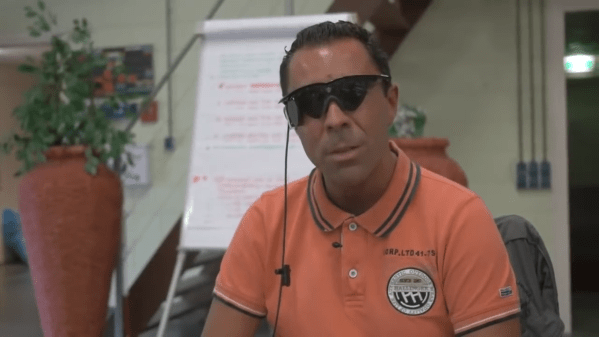
For [Casey’s] build, LEDs were used to produce the required 670 nm red light, installed into ping pong balls that were glued onto a pair of sunglasses. After calculating the right exposure level and blasting light into the eyes regularly each morning, [Casey] plans on running a chromaticity test in the evenings with a custom Python script to measure color perception.

[Casey] shows a proper understanding of the scientific process, and has accounted for the cheap monitor and equipment used in the testing. The expectation is that it should be possible to show a relative positive or negative drift, even if the results may not be directly comparable to industry-grade measures.

We’re eager to see the results of [Casey]’s testing, and might even be tempted to replicate the experiment if it proves successful. We’ve explored some ocular topics in the past too, like the technology that goes into eyeglasses. Video after the break.

Continue reading “DIY Glasses Aim To Improve Color Vision”