Directly Executing Chunks Of Memory: Function Pointers In C

In the first part of this series, we covered the basics of pointers in C, and went on to more complex arrangements and pointer arithmetic in the second part. Both times, we focused solely on pointers representing data in memory.

But data isn’t the only thing residing in memory. All the program code is accessible through either the RAM or some other executable type of memory, giving each function a specific address inside that memory as entry point. Once again, pointers are simply memory addresses, and to fully utilize this similarity, C provides the concept of function pointers. Function pointers provide us with ways to make conditional code execution faster, implement callbacks to make code more modular, and even provide a foothold into the running machine code itself for reverse engineering or exploitation. So read on!

Function Pointers

In general, function pointers aren’t any more mysterious than data pointers: the main difference is that one references variables and the other references functions. If you recall from last time how arrays decay into pointers to their first element, a function equally decays into a pointer to the address of its entry point, with the () operator executing whatever is at that address. As a result, we can declare a function pointer variable fptr and assign a function func() to it: fptr = func;. Calling fptr(); will then resolve to the entry point of function func() and execute it.

Admittedly, the idea of turning a function into a variable may seem strange at first and might require some getting used to, but it gets easier with time and it can be a very useful idiom. The same is true for the function pointer syntax, which can be intimidating and confusing in the beginning. But let’s have a look at that ourselves.

Continue reading “Directly Executing Chunks Of Memory: Function Pointers In C”
Accessing Blockchain On ESP8266 Using The NodeMCU Board

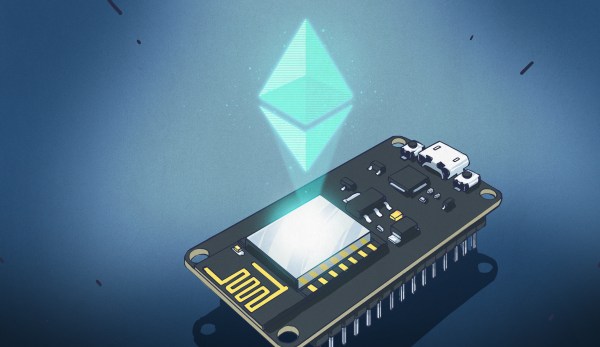
Blockchains claim to be public, distributed, effectively immutable ledgers. Unfortunately, they also tend to get a little bit huge – presently the Bitcoin blockchain is 194GB and Ethereum weighs in at 444GB. That poses quite an inconvenience for me, as I was looking at making some fun ‘Ethereum blockchain aware’ gadgets and that’s several orders of magnitude too much data to deal with on a microcontroller, not to mention the bandwidth cost if using 3G.

Having imagined a thin device that I could integrate into my mobile phone cover (or perhaps… a wallet?) dealing with the whole blockchain was clearly not a possibility. I could use a VPS or router to efficiently download the necessary data and respond to queries, but even that seemed like a lot of overhead, so I investigated available APIs.

As it turns out, several blockchain explorers offer APIs that do what I want. My efforts get an ESP8266 involved with the blockchain began with two of the available APIs: Ethplorer and Etherscan.

Continue reading “Accessing Blockchain On ESP8266 Using The NodeMCU Board”

The Anxiety Of Open Source: Why We Struggle With Putting It Out There

You’ve just finished your project. Well, not finished, but it works and you’ve solved all the problems worth solving, and you have a thing that works for you. Then you think about sharing your creation with the world. “This is cool” you think. “Other people might think it’s cool, too.” So you have to take pictures and video, and you wish you had documented some more of the assembly steps, and you have to do a writeup, and comment your code, and create a repository for it, maybe think about licensing. All of a sudden, the actual project was only the beginning, and now you’re stressing out about all the other things involved in telling other people about your project, because you know from past experience that there are a lot of haters out there who are going to tear it down unless it’s perfect, or even if it is, and even if people like it they are going to ask you for help or to make one for them, and now it’s 7 years later and people are STILL asking you for the source code for some quick little thing you did and threw up on YouTube when you were just out of college, and of course it won’t work anymore because that was on Windows XP when people still used Java.

Take a deep breath. We’ve all been there. This is an article about finding a good solution to sharing your work without dealing with the hassle. If you read the previous paragraph and finished with a heart rate twice what you started, you know the problem. You just want to share something with the world, but you don’t want to support that project for the rest of your life; you want to move on to new and better and more interesting projects. Here are some tips.

Continue reading “The Anxiety Of Open Source: Why We Struggle With Putting It Out There”

Circuit VR: Oscillating Bridges

Circuit VR is where we talk about a circuit and examine how it works in simulation with LT Spice. This time we are looking at a common low-frequency oscillator known as the Wien bridge oscillator.

What makes an oscillator oscillate? A circuit with amplification that gets the same amount of the output signal fed back into its input, in phase, will oscillate. This is the Barkhausen criterion. Here, we’re going to look into what makes an oscillator work in simulation, and gain some insight into what happens when there’s too much feedback and too little.

In particular, we’ll look at the Wien bridge oscillator, a very simple design that originated as a way to measure impedance back in 1891. Modern versions add some additional features, but let’s start with the most simple implementation and work our way up.

Continue reading “Circuit VR: Oscillating Bridges”

Firing Bullets Through Propellers

Early airborne combat was more like a drive-by shooting as pilot used handheld firearms to fire upon other aircraft. Whomever could boost firepower and accuracy would have the upper hand and so machine guns were added to planes. But it certainly wasn’t as simple as just bolting one to the chassis.

This was during World War I which spanned 1914 to 1918 and the controllable airplane had been invented a mere eleven years before. Most airplanes still used wooden frames, fabric-covered wings, and external cable bracing. The engineers became pretty inventive, even finding ways to fire bullets through the path of the wooden propeller blades while somehow not tearing them to splinters.

Continue reading “Firing Bullets Through Propellers”

Émilie Du Châtelet: An Energetic Life

Émilie du Châtelet lived a wild, wild life. She was a brilliant polymath who made important contributions to the Enlightenment, including adding a mathematical statement of conservation of energy into her French translation of Newton’s Principia, debunking the phlogiston theory of fire, and suggesting that what we would call infrared light carried heat.

She had good company; she was Voltaire’s lover and companion for fifteen years, and she built a private research institution out of a château with him before falling in love with a younger poet. She was tutored in math by Maupertuis and corresponded with Bernoulli and Euler. She was an avid gambler and handy with a sword. She died early, at 41 years, but those years that she did live were pretty amazing. Continue reading “Émilie Du Châtelet: An Energetic Life”

What Does ‘Crypto’ Actually Mean?

This article is about crypto. It’s in the title, and the first sentence, yet the topic still remains hidden.

At Hackaday, we are deeply concerned with language. Part of this is the fact that we are a purely text-based publication, yes, but a better reason is right there in the masthead. This is Hackaday, and for more than a decade, we have countered to the notion that ‘hackers’ are only bad actors. We have railed against co-opted language for our entire existence, and our more successful stories are entirely about the use and abuse of language.

Part of this is due to the nature of the Internet. Pedantry is an acceptable substitute for wisdom, it seems, and choosing the right word isn’t just a matter of semantics — it’s a compiler error. The wrong word shuts down all discussion. Use the phrase, ‘fused deposition modeling’ when describing a filament-based 3D printer, and some will inevitably reach for their pitchforks and torches; the correct phrase is, ‘fused filament fabrication’, the term preferred by the RepRap community because it is legally unencumbered by patents. That’s actually a neat tidbit, but the phrase describing a technology is covered by a trademark, and not by a patent.

The technical side of the Internet, or at least the subpopulation concerned about backdoors, 0-days, and commitments to hodl, is now at a semantic crossroads. ‘Crypto’ is starting to mean ‘cryptocurrency’. The netsec and technology-minded populations of the Internet are now deeply concerned over language. Cryptocurrency enthusiasts have usurped the word ‘crypto’, and the folks that were hacking around with DES thirty years ago aren’t happy. A DH key exchange has nothing to do with virtual cats bought with Etherium, and there’s no way anyone losing money to ICO scams could come up with an encryption protocol as elegant as ROT-13.

But language changes. Now, cryptographers are dealing with the same problem hackers had in the 90s, and this time there’s nothing as cool as rollerblading into the Gibson to fall back on. Does ‘crypto’ mean ‘cryptography’, or does ‘crypto’ mean cryptocurrency? If frequency of usage determines the correct definition, a quick perusal of the press releases in my email quickly reveals a winner. It’s cryptocurrency by a mile. However, cryptography has been around much, much longer than cryptocurrency. What’s the right definition of ‘crypto’? Does it mean cryptography, or does it mean cryptocurrency?

Continue reading “What Does ‘Crypto’ Actually Mean?”