Microcontrollers existed before the Arduino, and a device that anyone could program and blink an LED existed before the first Maker Faire. This might come as a surprise to some, but for others PICs and 68HC11s will remain as the first popular microcontrollers, found in everything from toys to microwave ovens.
Arduino can’t even claim its prominence as the first user-friendly microcontroller development board. This title goes to the humble Basic Stamp, a four-component board that was introduced in the early 1990s. I recently managed to get my hands on an original Basic Stamp kit. This is the teardown and introduction to the first user friendly microcontroller development boards. Consider it a walk down memory lane, showing us how far the hobbyist electronics market has come in the past twenty year, and also an insight in how far we have left to go.
It happens with every generation – we’re born, our parents care for us and nurture us, we grow up, they grow old, and then we switch roles and care for them. Soon it’ll be my turn to be the caregiver to my parents, and I recently got a preview of things to come when my mom fell and busted her ankle. That it wasn’t the classic broken hip was a relief, but even “just” a broken ankle was difficult enough to deal with. I live 40 minutes away from the ‘rents, and while that’s not too bad when the visits are just the weekly dinner at Grammy’s, the time and the miles really start to add up when the visits turn into every other day to make sure Mom’s getting around OK and Dad is eating and sleeping.
I was sorely tempted to hack some kind of solution to give myself a rudimentary telepresence, but I couldn’t think of anything that wouldn’t have either been unacceptably intrusive (think webcams) or difficult to support from an IT perspective. Mom’s pretty handy with the iPad and she Skypes with my brother and his family out in California, but beyond leveraging that I was tapped out for ideas that I could easily deploy and would deliver sufficient value beyond the support burden within the time frame of healing the ankle. Consequently, I spent a lot of time in the car this summer.
This experience got me to thinking about how intergenerational caregiving will change with the rise of pervasive technology. The bad news: we’re still going to get old, and getting old sucks. The good news is, I think technology is going to make things easier for caregivers and elders alike. We have an incredible range of technology experiences among the generations present right now, from my parents who can remember phones without dials and nights spent listening to the radio, to my daughter’s generation that is practically growing up with supercomputers in the palms of their hands. How each generation ages and how it embraces technology as a solution for age-related problems are going to be vastly different.
There is a lot to be said for replacing certain kinds of jobs with robots. Most people would agree that replacing physical human labor with automation is a good thing. It’s especially good to automate the dangerous kinds of labor like some facets of factory work. What about automation in fields that require more mental labor, where physical strain isn’t the concern? Is replacing humans really the best course of action? A year ago, a video called Humans Need Not Applyset forth an explanation of how robots will inevitably replace us. But that narrative is a tough sell.
Whether it is even possible depends on the job being automated. It also depends on how far we are able to take technology, and the amount of labor we are willing to offload. Automation has been replacing human workers in assembly and manufacturing industries for years. Even with equipment and upkeep expenses, the tireless nature of robotic workers means dramatically lower overhead for businesses.
Many of the current forms of factory automation are rather dumb. When something goes wrong and their task is compromised, they keep chugging away. That costs time and money. But there are companies out there producing robots that are better on many levels.
May Your Robot Overlords Be Cute and Cuddly
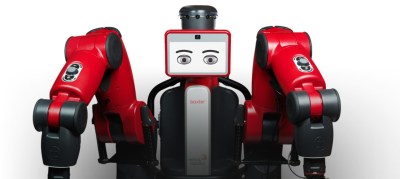
In 2013, Rethink Robotics started filling orders for a new line called Baxter. They are a class of general purpose robot that can be programmed to do many kinds of manual tasks. Baxter bots have vision, and they can learn how to do a job simply by watching. They don’t need to be programmed in the traditional sense.
Baxter even has a face – a screen that shows different expressions depending on his state. When he’s in the midst of a task, his eyes are cast downward. If something goes wrong, he stops what he’s doing. His cartoon face appears sort of shocked, then sad. He goes into safe mode and waits to be fixed.
I have always laughed at people who keep multitools–those modern Swiss army knives–in their toolbox. To me, the whole premise of a multitool is that they keep me from going to the toolbox. If I’ve got time to go to the garage, I’m going to get the right tool for the job.
Not that I don’t like a good multitool. They are expedient and great to get a job done. That’s kind of the way I feel about axasm — a universal assembler I’ve been hacking together. To call it a cross assembler hack doesn’t do it justice. It is a huge and ugly hack, but it does get the job done. If I needed something serious, I’d go to the tool box and get a real assembler, but sometimes you just want to use what’s in your pocket.
Not long after [Hitler] took control of Germany, his party passed laws forbidding any persons of Jewish descent from holding academic positions in German Universities. This had the effect of running many of the world’s smartest people out of the country, including [Albert Einstein]. Einstein settled into his new home in Princeton, and began to seek out bright young mathematicians to work with, for he still had a bone to pick with [Niels Bohr] and his quantum theory. It wasn’t long until he ran into an American, [Nathan Rosen] and a Russian, [Boris Podolsky]. The trio would soon lay before the world a direct challenge that would strike at the very core of quantum theory’s definition of reality. And unlike the previous challenges, this one would not be so easily dismissed by [Bohr].
Need a bit of catching up? You can check out Complimentarity as well as Tunneling and Transistors but that is just some optional background for wrapping your head around Quantum Computing.
The EPR Argument
On May 4th, 1935, the New York Times published an article entitled “Einstein Attacks Quantum Theory”, which gave a non technical summary of the [Einstein-Podolsky-Rosen] paper. We shall do something similar.
By the turn of the 19th century, most scientists were convinced that the natural world was composed of atoms. [Einstein’s] 1905 paper on Brownian motion, which links the behavior of tiny particles suspended in a liquid to the movement of atoms put the nail in the coffin of the anti-atom crowd. No one could actually see atoms, however. The typical size of a single atom ranges from 30 to 300 picometers. With the wavelength of visible light coming in at a whopping 400 – 700 nanometers, it is simply not possible to “see” an atom. Not possible with visible light, that is. It was the summer of 1982 when Gerd Binnig and Heinrich Rohrer, two researchers at IBM’s Zurich Research Laboratory, show to the world the first ever visual image of an atomic structure. They would be awarded the Nobel prize in physics for their invention in 1986.
The Scanning Tunneling Microscope
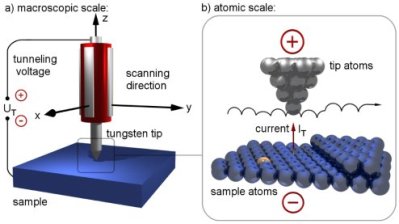
IBM’s Scanning Tunneling Microscope, or STM for short, uses an atomically sharp needle that passes over the surface of an (electrically conductive) object – the distance between the tip and object being just a few hundred picometers, or the diameter of a large atom.
[Image Source]A small voltage is applied between the needle and the object. Electrons ‘move’ from the object to the needle tip. The needle scans the object, much like a CRT screen is scanned. A current from the object to the needed is measured. The tip of the needle is moved up and down so that this current value does not change, thus allowing the needle to perfectly contour the object as it scans. If one makes a visual image of the current values after the scan is complete, individual atoms become recognizable. Some of this might sound familiar, as we’ve seen a handful of people make electron microscopes from scratch. What we’re going to focus on in this article is how these electrons ‘move’ from the object to the needle. Unless you’re well versed in quantum mechanics, the answer might just leave your jaw in the same position as this image will from a home built STM machine.
While the official title of the 5th Solvay conference was “on Electrons and Photons”, it was abundantly clear amongst the guests that the presentations would center on the new theory of quantum mechanics. [Planck], [Einstein], [Bohr], [de Broglie], [Schrodinger], [Heisenberg] and many other giants of the time would be in attendance. Just a month earlier, [Niels Bohr] had revealed his idea of complementarity to fellow physicists at the Instituto Carducci, which lay just off the shores of Lake Como in Italy.
The theory suggested that subatomic particles and waves are actually two sides of a single ‘quantum’ coin. Whichever properties it would take on, be it wave or particle, would be dependent upon what the curious scientist was looking for. And asking what that “wave/particle” object is while not looking for it is meaningless. Not surprisingly, the theory was greeted with mixed reception by those who were there, but most were distracted by the bigwig who was not there – [Albert Einstein]. He couldn’t make it due to illness, but all were eager to hear his thoughts on [Bohr’s] somewhat radical theory. After all, it was he who introduced the particle nature of light in his 1905 paper on the photoelectric effect, revealing light could be thought of as particles called photons. [Bohr’s] theory reconciled [Einstein’s] photoelectric effect theory with the classical understanding of the wave nature of light. One would think he would be thrilled with it. [Einstein], however, would have no part of [Bohr’s] theory, and would spend the rest of his life trying to disprove it.
Complementarity – Wave , Particle or both?
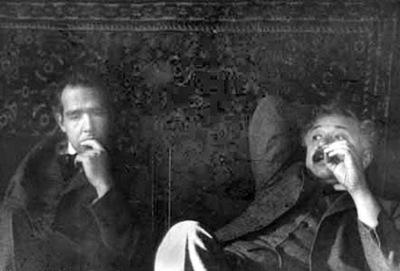
[Niels Bohr] contemplates one of [Einstein’s] many challenges to quantum theory.For more than a century it was thought that light was a wave. In 1801, [Thomas Young] had discovered interference patterns when shining a light through two very close slits. Interference is a well known property of waves. This combined with [Maxwell’s] equations, which predicted the existence of electromagnetic radiation put little doubt into anyone’s mind that light was nothing more, or less, than a wave. There was a very odd issue, however, that puzzled physicists during the 18th century. When shining light upon a metallic surface, electrons would be ejected from that surface. Increasing the intensity of the light did not translate to an increase in speed of the expelled electrons, like classical mechanics says it should. Increasing the frequency of the light did increase the speed. The explanation of this phenomenon could not be had until 1900, when [Max Planck] realized that physical action could not be continuous, but must be a multiple of some small quantity. This quantity would lead to the “quantum of action”, which is now called [Planck’s] constant and birthed quantum physics. It would have been impossible for him to know that this simple idea, in less than two decades, would lead to a change in understanding of the nature of reality. It only took Einstein, however, a few years to use [Planck’s] quantum of action to explain that mind-boggling issue of electrons releasing from metal via light and not following classical law with the incredibly complex equation:
E = hv
Where E is the energy of the light quanta, h is Planck’s constant and v is the frequency of the light. The most important item to consider here is this light quanta, later to be called a photon. It is treated as a particle. Now, if you’re not scratching your head in confusion right about now, you haven’t been paying attention. How can light be a wave and a particle? Join me after the jump and we’ll travel further down this physics rabbit hole.




 In 2013,