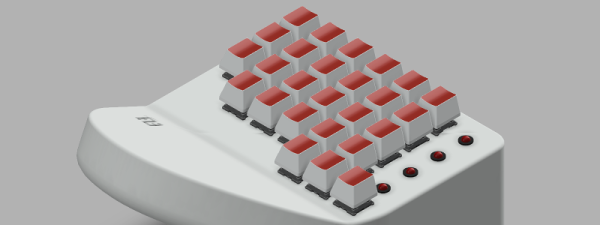
A keyboard is the most important tool in the modern desk jockey’s arsenal but, despite this fact, millions of people suffer the $10 membrane keyboards that shipped with the computer they got a decade ago. It’s a terrible way to live your life, but for those of us who are enlightened, there’s another way: mechanical keyboards. [Mário] over at the Bit Bang Theory just built his own mechanical keyboard with his own homebrew firmware and a few interesting features that aren’t found in other open hardware keyboard projects.
The ‘from scratch’ aspect of this build is somewhat of a misnomer; the key switches used in this build were taken from a Monterey K108, and the key caps were taken from a keyboard with a Portuguese layout. Once the switches were in place and soldered up, it was time for the electronics.
While most homebrew keyboards these days use a Teensy 2 thanks to some amazing firmware and development tools that have grown up around this device, there’s not a Teensy to be found inside this keyboard. The keyboard controller is built around a PIC18F4550 and uses the USB available on the chip. Naturally, there are more than a few WS2812b RGB LEDs around the edge of the keyboard that “breathe”, run a KITT-style LED chaser, or simply display a single chosen color.
There are a few neat features in this keyboard controller that aren’t readily available with other open source keyboard firmwares. There’s a keylogger, macro recorder, and a toggle macro that will activate or deactivate a (secret) internal 8GB USB storage key. Settings are saved in the internal EEPROM.
It’s a great looking build, and something we don’t see enough of around here. In any event, it’s just one step further towards eliminating the menace of cheap keyboards, and something we hope to see more of soon.


From what we can see, the box has two potentiometer sliders, two touch-sensitive potentiometers, two force sensitive resistors, a slew of knobs, and a whole bunch of (capacitive?) touch points. In short, a ton of continuous controllers of all sizes and shapes in an aesthetic case. But stealing the show, and giving the device its name, are two platters from old hard drives that serve as jog wheels.

your son has a Minecraft addiction. [Jim], however, is no stranger to the hacker community and began working on a solution. He broke out the #2 Philips screwdriver, fired up the soldering iron and 
He used the frame, disk and motor from a drive and added LEDs under the spinning disk as the light source. The disk has 8 small holes drilled equidistant around the disk, and spiraling slightly toward the center. As the holes pass by the LEDS they are flashed by the ATtiny2313 processor to create images. To determine the position of the platters a Hall effect sensor is monitored by the 2313 to detect a magnet on the underside of the disk. There is room to display ten characters at one time. Each cursor position can scroll through the character set by rotating an encoder. For all the precision needed to coordinate the LEDs with the spinning holes the electronics and software code are amazingly simple. That’s a really nice job, [Adam]!