Even simple robots used to require quite a bit of effort to pull together. This example shows how far we’ve come with the tools and techniques that make things move and interact. It’s a 3D printed rover controlled by the touchscreen on your phone. This achieves the most basic building block of wheeled robotics, and the process is easy on you and your pocketbook.
We just can’t stop loving the projects [Greg Zumwalt], aka[gzumwalt], is turning out. We just saw his air-powered airplane engine and now this little rover perks our ears up. The design uses the familiar trick of two powered wheels with a ball bearing to avoid problems with differential turning. But the simplicity is all in the implementation.
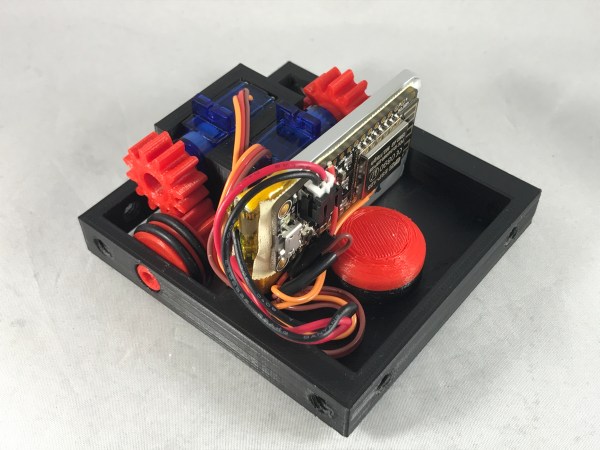
This bot is 3D printed using eight very simple pieces: four gears, two axles, a cap and a single tray to mount everything. The cap captures the ball bearing which pokes out a hole in the bottom of the tray to form an omnidirectional wheel. Two 9G servos modified for continuous rotation. The mating teeth of the gears are found on the wheel sections which have grooves for neoprene O-rings to provide traction. The entire thing is driven by an ESP8266 in the form of an Adafruit Feather Huzzah. This is programmed using the Arduino IDE and your phone can connect directly or through a WiFi router.
We’re not crazy, right? Robots didn’t used to be this easy to pull together? This goes for the power of 3D printing versus traditional basement fabrication methods, but in the availability of powerful yet inexpensive embedded systems and the available tools and libraries to program them. Kudos to you [Greg] for showing us how great the currently available building blocks are in the hands of anyone who wants to channel their engineering creativity. He certainly has… this chassis ultimately powers Santa’s sleigh.
Need a bigger printing challenge? Here’s a 3D printed rover that goes all-in with the suspension system.
Continue reading “Remember When Scratch-Built Robots Were Hard?”