Anything can be a remote controlled airplane, and ‘copters – quad or not – simply beat the air into submission. Remote controlled cars are easy, and RC tanks can even shoot their guns. One type of vehicle has eluded remote control hobbyists to a large extent; building a remote control submarine is hard. Not only do you have buoyancy to worry about, but you also need a way to keep the dry parts dry, all while operating in an environment where radio doesn’t really work well.
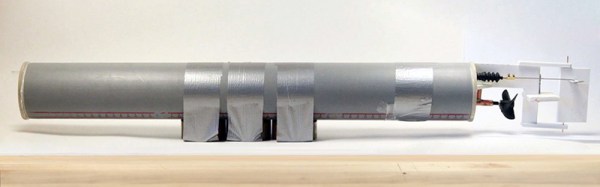
[Ivan] has already built RC planes, but wanted to tackle a new challenge. He built an RC submarine, and he did it using the simplest household materials.
Nadya Peek is one of the hackers that should require no introduction for the regular Hackaday reader. She is a postdoc at the Center for Bits and Atoms at the MIT Media Lab. She’s responsible for Popfab, a CNC machine that fits in a suitcase and one of the first implementations of a Core XY stage we’ve seen. Nadya has joined the ranks of Rudolf Diesel, Nikola Tesla, Mikhail Kalashnikov, and George W.G. Ferris by having a very tiny piece of the Novena laptop bear her name. She’s built cardboard CNC machines, and taken the idea of simple, easy to build printers, routers, and drawbots worldwide. She just defended her thesis, the gist of which is, ‘How to rapidly prototype rapid prototyping machines.’ She’s also one of this year’s Hackaday Prize judges, for which we have the utmost appreciation.
This year, the organizers of the Fab 12 conference on digital fabrication in Shenzhen turned to Nadya and her team to bring their amazing experience to conference attendees. A workshop was in order, but Nadya didn’t have time to organize the logistics. The conference organizers made a deal: the Center for Bits and Atoms would teach a workshop, but getting all the materials and electronics was the responsibility of the organizers.
Upon arriving at the Shenzhen Sheridan, Nadya found the organizers didn’t hold up their end of the bargain. The cardboard, motors, electronics, and glue were nowhere to be found. A “rider” doesn’t quite translate from English, it seems. This is Shenzhen, though, where you can buy all the cardboard, motors, electronics, and iPhone clones you could imagine. What was the solution to this problem? Founding a company in Shenzhen for eight days.
Half a tourist’s guide to Shenzhen and half a deconstruction of what goes into cardboard CNC, Nadya’s talk for the 2016 Hackaday SuperConference covers what happens when you have a week to build a company that will build machines that build machines.
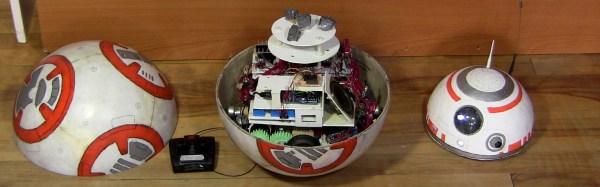
Imagine trying to make a ball-shaped robot that rolls in any direction but with a head that stays on. When I saw the BB-8 droid doing just that in the first Star Wars: The Force Awakens trailer, it was an interesting engineering challenge that I couldn’t resist. All the details for how I made it would fill a book, so here are the highlights: the problems I ran into, how I solved them and what I learned.
The HTC Vive’s Lighthouse localization system is one of the cleverest things we’ve seen in a while. It uses a synchronization flash followed by a swept beam to tell any device that can see the lights exactly where it is in space. Of course, the device has to understand the signals to figure it out.
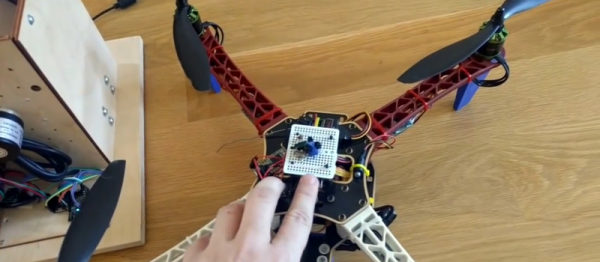
[Alex Shtuchkin] built a very well documented device that can use these signals to localize itself in your room. For now, the Lighthouse stations are still fairly expensive, but the per-device hardware requirements are quite reasonable. [Alex] has the costs down around ten dollars plus the cost of a microcontroller if your project doesn’t already include one. Indeed, his proof-of-concept is basically a breadboard, three photodiodes, op-amps, and some code.
His demo is awesome! Check it out in the video below. He uses it to teach a quadcopter to land itself back on a charging platform, and it’s able to get there with what looks like a few centimeters of play in any direction — more than good enough to land in the 3D-printed plastic landing thingy. That fixture has a rotating drum that swaps out the battery automatically, readying the drone for another flight.
If this is just the tip of the iceberg of upcoming Lighthouse hacks, we can’t wait!
Imagine. There you are, comfortable in your lounge pants. Lounging in your lounge. Suddenly in the distance you hear a buzzing. Quiet at first, then louder. A light bulb goes on in your head.
You forgotten that you’d scheduled an Amazon drone repair service in partnership with The Home Depot and Dewalt. They break through the window, spraying you with shards. They paint the spots on the walls. Snap photos of the brands in your closet. Change the light bulbs. Place a bandaid on your glass wounds. Pick up the shards and leave. Repairing it on their way out.
Horrible.
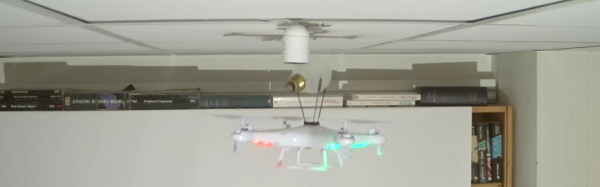
Of course the first step before this dark future comes to be is to see if it can be done; which is what [Marek Baczynski] and a friend accomplished many broken light bulbs later. Using an off the shelf drone with three springy prongs glued to the top they try time and time again to both unscrew and screw in a light bulb. They try at first with a lighter drone, but eventually switch to a more robust model.
After a while they finally manage it, so it’s possible. Next step, automate. Video after the break.
There are many kits available to today’s hobbyists who wish to try their hand at producing simple computer-controlled robots. Small concoctions of servos and laser-cut acrylic, to which boards such as the Arduino, Raspberry Pi, or Beaglebone can easily be fitted.
In the 1980s though this was a market that was yet to be adequately served. The sheer size of the many 8-bit machines of the day meant they could not be incorporated in your robot, and interfacing to them was a bit more challenging than the easy-to-use GPIOs of their modern counterparts. Then the mechanical hardware of a small robot was something that had not been easily and cheaply packaged for the constructor, making building a physical robotic platform a significant task in itself.
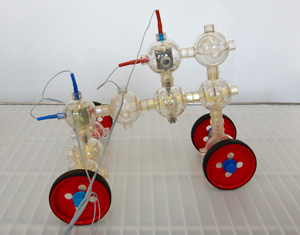
[Charlie] is a robot based on the Capsela construction system, a toy consisting of interlocking plastic spheres containing different functions of shafts, gears, and motors. There was a Robotic Workshop kit for Capsella that featured a Commodore 64 interface, and it is through this means that [Charlie]’s three motors are controlled. It includes a ROM that extends Commodore BASIC with extra commands, which allow the robot to be easily controlled.
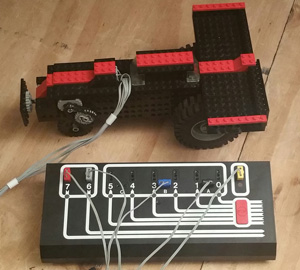
Artie the robot, with Dacta box in foreground
Meanwhile [Artie] is a Lego robot, using the Dacta TC Logo, a kit sold for the educational market and available at the time with interfaces for the PC and the Apple II. They had a Dacta control box but not the Apple II card to go with it, so had to make do with a functional replica built on a prototyping card. As the name suggests, this was programmed using Logo, and came with the appropriate interpreter software.
Both robots are reported to have been a success in terms of working in the first place, then demonstrating the 1980s technology and providing entertainment and engagement with the faire’s visitors.
We have covered numerous Lego robots over the years, as a search of our site will confirm. But this is only the second time we’ve featured a Capsela project, the first being this Arduino rover from 2011. [Mike] mused why we don’t see Capsela more often, and the same sentiment is true today. Do you have a Capsela set gathering dust somewhere that could make a robotic project?
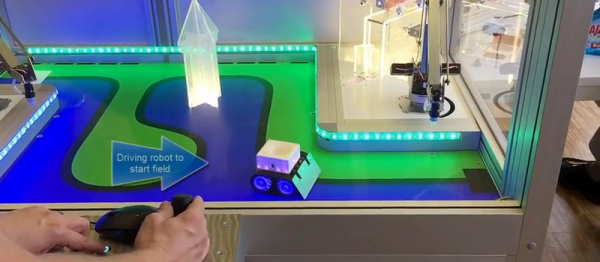
How do you get teenagers interested in science, technology, and engineering? [Erich]’s team at the Lucerne University of Applied Sciences makes them operate three robots to get a gumball. The entire demonstration was whipped together in a few days, and has been field-repaired at least once; a green-wire fix was a little heavy on the solder and would short out to a neighboring trace when mechanical force was applied.