Injection-Molded Glass Breakthrough Shatters Ceiling Of Work Methods

Glass is one of humanity’s oldest materials, and it is still used widely for everything from drinking vessels and packaging to optics and communications. Unfortunately, the methods for working with glass are stuck in the past. Most methods require a lot of high heat in the range of 1500 °C to 2000 °C, and they’re all limited in the complexity of shapes that can be made.

As far as making shapes goes, glass can be blown and molten glass pressed into molds. Glass can also be ground, etched, or cast in a kiln. Glass would be fantastic for many applications if it weren’t for the whole limited geometry thing. Because of the limitations of forming glass, some optic lenses are made with polymers, even though glass has better optical characteristics.

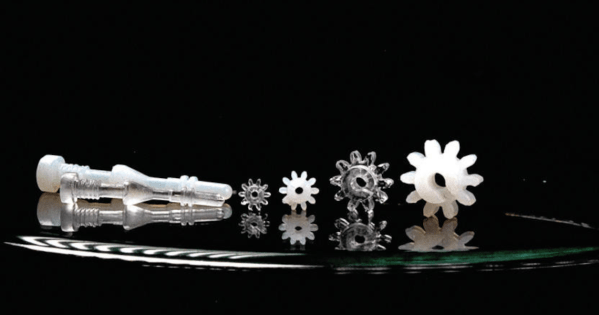
Ideally, glass could be injection molded like plastic. The benefits of this would be twofold: more intricate shapes would be possible, and they would have a much faster manufacturing time. Well, the wait is over. Researchers at Germany’s University of Freiburg have figured out a way to apply injection molding to glass. And it’s not just any glass — they’ve made highly-quality, transparent fused quartz glass, and they did it at lower temperatures than traditional methods. The team used x-ray diffraction to verify that the glass is amorphous and free of crystals, and were able to confirm its optical transparency three ways — light microscopy, UV-visible, and infrared measurements. All it revealed was a tiny bit of dust, which is to be expected outside of a clean room.

Continue reading “Injection-Molded Glass Breakthrough Shatters Ceiling Of Work Methods”

Historical Hackers: Ctesibius Tells Time

People are obsessed with the time and the weather. We’ve talked about the weather since we were all cave dwellers hunting with spears. But the time is a different matter. Sure, people always had the idea of the passage of time. The sun rising and setting gives a natural sense of days, but daylight and dark periods vary by the time of year and to get an accurate and linear representation of time turns out to be rather difficult. That is unless you are a Greek engineer living in Alexandria around 250 BC.

Legend has it that and engineer working in his father’s barbershop led him to discover not only the first working clock, but also the pipe organ, launching the field of pneumatics in the process. That engineer was named Ctesibius and while his story is mostly forgotten, it shows he has a place as a historical hacker.

You might think there were timekeeping devices before 250 BC, and that’s sort of true. However, the devices before Ctesibius had many limitations. For example, a sundial can tell time, but only if the sun is shining. At night or during a storm it is worthless.

Continue reading “Historical Hackers: Ctesibius Tells Time”

What Is Ultra Wideband?

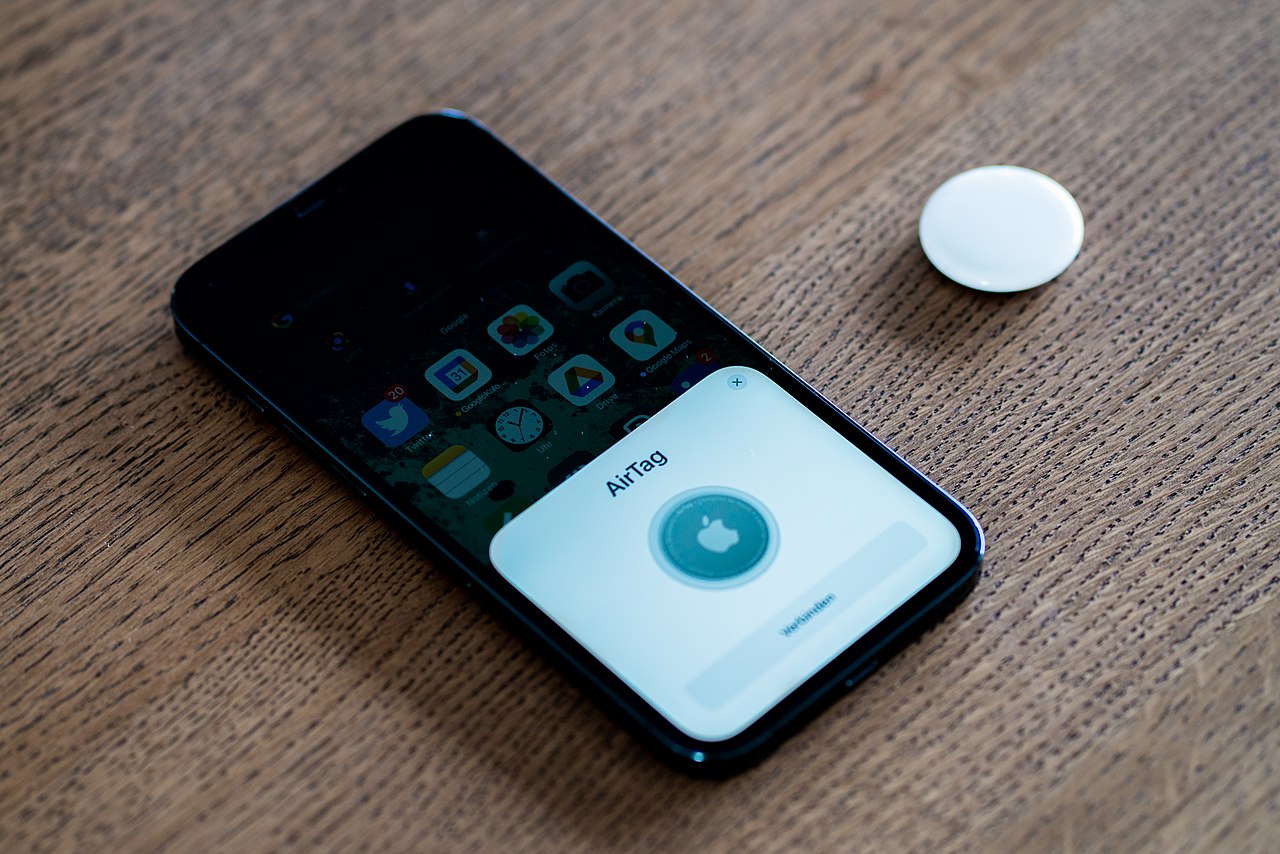
If you’ve been following the world of mobile phone technology of late, you may be aware that Apple’s latest IPhones and AirTag locator tags bring something new to that platform. Ultra wideband radios are the new hotness when it comes to cellphones, so just what are they and what’s in it for those of us who experiment with these things?

An Apple AirTag being paired with an iPhone. Swisshashtag, CC BY-SA 4.0.

Ultra wideband in this context refers to radio signals with a very high bandwidth of over 500 MHz, and a very low overall power density spread over that  spectrum. Transmissions are encoded not by modulation of discrete-frequency carriers as they would be in a conventional radio system, but by the emission of wideband pulses of RF energy across that bandwidth.  It can exist across the same unlicensed spectrum as narrower bandwidth channelised services, and that huge bandwidth gives it an extremely high short-range data transfer bandwidth capability. The chipsets used by consumer devices use a range of UWB channels between about 3.5 and 6.5 GHz, which in radio terms is an immense quantity of spectrum. Continue reading “What Is Ultra Wideband?”

Linux Fu: Databases Are Next-Level File Systems

It is funny how exotic computer technology eventually either fails or becomes commonplace. At one time, having more than one user on a computer at once was high tech, for example. Then there are things that didn’t catch on widely like vector display or content-addressable memory. The use of mass storage — especially disk drives — in computers, though has become very widespread. But at one time it was an exotic technique and wasn’t nearly as simple as it is today.

However, I’m surprised that the filesystem as we know it hasn’t changed much over the years. Sure, compared to, say, the 1960s we have a lot better functionality. And we have lots of improvements surrounding speed, encoding, encryption, compression, and so on. But the fundamental nature of how we store and access files in computer programs is stagnant. But it doesn’t have to be. We know of better ways to organize data, but for some reason, most of us don’t use them in our programs. Turns out, though, it is reasonably simple and I’m going to show you how with a toy application that might be the start of a database for the electronic components in my lab.

You could store a database like this in a comma-delimited file or using something like JSON. But I’m going to use a full-featured SQLite database to avoid having a heavy-weight database server and all the pain that entails. Is it going to replace the database behind the airline reservation system? No. But will it work for most of what you are likely to do? You bet. Continue reading “Linux Fu: Databases Are Next-Level File Systems”

ISS Artificial Gravity Study Shows Promise For Long Duration Spaceflight

The International Space Station is humanity’s most expensive gym membership.

Since the earliest days of human spaceflight, it’s been understood that longer trips away from Earth’s gravity can have a detrimental effect on an astronaut’s body. Floating weightless invariably leads to significantly reduced muscle mass in the same way that a patient’s muscles can atrophy if they spend too much time laying in bed. With no gravity to constantly fight against, an astronauts legs, back, and neck muscles will weaken from disuse in as little as a week. While this may not pose an immediate problem during spaceflight, astronauts landing back on Earth in this physically diminished state are at a higher risk of injury.

Luckily this problem can be largely mitigated with rigorous exercise, and any orbiting vessel spacious enough to hold human occupants for weeks or months will by necessity have enough internal volume to outfit it with basic exercise equipment such as a treadmill or a resistance machine. In practice, every space station since the Soviet Union’s Salyut 1 in 1971 has featured some way for its occupants to workout while in orbit. It’s no replacement for being on Earth, as astronauts still return home weaker than when they left, but it’s proven to be the most practical approach to combating the debilitating aspects of long duration spaceflight.

Early NASA concept for creating artificial gravity.

Of course, there’s an obvious problem with this: every hour spent exercising in space is an hour that could be better spent doing research or performing maintenance on the spacecraft. Given the incredible cost of not just putting a human into orbit, but keeping them there long-term, time is very literally money. Which brings us back to my original point: astronauts spending two or more hours each day on the International Space Station’s various pieces of exercise equipment just to stave off muscle loss make it the world’s most expensive gym membership.

The ideal solution, it’s been argued, is to design future spacecraft with the ability to impart some degree of artificial gravity on its passengers through centripetal force. The technique is simple enough: just rotate the craft along its axis and the crew will “stick” to the inside of the hull. Unfortunately, simulating Earth-like gravity in this way would require the vessel to either be far larger than anything humanity has ever launched into space, or rotate at a dangerously high speed. That’s a lot of risk to take on for what’s ultimately just a theory.

But a recent paper from the University of Tsukuba in Japan may represent the first real steps towards the development of practical artificial gravity systems aboard crewed spacecraft. While their study focused on mice rather than humans, the results should go a long way to codifying what until now was largely the stuff of science fiction.

Continue reading “ISS Artificial Gravity Study Shows Promise For Long Duration Spaceflight”

Intel’s ATX12VO Standard: A Study In Increasing Computer Power Supply Efficiency

The venerable ATX standard was developed in 1995 by Intel, as an attempt to standardize what had until then been a PC ecosystem formed around the IBM AT PC’s legacy. The preceding AT form factor was not so much a standard as it was the copying of the IBM AT’s approximate mainboard and with it all of its flaws.

With the ATX standard also came the ATX power supply (PSU), the standard for which defines the standard voltage rails and the function of each additional feature, such as soft power on (PS_ON).  As with all electrical appliances and gadgets during the 1990s and beyond, the ATX PSUs became the subject of power efficiency regulations, which would also lead to the 80+ certification program in 2004.

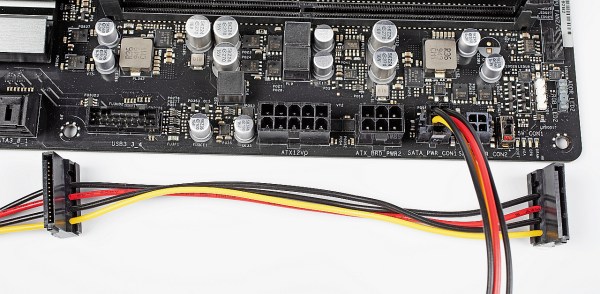
Starting in 2019, Intel has been promoting the ATX12VO (12 V only) standard for new systems, but what is this new standard about, and will switching everything to 12 V really be worth any power savings? Continue reading “Intel’s ATX12VO Standard: A Study In Increasing Computer Power Supply Efficiency”

Electric Vehicles Could Be The Grid Storage Solution We’ve Been Dreaming Of

As nation states grapple with the spectre of environmental and economic losses due to climate change, we’ve seen an ever greater push towards renewable energy sources to replace heavier polluters like coal and natural gas. One key drawback of these sources has always been their intermittent availability, spurring interest in energy storage technologies that can operate at the grid level.

With the rise in distributed energy generation with options like home solar power, there’s been similar interest in the idea of distributed home battery storage. However, homeowners can be reluctant to make investments in expensive batteries that take years to pay themselves off in energy savings. But what if they had a giant battery already, just sitting outside in the driveway? Could electric vehicles become a useful source of grid power storage? As it turns out, Ford wants to make their electric trucks double as grid storage batteries for your home.

Continue reading “Electric Vehicles Could Be The Grid Storage Solution We’ve Been Dreaming Of”