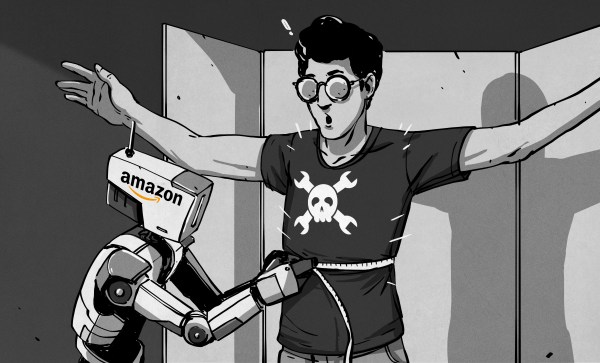
Amazon’s Custom T-Shirt May Rub You The Wrong Way

How far would you go in pursuit of the perfect black t-shirt? Would you let Amazon build a virtual double of your body? They already know so much about you, so what’s a body scan or two between customer and company?

So here’s the deal — Amazon is trying to launch a brand of bespoke clothing called Made for You, and they’re starting with custom solid color t-shirts. Here’s how it works: you give them $25 along with information about your height, weight, and skin tone. Then you upload two pictures of your torso to their app, and these get turned into a 3D model of your body. Once your avatar is built to match, you design your shirt to fit the model. In theory, you get a really good idea of how it will fit.

You can choose from two different fabrics and eight colors, and can customize the neckline, the shirt length, and the sleeve length. If you want to, you can put your name on the tag. Then your perfect t-shirt gets made in the US from imported fabric — either lightweight or medium weight pima cotton. We’re not sure if robots or people are making them, but our money is on people. After all, Amazon is the company that created Mechanical Turk to form a pool of humans available to do on-demand work via the Internet. This is along those lines but with tailors sewing to your specifications. The big questions are what do you get, how does the technology make these better than off-the-rack, and do you give up your privacy in return?

One-Size Fits One

To say that these are custom t-shirts is a bit of a stretch. Oh you don’t need to worry about the t-shirts being skin-tight and showcasing your spare tire — if it’s a relaxed fit you want, that’s one of the options. But the current options are limited.

Continue reading “Amazon’s Custom T-Shirt May Rub You The Wrong Way”

Solar Flares And Radio Communications — How Precarious Are Our Electronics?

On November 8th, 2020 the Sun exploded. Well, that’s a bit dramatic (it explodes a lot) — but a particularly large sunspot named AR2781 produced a C5-class solar flare which is a medium-sized explosion even for the Sun. Flares range from A, B, C, M, and X with a zero to nine scale in each category (or even higher for giant X flares). So a C5 is just about dead center of the scale. You might not have noticed, but if you lived in Australia or around the Indian Ocean and you were using radio frequencies below 10 MHz, you would have noticed since the flare caused a 20-minute-long radio blackout at those frequencies.

According to NOAA’s Space Weather Prediction Center, the sunspot has the energy to produce M-class flares which are an order of magnitude more powerful. NOAA also has a scale for radio disruptions ranging from R1 (an M1 flare) to R5 (an X20 flare). The sunspot in question is facing Earth for the moment, so any new flares will cause more problems. That led us to ask ourselves: What if there were a major radio disruption?

Continue reading “Solar Flares And Radio Communications — How Precarious Are Our Electronics?”

2020: As The Hardware World Turns

By pretty much any metric you care to use, 2020 has been an unforgettable year. Usually that would be a positive thing, but this time around it’s a bit more complicated. The global pandemic, unprecedented in modern times, impacted the way we work, learn, and gather. Some will look back on their time in lockdown as productive, if a bit lonely. Other’s have had their entire way of life uprooted, with no indication as to when or if things will ever return to normal. Whatever “normal” is at this point.

But even in the face of such adversity, there have been bright spots for our community. With traditional gatherings out of the question, many long-running tech conferences moved over to a virtual format that allowed a larger and more diverse array of presenters and attendees than would have been possible in the past. We also saw hackers and makers all over the planet devote their skills and tools to the production of personal protective equipment (PPE). In a turn of events few could have predicted, the 2020 COVID-19 pandemic helped demonstrate the validity of hyperlocal manufacturing in a way that’s never happened before.

For better or for worse, most of us will associate 2020 with COVID-19 for the rest of our lives. Really, how could we not? But over these last twelve months we’ve borne witness to plenty of stories that are just as deserving of a spot in our collective memories. As we approach the twilight hours of this most ponderous year, let’s take a look back at some of the most interesting themes that touched our little corner of the tech world this year.

Continue reading “2020: As The Hardware World Turns”

The High-Tech Valor Glass Vials Used To Deliver The Coronavirus Vaccine

As the world waits for COVID-19 vaccines, some pharmaceutical companies stand armed and ready with an exciting improvement: better vials to hold the doses. Vials haven’t changed much in the last 100 years, but in 2011, Corning decided to do something about that. They started developing an alternative glass that is able to resist damage and prevent cracks. It’s called Valor glass, and it’s amazingly strong stuff. Think Gorilla glass for the medical industry.

Traditionally, pharmaceutical vials have been made from borosilicate glass, which is the same laboratory-safe material as Corning’s Pyrex. Borosilicate glass gets its strength from the addition of boron. Although borosilicate glass is pretty tough, it comes with some issues. Any type of glass is only as strong as its flaws, and borosilicate glasses are prone to some particularly strength-limiting flaws. Pharmaceutical glass must stand up to extreme temperatures, from the high heat of the vial-making process to the bitterly cold freeze-drying process and storing temperature required by the fragile viral RNA of some COVID-19 vaccines. Let’s take a look at how Valor glass vials tackle these challenges.

Continue reading “The High-Tech Valor Glass Vials Used To Deliver The Coronavirus Vaccine”

The Mouth-Watering World Of NIST Standard Foods

The National Institute Of Standards and Technology was founded on March 3, 1901 as the National Bureau of Standards, taking on its current moniker in 1988. The organisation is charged by the government with ensuring the uniformity of weights and measures across the United States, and generally helping out industry, academia and other users wherever some kind of overarching standard is required.

One of the primary jobs of NIST is the production and sale of Standard Reference Materials, or SRMs. These cover a huge variety of applications, from steel samples to concrete and geological materials like clay. However, there are also edible SRMS, too. Yes, you can purchase yourself a jar of NIST Standard Peanut Butter, though you might find the price uncompetitive with the varieties at your local supermarket. Let’s dive into why these “standard” foods exist, and see what’s available from the shelves of our favourite national standards institute. Continue reading “The Mouth-Watering World Of NIST Standard Foods”

New Part Day: Hackboard 2, An X86 Single-Board Computer

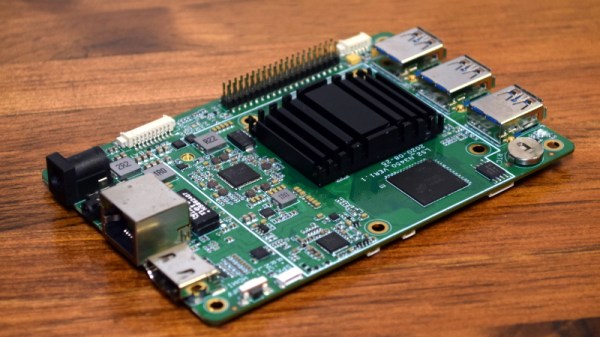
From the old Gumstix boards to everyone’s favorite Raspberry Pi, common single-board computers (SBCs) have traditionally had at least one thing in common: an ARM processor. But that’s not to say hackers and makers haven’t been interested in an SBC with a proper x86 processor. Which is why the $99 Hackboard 2 is so exciting. With a modern x86 chip at the core it’s akin to a small footprint desktop motherboard, but with all the extra features that we’ve come to expect in a hacker-friendly SBC.

So what’s the big deal? In a word, compatibility. The fact that these diminutive computing devices shied away from the x86 architecture that most of us have been using on our desktops and laptops since the 1980s originally introduced software compatibility issues, but this was largely outweighed by the advantages of ARM. The latest NVIDIA Jetson is running on an ARM chip for the same reason the smartphone in your pocket is: they’re smaller, cheaper, and more energy efficient than x86.

However they’re rarely more powerful. Even the latest and greatest Raspberry Pi 4, often touted as a viable desktop replacement thanks to its quad core Cortex-A72, will get absolutely trounced by the pokiest of Intel’s Celeron CPUs. The performance gap is just too great. While the Pi can admirably handle most of the tasks the hacker community asks of it, there will always be a call for a board that puts raw processing power before anything else.

Sucking down nearly 40 watts at full tilt, the Hackboard 2 isn’t the SBC you’d want to use for a solar powered weather station. But if you’re putting together a set top box to play back video and run the occasional emulator, its Celeron N4020 processor and Intel UHD 600 GPU represent the most powerful combination available for a device of this size.

Continue reading “New Part Day: Hackboard 2, An X86 Single-Board Computer”

Uber Traded Away Its In-House Self-Driving Effort

Perhaps the best-known ridesharing service, Uber has grown rapidly over the last decade. Since its founding in 2009, it has expanded into markets around the globe, and entered the world of food delivery and even helicopter transport.

One of the main headline research areas for the company was the development of autonomous cars, which would revolutionize the company’s business model by eliminating the need to pay human drivers. However, as of December, the company has announced that it it spinning off its driverless car division in a deal reportedly worth $4 billion, though that’s all on paper — Uber is trading its autonomous driving division, and a promise to invest a further $400 million, in return for a 26% share in the self-driving tech company Aurora Innovation.

Playing A Long Game

Uber’s self-driving efforts have been undertaken in close partnership with Volvo in recent years.

Uber’s driverless car research was handled by the internal Advanced Technologies Group, made up of 1,200 employees dedicated to working on the new technology. The push to eliminate human drivers from the ride-sharing business model was a major consideration for investors of Uber’s Initial Public Offering on the NYSE in 2019. The company is yet to post a profit, and reducing the amount of fares going to human drivers would make it much easier for the company to achieve that crucial goal.

However, Uber’s efforts have not been without incident. Tragically, in 2018, a development vehicle running in autonomous mode hit and killed a pedestrian in Tempe, Arizona. This marked the first pedestrian fatality caused by an autonomous car, and led to the suspension of on-road testing by the company. The incident revealed shortcomings in the company’s technology and processes, and was a black mark on the company moving forward.

The Advanced Technology Group (ATG) has been purchased by a Mountain View startup by the name of Aurora Innovation, Inc. The company counts several self-driving luminaries amongst its cofounders. Chris Urmson, now CEO, was a technical leader during his time at Google’s self-driving research group. Drew Bagnell worked on autonomous driving at Uber, and Sterling Anderson came to the startup from Tesla’s Autopilot program. The company was founded in 2017, and counts Hyundai and Amazon among its venture capital investors.

Aurora could also have links with Toyota, which also invested in ATG under Uber’s ownership in 2019. Unlike Uber, which solely focused on building viable robotaxis for use in limited geographical locations, the Aurora Driver, the core of the company’s technology, aims to be adaptable to everything from “passenger sedans to class-8 trucks”.

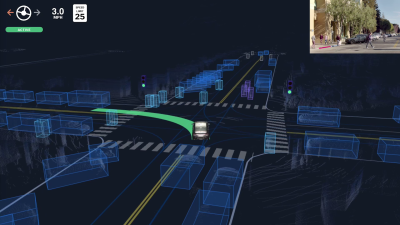
Aurora has been developing self-driving technology to handle real-world situations since its founding in 2017. Being able to master the challenges of a crowded city will be key to succeeding in the marketplace.

Getting rid of ATG certainly spells the end of Uber’s in-house autonomous driving effort, but it doesn’t mean they’re getting out of the game. Holding a stake in Aurora, Uber still stands to profit from early investment, and will retain access to the technology as it develops. At the same time, trading ATG off to an outside firm puts daylight between the rideshare company and any negative press from future testing incidents.

Even if Aurora only retains 75% of ATG’s 1,200 employees, it’s doubling in size, and will be worth keeping an eye on in the future.