Hacking When It Counts: Setting Sail In A Submarine

By the early 20th century, naval warfare was undergoing drastic technological changes. Ships were getting better and faster engines and were being outfitted with wireless communications, while naval aviation was coming into its own. The most dramatic changes were taking place below the surface of the ocean, though, as brave men stuffed themselves into steel tubes designed to sink and, usually, surface, and to attack by stealth and cunning rather than brute force. The submarine was becoming a major part of the world’s navies, albeit a feared and hated one.

For as much animosity as there was between sailors of surface vessels and those that chose the life of a submariner, and for as vastly different as a battleship or cruiser seems from a submarine, they all had one thing in common: the battle against the sea. Sailors and their ships are always on their own dealing with forces that can swat them out of existence in an instant. As a result, mariners have a long history of doing whatever it takes to get back to shore safely — even if that means turning a submarine into a sailboat.

Continue reading “Hacking When It Counts: Setting Sail In A Submarine”

Can A Motorized Bicycle Run On Trees?

Some of the earliest automobiles weren’t powered by refined petrochemicals, but instead wood gas. This wood gas is produced by burning wood or charcoal, capturing the fumes given off, and burning those fumes again. During World War II, nearly every European country was under gasoline rations, and tens of thousands of automobiles would be converted to run on wood gas before the war’s end.

In the century or so since the first car rolled on wood gas, and after hundreds of books and studies were published on the manufacturing and development of wood gas generators and conversion of internal combustion engines, there’s one question: can someone convert a moped to run on wood gas? [NightHawkinLight] finally answered that question.

The basic setup for this experiment is a tiny, tiny internal combustion engine attached to a bicycle. Add a gas tank, and you have a moped, no problem. But this is meant to run on firewood, and for that you need a wood gas generator. This means [NightHawkinLight] will need to burn wood without a whole lot of oxygen, similar to how you make charcoal. There is, apparently, the perfect device to do this, and it’ll fit on the back of a bike. It’s a bee smoker, that thing bee keepers use to calm down a hive of honeybees.

The bee smoker generates the wood gas, which is filtered and cooled in a gallon paint bucket filled with cedar chips. The output from this filter is fed right into where the air filter for the internal combustion engine should be, with an added valve to put more air into the carburetor.

So, with that setup, does the weird bike motorcycle wood gas thing turn over? Yes. The engine idled for a few seconds without producing any useful power. That’s alright, though, because this is just a proof of concept and work in progress. Getting this thing to run and be a useful mode of transportation will require a much larger wood gas generator, but right now [NightHawkinLight] knows his engine can run on wood gas.

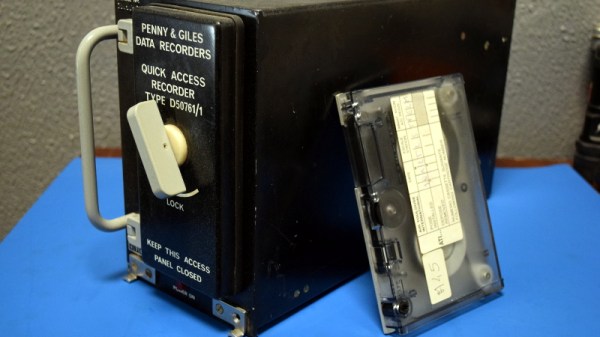
Teardown: D50761 Aircraft Quick Access Recorder

Everyone’s heard of the “black box”. Officially known as the Flight Data Recorder (FDR), it’s a mandatory piece of equipment on commercial aircraft. The FDR is instrumental in investigating incidents or crashes, and is specifically designed to survive should the aircraft be destroyed. The search for the so-called “black box” often dominates the news cycle after the loss of a commercial aircraft; as finding it will almost certainly be necessary to determine the true cause of the accident. What you probably haven’t heard of is a Quick Access Recorder (QAR).

While it’s the best known, the FDR is not the only type of recording device used in aviation. The QAR could be thought of as the non-emergency alternative to the FDR. While retrieving data from the FDR usually means the worst has happened, the QAR is specifically designed to facilitate easy and regular access to flight data for research and maintenance purposes. Its data is stored on removable media and since the QAR is not expected to survive the loss of the aircraft it isn’t physically hardened. In fact, modern aircraft often use consumer-grade technology such as Compact Flash cards and USB flash drives as storage media in their QAR.

Through the wonders of eBay, I recently acquired a vintage Penny & Giles D50761 Quick Access Recorder. This was pulled out of an aircraft which had been in service with the now defunct airline, Air Toulouse International. Let’s crack open this relatively obscure piece of equipment and see just what goes into the hardware that airlines trust to help ensure their multi-million dollar aircraft are operating in peak condition.

Continue reading “Teardown: D50761 Aircraft Quick Access Recorder”

Construction Cranes Versus Hurricanes

When engineers are designing buildings, bridges, or other large construction projects, a lot of thought is given to the environment. Some of these considerations might seem obvious, like designing a skyscraper in San Francisco to tolerate earthquakes, building a stadium in New York City to hold up not only its own weight but the weight of several feet of snow on the roof, or constructing bridges in any coastal area to be able to tolerate salt spray. Not everything is this straightforward, though. Not only do the structures themselves have to tolerate the environmental conditions they are in, but the equipment that is used to build them must tolerate these conditions as well, specifically the large cranes that are often semi-permanently attached to their construction sites.

Perhaps the most extreme example of this in recent memory was during Typhoon Manghut as it hit Hong Kong. There were several large construction cranes that didn’t fare too well with the high winds. At least one toppled as a result and catching the free-spinning of another on video is more than enough to make you gasp. Other videos of construction cranes surfaced from this typhoon showing some concerning, but surprisingly well-designed, emergency operation of the same type of crane.

Continue reading “Construction Cranes Versus Hurricanes”

International Space Station Is Racing The Clock After Soyuz Failure

Today’s failed Soyuz launch thankfully resulted in no casualties, but the fate of the International Space Station (ISS) is now in question.

Just two minutes after liftoff, the crew of the Soyuz MS-10 found themselves in a situation that every astronaut since the beginning of the manned space program has trained for, but very few have ever had to face: a failure during launch. Today the crew of two, Russian Aleksey Ovchinin and American Nick Hague, were forced to make a ballistic re-entry into the Earth’s atmosphere; a wild ride that put them through higher G forces than expected and dropped the vehicle approximately 430 km from the launch site in Baikonur. Both men walked away from the event unharmed, but while the ordeal is over for them, it’s just beginning for the crew of the ISS.

Until a full investigation can be completed by Roscosmos, Russia’s space agency, the Soyuz rocket is grounded. This is standard procedure, as they obviously don’t want to launch another rocket and risk encountering the same issue. But as the Soyuz is currently the only way we have to get humans into space, this means new crew can’t be sent to the ISS until Roscosmos is confident the issue has been identified and resolved.

Soyuz MS-11, which would have brought up three new crew members to relieve those already on the Station, was scheduled for liftoff on December 20th. While not yet officially confirmed, that mission is almost certainly not going to be launching as scheduled. Two months is simply not long enough to conduct an investigation into such a major event when human lives are on the line.

The failure of Soyuz MS-10 has started a domino effect which will deprive the ISS of the five crew members which were scheduled to be aboard by the end of 2018. To make matters worse, the three current crew members must return to Earth before the end of the year as well. NASA and Roscosmos will now need to make an unprecedented decision which could lead to abandoning the International Space Station; the first time it would be left unmanned since the Expedition 1 mission arrived in November 2000.

Continue reading “International Space Station Is Racing The Clock After Soyuz Failure”

I Ate A Robot Hamburger Before The Restaurant Went Out Of Business

The future is upon us and the robots will soon take over. Automated cars will put Uber drivers and cabbies alike out of work. Low-wage workers, like the people working behind the counter at McDonalds, will be replaced by burger-flipping robots. The entire operation of Spacely Space Sprockets, Inc. is run by a single man, pressing a single button, for four hours a day. This cartoon future is so fully automated that most people are unemployed, and all productive work is done by robots.

The first jobs to be replaced will be the first jobs teenagers get. These are low skill jobs, and when you think about low skill jobs (certainly not low-effort jobs, by the way), you think of flipping burgers. That’s where Creator comes in. They’re a culinary robotics company with a restaurant in San Francisco. They’ve been profiled by NPR, by Business Insider, and by CNBC. TechCrunch got a sneak preview proclaiming this as the future of the six dollar burger. It is a marvel of engineering prowess with a business model that I don’t think checks out. This is not the robot that will take your job, and I’m proud to say I ate a robot hamburger before the restaurant went out of business.

Continue reading “I Ate A Robot Hamburger Before The Restaurant Went Out Of Business”

The 555 And How It Got That Way

There’s a certain minimum set of stuff the typical Hackaday reader is likely to have within arm’s reach any time he or she is in the shop. Soldering station? Probably. Oscilloscope? Maybe. Multimeter? Quite likely. But there’s one thing so basic, something without which countless numbers of projects would be much more difficult to complete, that a shop without one or a dozen copies is almost unthinkable. It’s the humble 555 timer chip, a tiny chunk of black plastic with eight leads that in concert with just a few extra components can do everything from flashing an LED a couple of times a second to creating music and sound effects.

We’ve taken a look under the hood of the 555 before and featured many, many projects that show off the venerable chip’s multiple personalities quite well. But we haven’t looked at how Everyone’s First Chip came into being, and what inspired its design. Here’s the story of the 555 and how it got that way.

Continue reading “The 555 And How It Got That Way”