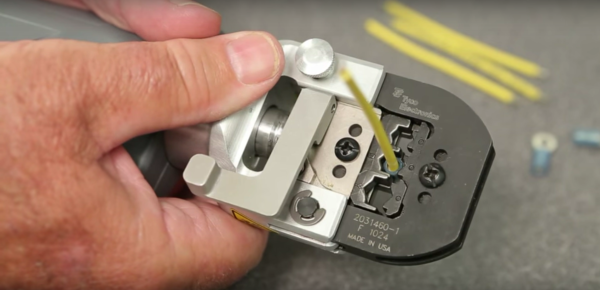
I had a friend who was an electronics assembly tech for a big defense contractor. He was a production floor guy who had a chip on his shoulder for the engineers with their fancy book-learnin’ who couldn’t figure out the simplest problems. He claimed that one assembly wasn’t passing QC and a bunch of the guys in ties couldn’t figure it out. He sidled up to assess the situation and delivered his two-word diagnosis: “Bad crimp.” The dodgy connector was re-worked and the assembly passed, much to the chagrin of the guys in the short-sleeved shirts.
Aside from the object lesson in experience sometimes trumping education, I always wondered about that “bad crimp” proclamation. What could go wrong with a crimp to so subtly futz with a circuit that engineers were baffled? How is it that we can rely on such a simple technology to wire up so much of the modern world? What exactly is going on inside a crimped connection anyway?
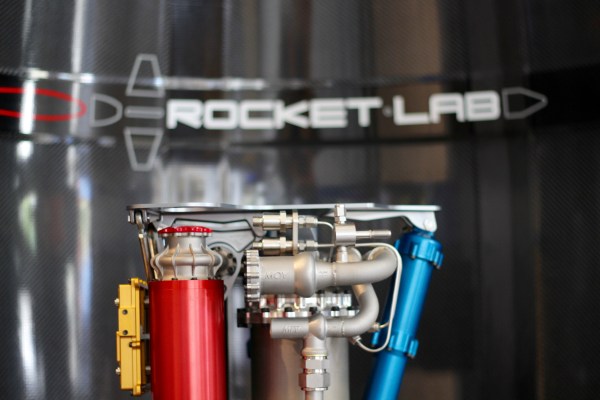
Over the last decade or so the definition of what a ‘small satellite’ is has ballooned beyond the original cubesat design specification to satellites of 50 or 100 kg. Today a ‘smallsat’ is defined far more around the cost, and sometimes the technologies used, than the size and shape of the box that goes into orbit.
There are now more than fifty companies working on launch vehicles dedicated to lifting these small satellites into orbit, and while nobody really expects all of those to survive the next few years, it’s going to be an interesting time in the launcher market. Because I have a sneaking suspicion that Jeff Bezos’ statement that “there’s not that much interesting about cubesats” may well turn out to be the twenty first century’s “nobody needs more than 640kb,” and it’s possible that everybody is wrong about how many of the launcher companies will survive in the long term.
The history of aviation is a fascinating one, spanning more than two thousand years starting from kites and tower jumping. Many hackers are also aviation fans, and the name of Alberto Santos Dumont may be familiar, but if not, here we talk about his role and accomplishments in the field. Santos Dumont is one of the few aviation pioneers that made contributions in both balloons, airships and heavier-than-air aircraft.
There have been a few “firsts” in AI-versus-human gaming lately, and the computers are now beating us at trivia, chess and Go. But in some sense, none of these are really interesting; they’re all games of fact. Poker is different. Aside from computing the odds of holding the winning hand, where a computer would obviously have an advantage, the key to winning in poker is bluffing, and figuring out when your opponent is bluffing. Until recently, this has helped man beat the machine. Those days are over.
Chess and Go are what a game theorist would call games of perfect information: everyone knows everything about the state of the game just from looking at the board, and this means that there is, in principle, a best strategy (series of moves) for every possible position. Granted, it’s hard to figure these out because it’s a big brute-force problem, but it’s still a brute-force problem where computers have an innate advantage. Chess and Go are games where the machines should be winning. Continue reading “AI Beats Poker Pros: Skynet Looms”→
Cut slots into a piece of paper to represent the IR remote control bitstream for putting your TV into standby. Insert it between your TV’s IR receiver and the flame from a lighter, and pull the slots along to generate the coded pattern. Get it just right and you have a paper and lighter remote control. That’s just what [ViralVideoLab] did and you can see it in action in the video below.
Think of this as just the germ of an idea. Imagine how you’d automate this and extend it to include more commands. A wheel with the various bitstreams cut into the circumference comes to mind. A servo would turn the wheel to the desired command and something else would fire up the lighter just as the slots pass by. Now take it a little further. You already have a remote control with keypad and IR light. Hack that to talk to a microcontroller which would control the servo and the IR light. And there you go. A useless but fun hack (hint hint).
Arc-fault circuit breakers are a boon for household electrical safety. The garden-variety home electrical fire is usually started by the heat coming from a faulty wire arcing over. But as any radio enthusiast knows, sparks also give off broadband radio noise. Arc-fault circuit interrupters (AFCI) are special circuit breakers that listen for this noise in the power line and trip when they hear it. The problem is that they can be so sensitive that they cut out needlessly. Check out the amusing video below the break.
Our friend [Martin] moved into a new house, and discovered that he could flip the breakers by transmitting on the 20-meter band. “All the lights in the place went out and my rig switched over to battery. I thought it was strange as I was certainly drawing less than 20 A. I reset the breakers and keyed up again. I reset the breakers again and did a [expletive] Google search.” Continue reading “Ham Radio Trips Circuit Breakers”→
The concept of artificial intelligence dates back far before the advent of modern computers — even as far back as Greek mythology. Hephaestus, the Greek god of craftsmen and blacksmiths, was believed to have created automatons to work for him. Another mythological figure, Pygmalion, carved a statue of a beautiful woman from ivory, who he proceeded to fall in love with. Aphrodite then imbued the statue with life as a gift to Pygmalion, who then married the now living woman.
Pygmalion by Jean-Baptiste Regnault, 1786, Musée National du Château et des Trianons
Throughout history, myths and legends of artificial beings that were given intelligence were common. These varied from having simple supernatural origins (such as the Greek myths), to more scientifically-reasoned methods as the idea of alchemy increased in popularity. In fiction, particularly science fiction, artificial intelligence became more and more common beginning in the 19th century.
But, it wasn’t until mathematics, philosophy, and the scientific method advanced enough in the 19th and 20th centuries that artificial intelligence was taken seriously as an actual possibility. It was during this time that mathematicians such as George Boole, Bertrand Russel, and Alfred North Whitehead began presenting theories formalizing logical reasoning. With the development of digital computers in the second half of the 20th century, these concepts were put into practice, and AI research began in earnest.
Over the last 50 years, interest in AI development has waxed and waned with public interest and the successes and failures of the industry. Predictions made by researchers in the field, and by science fiction visionaries, have often fallen short of reality. Generally, this can be chalked up to computing limitations. But, a deeper problem of the understanding of what intelligence actually is has been a source a tremendous debate.
Despite these setbacks, AI research and development has continued. Currently, this research is being conducted by technology corporations who see the economic potential in such advancements, and by academics working at universities around the world. Where does that research currently stand, and what might we expect to see in the future? To answer that, we’ll first need to attempt to define what exactly constitutes artificial intelligence.