Harrowing Story Of Installing Libreboot On ThinkPad

As an Apple user, I’ve become somewhat disillusioned over the past few years. Maybe it’s the spirit of Steve Jobs slowly vanishing from the company, or that Apple seems to care more about keeping up with expensive trends lately rather than setting them, or the nagging notion Apple doesn’t have my best interests as a user in mind.

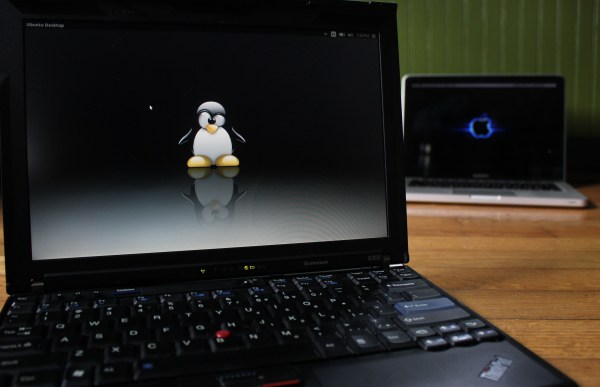
Whatever it is, I was passively on the hunt for a new laptop with the pipe dream that one day I could junk my Apple for something even better. One that could run a *nix operating system of some sort, be made with quality hardware, and not concern me over privacy issues. I didn’t think that those qualities existed in a laptop at all, and that my 2012 MacBook Pro was the “lesser of evils” that I might as well keep using. But then, we published a ThinkPad think piece that had two words in it that led me on a weeks-long journey to the brand-new, eight-year-old laptop I’m currently working from. Those two words: “install libreboot”.

Continue reading “Harrowing Story Of Installing Libreboot On ThinkPad”
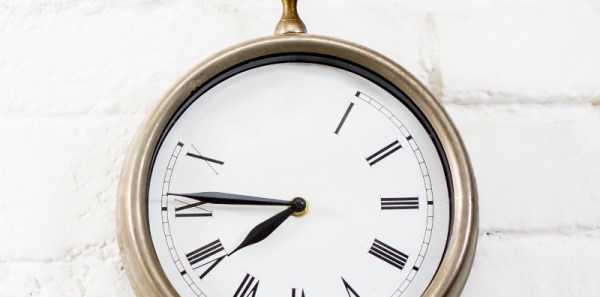
Set Your Clocks To Decimal Time

Many stop lights at street intersections display a countdown of the remaining seconds before the light changes. If you’re like me, you count this time in your head and then check how in sync you are. But did you know that if the French had their way back in the 1890s when they tried to introduce decimal time, you’d be counting to a different beat? Did you know the Chinese have used decimal time for millennia? And did you know that you may have unknowingly used it already if you’ve programmed in Linux? Read on to see what decimal time is along with the answers to these questions.

Continue reading “Set Your Clocks To Decimal Time”

Make Your Own Arduino Header Pins

There are two kinds of people in the world (and, no, this isn’t a binary joke). People who love the Arduino, and people who hate it. If you’ve ever tried to use a standard prototype board to mount on an Arduino, you’ll know what kind of person you are. When you notice the pins aren’t on 0.1 inch centers, you might think, “What the heck were those idiots thinking!” Or, you might say, “How clever! This way the connectors are keyed to prevent mistakes.” From your choice of statement, we can deduce your feelings on the subject.

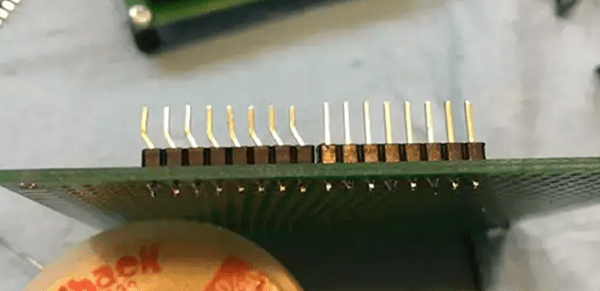
[Rssalnero] clearly said something different. We weren’t there, but we suspect it was: “Gee. I should 3D print a jig to bend headers to fit.” Actually, he apparently tried to do it by hand (we’ve tried it, too). The results are not usually very good.

He created two simple 3D printed jigs that let you bend an 8-pin header. The first jig bends the correct offset and the second helps you straighten out the ends again. You can see the result in the picture above.

Continue reading “Make Your Own Arduino Header Pins”

Ask Hackaday: Dude, Where’s My MOSFET?

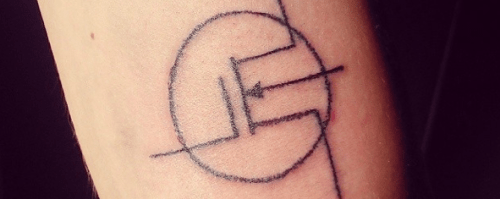
(Bipolar Junction) Transistors versus MOSFETs: both have their obvious niches. FETs are great for relatively high power applications because they have such a low on-resistance, but transistors are often easier to drive from low voltage microcontrollers because all they require is a current. It’s uncanny, though, how often we find ourselves in the middle between these extremes. What we’d really love is a part that has the virtues of both.

The ask in today’s Ask Hackaday is for your favorite part that fills a particular gap: a MOSFET device that’s able to move a handful of amps of low-voltage current without losing too much to heat, that is still drivable from a 3.3 V microcontroller, with bonus points for PWM ability at a frequency above human hearing. Imagine driving a moderately robust small DC robot motor forwards with a microcontroller, all running on a LiPo — a simple application that doesn’t need a full motor driver IC, but requires a high-efficiency, moderate current, and low-voltage-logic compatible transistor. If you’ve been here and done that, what did you use?

Continue reading “Ask Hackaday: Dude, Where’s My MOSFET?”

Modify Locks To Baffle Burglars

While it’s often thought of as a criminal activity, there’s actually a vibrant hobby community surrounding the art of lock picking. In the same way that white hat hackers try to break into information systems to learn the ways that they can be made stronger, so do those in the locksport arena try to assess the weaknesses of various locks. For the amateur, it can be exciting (and a little unnerving) to experience the ease at which a deadbolt can be picked, and if your concern is great enough, you can go a little farther and modify your locks to make them harder to defeat.

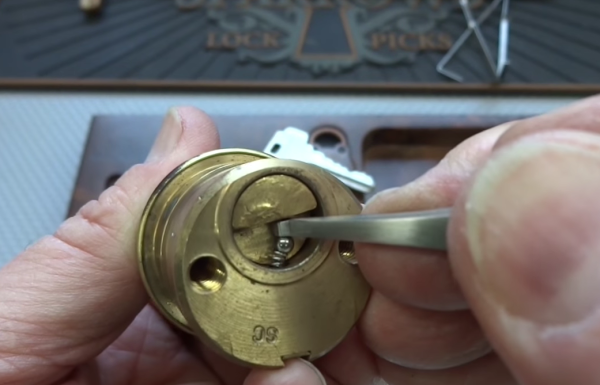
The lock in question was sent to [bosnianbill] by [Rallock67] with a device that [Rallock67] had installed using common tools. Known as a Murphy Ball, a larger-than-normal spring was inserted into one of the pins and held in place by a ball bearing. This makes the lock almost completely immune to bumping, and also made it much more difficult for [bosnianbill], an accomplished and skilled locksmith, to pick the lock due to the amount of force the spring exerted on the cylinder. The surprising thing here was that this modification seems to be relatively easy to do by tapping out some threads and inserting a set screw to hold in the spring.

Locksport and lockpicking are a great hobby to get into. Most people start out picking small padlocks due to their simplicity and ease. It’s even possible to pick some locks with a set of bobby pins. And, if you really want to see how easy it is to defeat some locks and/or how much good the TSA does for your overall security, you’ll want to take a look at this, too.

Thanks to [TheFinn] for the tip!

Continue reading “Modify Locks To Baffle Burglars”

My Beef With Ham Radio

My amateur radio journey began back in the mid-1970s. I was about 12 at the time, with an interest in electronics that baffled my parents. With little to guide me and fear for my life as I routinely explored the innards of the TVs and radios in the house, they turned to the kindly older gentleman across the street from us, Mr. Brown. He had the traditional calling card of the suburban ham — a gigantic beam antenna on a 60′ mast in the backyard – so they figured he could act as a mentor to me.

Mr. Brown taught me a lot about electronics, and very nearly got me far enough along to take the test for my Novice class license. But I lost interest, probably because I was an adolescent male and didn’t figure a ham ticket would improve my chances with the young ladies. My ham ambitions remained well below the surface as life happened over the next 40 or so years. But as my circumstances changed, the idea of working the airwaves resurfaced, and in 2015 I finally took the plunge and earned my General class license.

The next part of my ham story is all-too-familiar these days: I haven’t done a damn thing with my license. Oh, sure, I bought a couple of Baofeng and Wouxun handy-talkies and lurked on the local repeaters. I even bought a good, solid HF rig and built some antennas, but I’ve made a grand total of one QSO — a brief chat with a ham in Texas from my old home in Connecticut on the 10-meter band. That’s it.

Continue reading “My Beef With Ham Radio”

The Many Uses Of The Neon Lamp

Neon lights are that kind of nostalgic item that everybody seems to love. The neon lamp is a type of gas discharge lamp, they generate light when an electrical discharge travels through an ionized gas, or plasma. When the voltage between the electrodes exceeds certain threshold, the gas ionizes and begins conducting electricity. The basic process that generates light is the return of the ions to the ground energy state, with the emission of a photon of light. The light color depends on the emission spectra of the atoms in the gas, and also  on the gas pressure, among other variables.  Gas discharge lamps can be classified by the pressure of the gas:

  • Low pressure: includes the neon lamp, fluorescent lamps and low pressure sodium lamps.
  • High pressure: such as the metal halide, high pressure sodium and mercury vapor lamps.

Another classification comes from the heating method of the cathode:

  • Hot cathode lamps: the electric arc between the electrodes is created via thermionic emission, where electrons are expelled from the electrodes because of the high temperature.
  • Cold cathode lamps: In these, the electric arc results from the high voltage applied between the electrons, that ionizes the gas and conduction can take place.

High intensity lamps are another type of gas discharge lamp where a high power arc is formed between tungsten electrodes. Power levels of several kilowatts can be easily produced this type of lamp. Of course we can’t forget to mention nixie tubes, which are a type of cold cathode neon lamp, popular for building retro clocks. Fortunately, they are now in production again.

Continue reading “The Many Uses Of The Neon Lamp”