You’re Overdue For A Visit To The Library

When was the last time you went to a library? If it’s been more than a couple of years, the library is probably a very different place than you remember. Public libraries pride themselves on keeping up with changing technology, especially technology that benefits the communities they serve. No matter your age or your interests, libraries are a great resource for learning new skills, doing research, or getting help with just about any task. After all, library science is about gathering together all of human knowledge and indexing it for easy lookup.

It doesn’t matter if you’re not a researcher or a student. Libraries exist to serve everyone in a class-free environment. In recent years, patrons have started looking to libraries to get their piece of the burgeoning DIY culture. They want to learn to make their lives better. Public libraries have stepped up to meet this need by adding new materials to their collections, building makerspaces, and starting tool libraries. And this is in addition to ever-growing collections of electronic resources. Somehow, they manage to do all of this with increasingly strained budgets.

The purpose of this article is to explore the ways that libraries of all stripes can be a valuable resource to our readers. From the public library system to the sprawling academic libraries on college campuses, there is something for hackers and makers at all levels.

Continue reading “You’re Overdue For A Visit To The Library”

Building A DIY Heat Pipe

Once the secret design tool for aerospace designers, the heat pipe is a common fixture now thanks to the demands of PC CPU cooling. Heat pipes can transfer lots of energy from a hot side to a cold side and is useful when you need to cool something where having a fan near the hot part isn’t feasible for some reason. Unlike active cooling, a heat pipe doesn’t require any external power or pumps, either.

[James Biggar] builds his own heat pipes using copper tubing. You can see a video of one being made, below. There’s not much to it, just a copper pipe with some water in it. However, [James] gets the water boiling to reduce the pressure in the tube before sealing it, which is an interesting trick.

One limitation of his technique is that there is no internal wick. That means the tube can only be installed vertically. If you haven’t looked at heat pipes before, most of them do have a wick. The idea is that some working fluid is in the pipe. You select that fluid so that it boils at or below the temperature you want to handle. The hot vapor rushes to the cool side of the pipe (carrying heat) where you have a large heatsink that may have a fan or active cooling system. The vapor condenses and–in this case–drops back to the bottom of the tube. However, if there is a wick, capillary action will return the fluid to the hot end of the tube.

You might think that using water as the working fluid would limit you to 100°C, but remember, [James’] technique lowers the pressure in the tube. At a lower pressure, the water will boil at a lower temperature.

We’ve seen heat pipes and wine chillers used to cool a PC before. In fact, we’ve even seen them in builds of completely fanless PCs.

Continue reading “Building A DIY Heat Pipe”

Fly With A Game Boy Classic

How many grown-up hardware hackers whiled away their youth playing Tetris or Mario on their Game Boy? Fond memories for many, but unless you are lucky your Game Boy will probably be long gone. Not for [Gautier Hattenberger] though, he had an unexpected find at his parents’ house; his Game Boy Classic, unloved and forgotten for all those years. Fortunately for us his first thought was whether he could use it as a controller for a drone, and better still he’s shared his work for all of us to see.

How to connect a drone and a Game Boy

Back in the day a would-be Game Boy hacker would have been deterred by Nintendo’s legal defences against game piracy, but with the benefit of a couple of decades the handheld console’s hardware is now an open book. Unfortunately for [Gautier], he seems to be the first to use one as a flight controller, so he had to plough his own furrow. His Game Boy Game Link serial port feeds an Arduino/FTDI combination that converts Game Link  to USB, which is then sent to his laptop on which a small piece of software converts them to commands for the drone through the Paparazzi UAV framework.

All his code is in a GitHub repository, and he’s posted a video of his work which you can see below the break. For a child of the early ’90s, the mere thought that their handheld console could do this would have been mindblowing!

Continue reading “Fly With A Game Boy Classic”

Books You Should Read: Basic Electronics

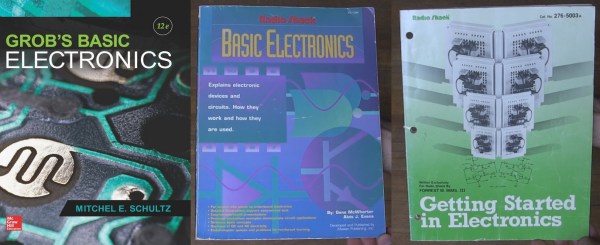
I learned some basic electronics in high school physics class: resistors, capacitors, Kirchhoff’s law and such, and added only what was required for projects as I did them. Then around 15 years ago I decided to read some books to flesh out what I knew and add to my body of knowledge. It turned out to be hard to find good ones.

The electronics section of my bookcase has a number of what I’d consider duds, but also some gems. Here are the gems. They may not be the electronics-Rosetta-Stone for every hacker, but they are the rock on which I built my church and well worth a spot in your own reading list.

Grob’s Basic Electronics

Grob's Basic Electronics 12th Edition
Grob’s Basic Electronics 12th Edition

Grob’s Basic Electronics by Mitchel E Schultz and Bernard Grob is a textbook, one that is easy to read yet very thorough. I bought mine from a used books store. The 1st Edition was published in 1959 and it’s currently on the 12th edition, published in 2015. Clearly this one has staying power.

I refer back to it frequently, most often to the chapters on resonance, induction and capacitance when working on LC circuits, like the ones in my crystal radios. There are also things in here that I couldn’t find anywhere else, including thoroughly exhaustive online searches. One such example is the correct definitions and formulas for the various magnetic units: ampere turns, field intensity, flux density…

I’d recommend it to a high school student or any adult who’s serious about knowing electronics well. I’d also recommend it to anyone who wants to reduce frustration when designing or debugging circuits.

You can find the table of contents here but briefly it has all the necessary introductory material on Ohm’s and Kirchhoff’s laws, parallel and series circuits, and so on but to give you an idea of how deep it goes it also has chapters on network theorems and complex numbers for AC circuits. Interestingly my 1977 4th edition has a chapter on vacuum tubes that’s gone in the current version and in its place is a plethora of new ones devoted to diodes, BJTs, FETs, thyristors and op-amps.

You can also do the practice problems and self-examination, just to make sure you understood it correctly. (I sometimes do them!) But also, being a textbook, the newest edition is expensive. However, a search for older but still recent editions on Amazon turns up some affordable used copies. Most of basic electronics hasn’t changed and my ancient edition is one of my more frequent go-to books. But it’s not the only gem I’ve found. Below are a few more.

Continue reading “Books You Should Read: Basic Electronics”

Full Color 3D Printer Upgrade Leaves Competition In The Dust

Most hobby 3D printers are based on FDM, extruding a single-color noodle of melted plastic to build up an object. Powder-based inkjet 3D printing allows you to print detailed, full-color models from a plaster-like material. The process uses ink and water droplets, dispensed from an inkjet print head to selectively fuse and color layers of a powdered binder material. When you see an offer for a 3D printed miniature version of yourself (or someone else), they are made with powder. [Aad van der Geest] wants to put this technology on your desktop with ColorPod, a kit that converts your FDM printer into a powder printer.

Continue reading “Full Color 3D Printer Upgrade Leaves Competition In The Dust”

Arduino + Software Defined Radio = Millions Of Vulnerable Volkswagens

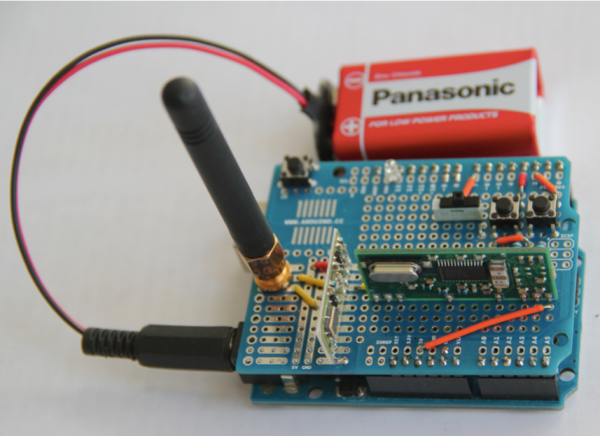
As we’ve mentioned previously, the integrity of your vehicle in an era where even your car can have a data connection could be a dubious bet at best. Speaking to these concerns, a soon-to-be published paper (PDF) out of the University of Birmingham in the UK, states that virtually every Volkswagen sold since 1995 can be hacked and unlocked by cloning the vehicle’s keyfob via an Arduino and software defined radio (SDR).

The research team, led by [Flavio Garcia], have described two main vulnerabilities: the first requires combining a cyrptographic key from the vehicle with the signal from the owner’s fob to grant access, while the second takes advantage of the virtually ancient HiTag2 security system that was implemented in the 1990s. The former affects up to 100 million vehicles across the Volkswagen line, while the latter will work on models from Citroen, Peugeot, Opel, Nissan, Alfa Romero, Fiat, Mitsubishi and Ford.

Continue reading “Arduino + Software Defined Radio = Millions Of Vulnerable Volkswagens”

Intel Releases The Tiny Joule Compute Module

At the keynote for the Intel Developers Forum, Intel CEO Brian Krzanich introduced the Intel Joule compute module, a ‘maker board’ targeted at Internet of Things developers. The high-end board in the lineup features a quad-core Intel Atom running at 2.4 GHz, 4GB of LPDDR4 RAM, 16GB of eMMC, 802.11ac, Bluetooth 4.1, USB 3.1, CSI and DSI interfaces, and multiple GPIO, I2C, and UART interfaces. According to the keynote, the Joule module will be useful for drones, robotics, and with support for Intel’s RealSense technology, it may find a use in VR and AR applications. The relevant specs can be found on the Intel News Fact Sheet (PDF).

This is not Intel’s first offering to the Internet of Things. A few years ago, Intel partnered up with Arduino (the Massimo one) to produce the Intel Galileo. This board featured the Intel Quark SoC, a 400MHz, 32-bit Intel Pentium ISA processor. It was x86 in an Arduino format. This was quickly followed by the Intel Edison based on the same Quark SoC, which was followed by the Intel Curie, found in the Arduino 101 and this year’s DEF CON badge.

We’ve seen plenty of Intel’s ‘maker’ and Internet of Things offerings, but we haven’t seen these platforms succeed. You could spend hundreds of thousands of dollars in market research to determine why these platforms haven’t seen much success, but the Hackaday comments will tell you the same thing for free: the documentation for these platforms is sparse, and nobody knows how to make these boards work.

Perhaps because of the failures of Intel’s IoT market, the Joule differs significantly from previous offerings. Although it can be easily compared to the Raspberry Pi, Beaglebone, and a hundred other tiny single board computers, the official literature for the Joule makes a comparison between it and the Nvidia Jetson easy. The Nvidia Jetson is a high-power, credit card-sized ‘supercomputer’ meant to be a building block for high-performance applications, such as drones and anything that requires video or a very fast processor. The Joule fits into this market splendidly, with demonstrated applications including augmented reality safety glasses for Airbus employees and highway patrol motorcycle helmet displays. Here, the Joule might just find a market. This might even be the main focus of the Joule – it can be integrated onto Gumstix carrier boards, providing a custom single board computer with configurable displays, connectors, and sensors.

The Intel Joule lineup consists of the Joule 570x and 550x, with the 550x being a bit slower, a Gig less RAM, and half as much storage. They will be available in Q4 2016 from Mouser, Newegg, and other Intel reseller partners.