It’s Time For Direct Metal 3D-Printing

It’s tough times for 3D-printing. Stratasys got burned on Makerbot, trustful backers got burned on the Peachy Printer meltdown, I burned my finger on a brand new hotend just yesterday, and that’s only the more recent events. In recent years more than a few startups embarked on the challenge of developing a piece of 3D printing technology that would make a difference. More colors, more materials, more reliable, bigger, faster, cheaper, easier to use. There was even a metal 3D printing startup, MatterFab, which pulled off a functional prototype of a low-cost metal-powder-laser-melting 3D printer, securing $13M in funding, and disappearing silently, poof.

This is just the children’s corner of the mall, and the grown-ups have really just begun pulling out their titanium credit cards. General Electric is on track to introduce 3D printed, FAA-approved fuel nozzles into its aircraft jet engines, Airbus is heading for 3D-printed, lightweight components and interior, and SpaceX has already sent rockets with 3D printed Main Oxidizer Valves (MOV) into orbit, aiming to make the SuperDraco the first fully 3D printed rocket engine. Direct metal 3D printing is transitioning from the experimental research phase to production, and it’s interesting to see how and why large industries, well, disrupt themselves.
Continue reading “It’s Time For Direct Metal 3D-Printing”

Star Trek Material Science Is Finally Real: Transparent Wood

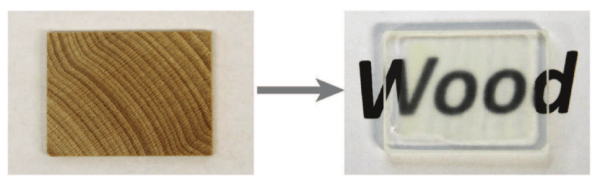
It’s not transparent aluminum, exactly, but it might be even better: transparent wood. Scientists at the University of Maryland have devised a way to remove all of its coloring, leaving behind an essentially clear piece of wood.

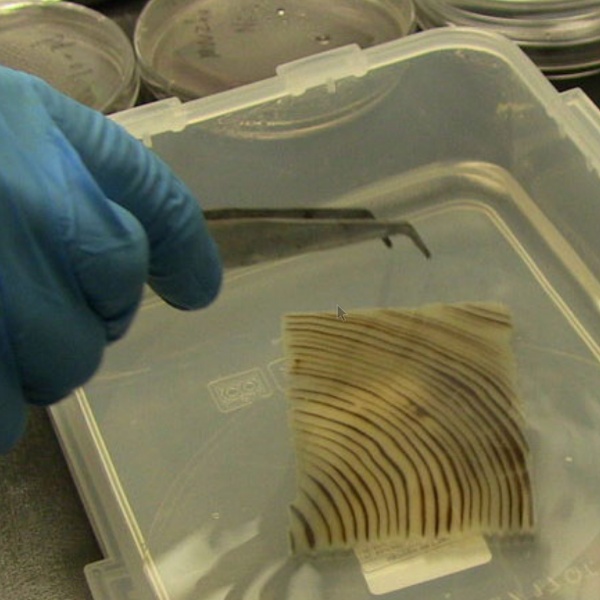
IMG_20160518_110605By boiling the block of wood in a NaOH and Na2SO chemical bath for a few hours the wood loses its lignin, which is gives wood its color. The major caveat here is that the lignin also gives wood strength; the colorless cellulose structure that remains is itself very fragile. The solution is to impregnate the transparent wood with an epoxy using about three vacuum cycles, which results in a composite that is stronger than the original wood.

There are some really interesting applications for this material. It does exhibit some haze so it is not as optimally transparent as glass but in cases where light and not vision is the goal — like architectural glass block — this is a winner. Anything traditionally build out of wood for its mechanical properties will be able to add an alpha color channel to the available options.

The next step is finding a way to scale up the process. At this point the process has only been successful on samples up to 1 centimeter thick. If you’re looking to build a starship out of this stuff in the meantime, your best bet is still transparent aluminum. We do still wonder if there’s a way to eliminate the need for epoxy, too.

Flying With Proportional – Integral – Derivative Control

Your quad-copter is hovering nicely 100 feet north of you, its camera pointed exactly on target. The hover is doing so well all the RC transmitter controls are in the neutral position. The wind picks up a bit and now the ‘copter is 110 feet north. You adjust its position with your control stick but as you do the wind dies and you overshoot the correction. Another gust pushed it away from target in more than one direction as frustration passes your lips: ARGGGHH!! You promise yourself to get a new flight computer with position hold capability.

How do multicopters with smart controllers hold their position? They use a technique called Proportional – Integral – Derivative (PID) control. It’s a concept found in control systems of just about everything imaginable. To use PID your copter needs sensors that measure the current position and movement.

The typical sensors used for position control are a GPS receiver and an Inertial Management  Measurement Unit (IMU) made up of an accelerometer, a gyroscope, and possibly a magnetometer (compass). Altitude control would require a barometer or some other means of measuring height above ground. Using sensor fusion techniques to combine the raw data, a computer can determine the position, movement, and altitude of the multicopter. But calculating corrections that will be just right, without over or undershooting the goal, is where PID comes into play. Continue reading “Flying With Proportional – Integral – Derivative Control”

The Art And Science Of Bending Sheet Metal

A motor mount. A sturdy enclosure. A 43.7° bracket. The average hack requires at least one angled metal part, and the best tool to make one is still the good ol’ press brake. Bending parts requires a few extra thoughts in the design and layout of the flat patterns, so if you want to know about bend allowances, bend deduction and how to bend accurate parts even without a press, read on.

Continue reading “The Art And Science Of Bending Sheet Metal”

Beyond WD-40: Lubes For The Home Shop

If your shop is anything like mine, you’ve got a large selection of colorful cans claiming to contain the best and absolutely only lubricant you’ll ever need. I’ve been sucked in by the marketing more times than I care to admit, hoping that the next product will really set itself apart from the others and magically unstick all the stuck stuff in my mechanical life. It never happens, though, and in the end I generally find myself reaching for the familiar blue and yellow can of WD-40 for just about every job.

Continue reading “Beyond WD-40: Lubes For The Home Shop”

Why Kickstarter Products Fail

It seems every week we report on Kickstarter campaigns that fail in extraordinary fashion. And yet there are templates for their failure; stories that are told and retold. These stereotypical faceplants can be avoided. And they are of course not limited to Kickstarter, but apply to all Crowd Funding platforms. Let me list the many failure modes of crowdfunding a product. Learn from these tropes and maybe we can break out of this cycle of despair.

Failure Out of the Gate

You don’t hear about these failures, and that’s the point. These are crowd funded projects that launch into the abyss and don’t get any wings through printed word or exposure. They may have a stellar product, an impressive engineering team, and a 100% likelihood of being able to deliver, but the project doesn’t get noticed and it dies. Coolest Cooler, the project that raised $13 million, failed miserably the first time they ran a campaign. It was the second attempt that got traction.
The solution is to have a mailing list of interested people are ready to purchase the moment you launch, and share to everyone they know. Reach out to blogs and news organizations a month early with a press package and a pitch catered to their specific audience. Press releases get tossed. Have a good reason why this thing is relevant to their audience. Offer an exclusive to a big news site that is your target market.

Continue reading “Why Kickstarter Products Fail”

A Dis-Integrated 6502

The 6502 is the classic CPU. This chip is found in the original Apple, Apple II, PET, Commodore 64, BBC Micro, Atari 2600, and 800, the original Nintendo Entertainment System, Tamagotchis, and Bender Bending Rodriguez. This was the chip that started the microcomputer revolution, and holds a special place in the heart of every nerd and technophile. The 6502 is also possibly the most studied processor, with die shots of polysilicon and metal found in VLSI textbooks and numerous simulators available online.

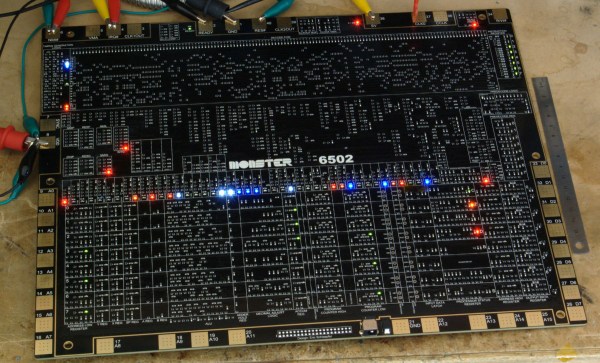
The only thing we haven’t seen, until now, is a version of the 6502 built out of discrete transistors. That’s what [Eric Schlaepfer] has been working on over the past year. It’s huge – 12 inches by 15 inches – has over four thousand individual components, and so far, this thing works. It’s not completely tested, but the preliminary results look good.

The MOnSter 6502 began as a thought experiment between [Eric] and [Windell Oskay], the guy behind Evil Mad Scientist and creator of the discrete 555 and dis-integrated 741 kits. After realizing that a few thousand transistors could fit on a single panel, [Eric] grabbed the netlist of the 6502 from Visual6502.org. With the help of several scripts, and placing 4,304 components into a board design, the 6502 was made dis-integrated. If you’re building a CPU made out of discrete components, it only makes sense to add a bunch of LEDs, so [Eric] threw a few of these on the data and address lines.

This is the NMOS version of the 6502, not the later, improved CMOS version. As such, this version of the 6502 doesn’t have all the instructions some programs would expect. The NMOS version is slower, more prone to noise, and is not a static CPU.

So far, the CPU is not completely tested and [eric] doesn’t expect it to run faster than a few hundred kilohertz, anyway. That means this gigantic CPU can’t be dropped into an Apple II or commodore; these computers need a CPU to run at a specific speed. It will, however, work in a custom development board.

Will the gigantic 6502 ever be for sale? That’s undetermined, but given the interest this project will receive it’s a foregone conclusion.

Correction: [Eric] designed the 555 and 741 kits