Thor’s Hammer Build Recognizes Its Master’s Hand

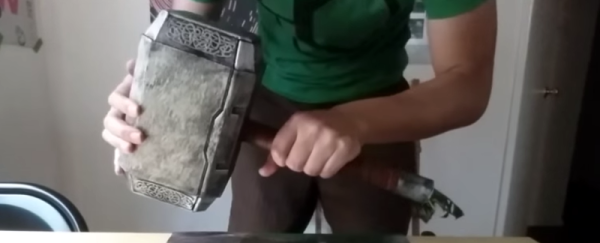
electromagnetic-thors-hammerOnly those who have completely insulated themselves from modern pop culture will miss the meaning of a Mjolnir build. It is, of course, the mythical hammer wielded by Thor, and only Thor. It’s a question of being worthy; a question solved perfectly by this electromagnetic Mjolnir build.

Using an electromagnet is smart, right? Just plunk the thing down on something metal (that is itself super-heavy or well-anchored) and nobody will be able to pick it up. It starts to get more interesting when you add a fingerprint reader, allowing only Mjolnir’s Master to retrieve it from atop a manhole cover.

But for us the real genius in the build is that the hammer isn’t burning power from the four 12V batteries most of the time. All of the people in the video below could have picked up the hammer had they first nudged it off the metal plate with their foot. The build uses a capacitive touch-sensor to enable and disable the microwave over transformer used as the electromagnet. An engineering trick like this really separates the gods from the posers.

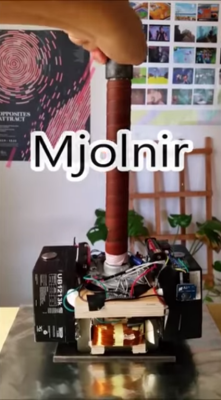
We hate to admit it, but this is probably a cooler build than the Telsa-Coil powered Mjolin that [Caleb] built a few years back. Still, his held up as the best for many years, and if you’re going to be displaced this really is a build worthy of the new title: coolest Mjolnir hack.

Continue reading “Thor’s Hammer Build Recognizes Its Master’s Hand”

Hacking When It Counts: Much Space Station Hacking Saved Skylab

Thanks to the seminal work of Howard and Hanks et al, the world is intimately familiar with the story behind perhaps the most epic hack of all time, the saving of the crippled Apollo 13 mission. But Apollo 13 is far from the only story of heroic space hacks. From the repairs to fix the blinded Hubble Space Telescope to the dodgy cooling system and other fixes on the International Space Station, both manned and unmanned spaceflight can be looked at as a series of hacks and repairs.

Long before the ISS, though, America’s first manned space station, Skylab, very nearly never came to fruition. Damaged during launch and crippled both electrically and thermally, the entire program was almost scrapped before the first crew ever arrived. This is the story of how Skylab came to be, how a team came together to fix a series of problems, and how Skylab went on to success despite having the deck stacked against her from the start.

Continue reading “Hacking When It Counts: Much Space Station Hacking Saved Skylab”

Citizen Scientist: Forrest Mims

Before the modern notion of the citizen scientist lies the earlier ideal of the independent scientist. Scientists outside of the academic community but engaging with it. These days citizen scientists are often seen as valuable assistants in the scientific process, helping collect and process data in a quantity which would be otherwise intractable.

In the past however, independent scientists had a far more central role. Galileo, Kepler, Darwin and Hooke were all self funded at various points in their careers. More recently independent scientist Peter Mitchell won the Nobel prize for Chemistry in 1978 for his foundational research into cell biochemistry and the development of the chemiosmotic hypothesis.

Sadly, peer-reviewed scientific contributions by scientists un-sponsored by a research organization are now few and far between. In this short series we hope to highlight the efforts of these lone researchers with particular reference to the tools they’ve had to hack together on a budget in their scientific quests (if you know an independent researcher you think we should feature, please comment below!).

In Hacker circles Forrest Mims is perhaps best known for his series of electronics books and the unforgeable Atari Punk Console. But it’s his ability to engage with the scientific community as an independent researcher through a series of well thought out scientific articles that interests us here. Contributions made all the more significant by his lack of formal scientific training.

Continue reading “Citizen Scientist: Forrest Mims”

Hackaday SuperConference — Apply Now To Attend

In the beginning there were simple circuits, and it was good. Our technology has advanced, our hardware prowess must advance in kind. The Hackaday SuperConference is the hardware con you’ve been waiting for. Experience spectacular presentations that move hardware creation forward while being surrounded by inspired hackers, designers, and engineers.

There are numerous serious professionals in the Hackaday Community pulling off amazing things that easily rank as world-class. It’s time to assemble our talent and spread those skills to others looking to grow their own repertoire. This is practical, hands-on learning. Many of the sessions will be workshops where you will manipulate registers and send solder smoke skyward.

Apply to Attend the Hackaday SuperConference

The Hackaday SuperCon is in San Francisco, November 14th and 15th. There is limited capacity. You must apply to be part of something this amazing. Do it now and unlock the early adopter rate of $64. Over the coming days that price will rise to $256. That’s assuming there are any tickets left after today. Those who want to hedge their bets should also apply as a volunteer.

You could procrastinate. You could let this one pass you by. But we know you’re like us and you’ve been disappointed by the lack of real hardware talks and workshops at conferences. The SuperCon is created for hardware. Your wait for something special is over.

We are still accepting proposals to present a talk or workshop at the SuperCon. Submit your proposal by this Wednesday. Travel stipends are available for outstanding proposals.


Download the SuperCon poster and hang it everywhere. Share the @hackaday #SuperCon.  Do it now.

The USB Killer, Version 2.0

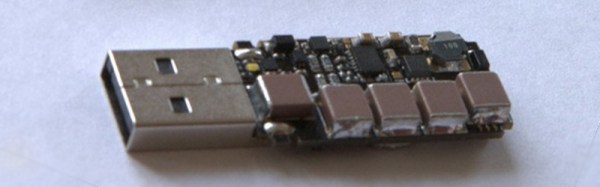
There are a lot of stupid things you can do with the ports on your computer. The best example is the Etherkiller, an RJ45 plug wired directly to a mains cable. Do not plug that into a router. USB is a little trickier, but with a sufficient number of caps, anyone can build a USB killer that will fry any computer (.ru, Google Translatrix)

The USB Killer v2.0 is [Dark Purple]’s second version of this device. The first version was just a small board with a DC/DC converter, a few caps, and a FET. When plugged in to a computer, the converter would charge the caps up to -110V, dump that voltage into the USB signal wires, and repeat the entire process until the computer died. This second version is slightly more refined, and it now dumps -220V directly onto the USB signal wires. Don’t try this at home.

So, does the device work? Most definitely. A poor Thinkpad X60 was destroyed with the USB killer for purposes of demonstration in the video below. This laptop was originally purchased just for the test, but the monster who created the USB killer grew attached to this neat little laptop. There’s a new motherboard on the way, and this laptop will live again.

Continue reading “The USB Killer, Version 2.0”

ARMing A Breadboard — Everyone Should Program An ARM

I’m always a little surprised that we don’t see more ARM-based projects. Of course, we do see some, but the volume isn’t what I’d expect given that low-level ARM chips are cheap, capable, low power, and readily available. Having a 32-bit processor with lots of memory running at 40 or 50 MIPS is a game changer compared to, say, a traditional Arduino (and, yes, the Arduino Due and Zero are ARM-based, so you can still stay with Arduino, if that’s what you want).

A few things might inhibit an Arduino, AVR, or PIC user from making the leap. For one thing, most ARM chips use 3.3V I/O instead of the traditional 5V levels (there are exceptions, like the Kinetis E). There was a time when the toolchain was difficult to set up, although this is largely not a problem anymore. But perhaps the largest hurdle is that most of the chips are surface mount devices.

Of course, builders today are getting pretty used to surface mount devices and you can also get evaluation boards pretty cheaply, too. But in some situations–for example, in classrooms–it is very attractive to have a chip that is directly mountable on a common breadboard. Even if you don’t mind using a development board, you may want to use the IC directly in a final version of a project and some people still prefer working with through hole components.

The 28 Pin Solution

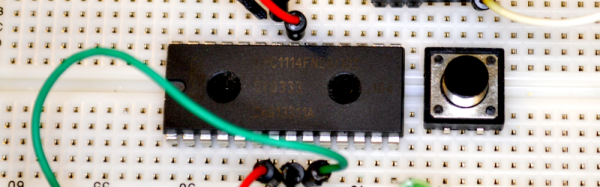
One solution that addresses most, if not all, of these concerns is the LPC1114FN28 processor. Unlike most other ARM processors, this one comes in a 28 pin DIP package and works great on a breadboard. It does require 3.3V, but it is 5V tolerant on digital inputs (and, of course, a 3.3V output is usually fine for driving a 5V input). The chip will work with mbed or other ARM tools and after prototyping, you can always move to a surface mount device for production, if you like. Even if you are buying just one, you should be able to find the device for under $6.

Continue reading “ARMing A Breadboard — Everyone Should Program An ARM”

Get Your Internet Out Of My Things

2014 was the year that the Internet of Things (IoT) reached the “Peak of Inflated Expectations” on the Gartner Hype Cycle. By 2015, it had only moved a tiny bit, towards the “Trough of Disillusionment”. We’re going to try to push it over the edge.

emerging-tech-hc.png;wa0131df2b233dcd17Depending on whom you ask, the IoT seems to mean that whatever the thing is, it’s got a tiny computer inside with an Internet connection and is sending or receiving data autonomously. Put a computer in your toaster and hook it up to the Internet! Your thermostat? Hook it up to the Internet!? Yoga mat? Internet! Mattress pad? To the Intertubes!
Snark aside, to get you through the phase of inflated expectations and on down into disillusionment, we’re going to use just one word: “security”. (Are you disillusioned yet? We’re personally bummed out anytime anyone says “security”. It’s a lot like saying “taxes” or “dentist’s appointment”, in that it means that we’re going to have to do something unpleasant but necessary. It’s a reality-laden buzzkill.)

Continue reading “Get Your Internet Out Of My Things”