SpaceX Joins In The Long History Of Catching Stuff From Space

On February 22nd, a Falcon 9 rocket lifted off from Vandenberg Air Force Base in California and successfully delivered into orbit an Earth-observation satellite operated by the Spanish company Hisdesat. Compared to the media coverage received by the launch of the Tesla-laden Falcon Heavy earlier in the month, this mission got very little attention. But that’s hardly surprising. With respect to Hisdesat, the payload this time around was not terribly exciting, and even the normally dramatic landing of the Falcon 9’s first stage was skipped in favor of simply allowing the booster to crash into the ocean.

As far as SpaceX launches go, this one was about as low-key as they come. It wouldn’t be a surprise if this is the first time some readers are even hearing about it. But while it didn’t invoke the same media circus as the images of a spacesuit-wearing mannequin traveling into deep space, there was still a historic “first” performed during this mission.

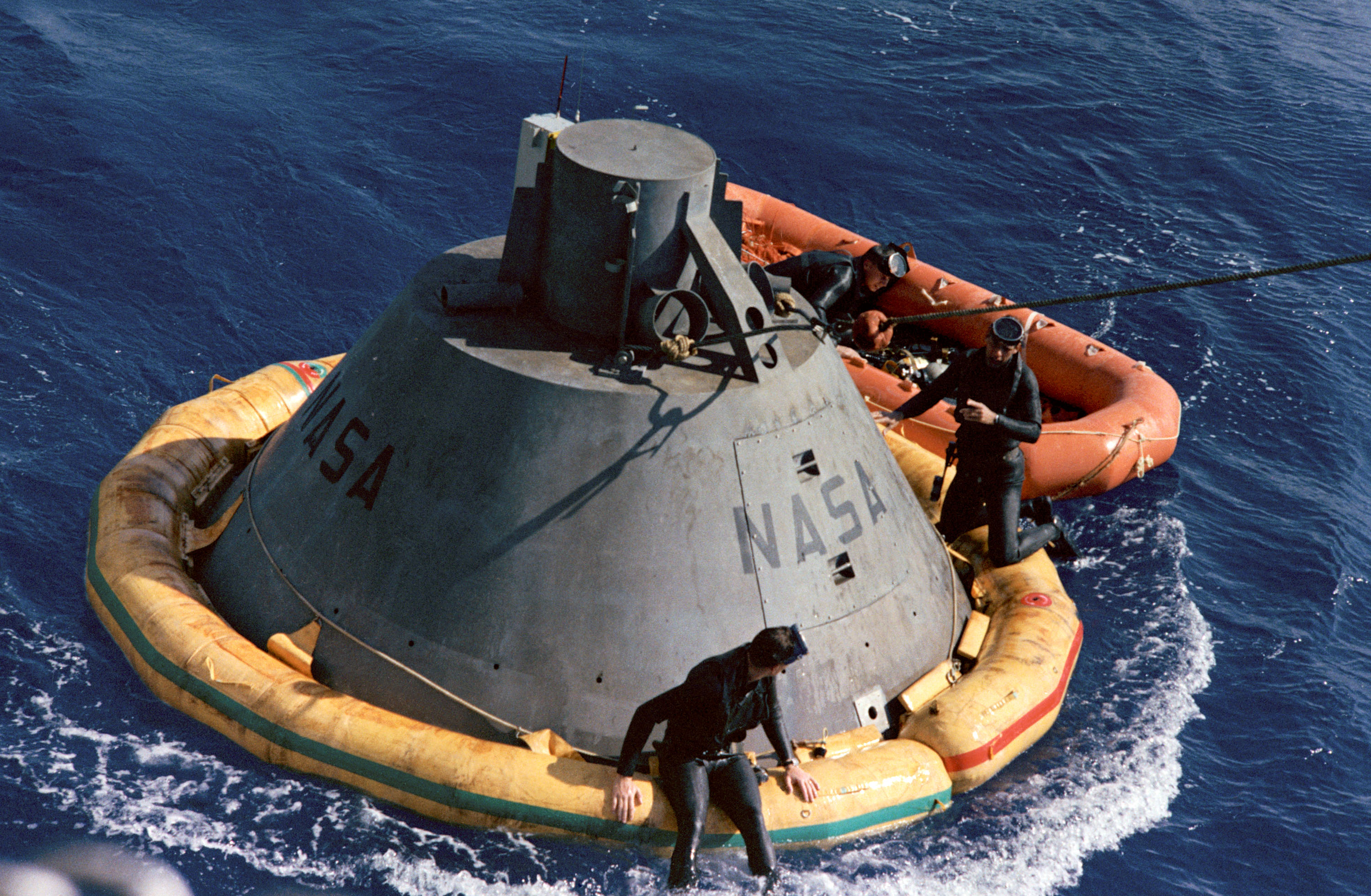
In an effort to increase the re-usability of the Falcon 9 booster, SpaceX attempted to catch the payload fairing (essentially a large protective nose cone) with a huge net as it fell from space. The most interesting thing about this new chapter in the quest for a fully reusable rocket system is that while SpaceX is generally considered to be pioneers in the world of bringing hardware back from space, this particular trick dates all the way back to the 1960’s.

Continue reading “SpaceX Joins In The Long History Of Catching Stuff From Space”

Vera Rubin: Shedding Light On Dark Matter

Vera sat hunched in the alcove at Kitt Peak observatory, poring over punch cards. The data was the same as it had been at Lowell, at Palomar, and every other telescope she’d peered through in her feverish race to collect the orbital velocities of stars in Andromeda. Although the data was perfectly clear, the problem it posed was puzzling. If the stars at the edges of spiral galaxy were moving as fast as the ones in the center, but the pull of gravity was weaker, how did they keep from flying off? The only possible answer was that Andromeda contained some kind of unseen matter and this invisible stuff was keeping the galaxy together.

Though the idea seemed radical, it wasn’t an entirely new one. In 1933, Swiss astronomer Fritz Zwicky made an amazing discovery that was bound to bring him fame and fortune. While trying to calculate the total mass of the galaxies that make up the Coma Cluster, he found that the mass calculation based on galaxy speed was about ten times higher than the one based on total light output. With this data as proof, he proposed that much of the universe is made of something undetectable, but undeniably real. He dubbed it Dunkle Materie: Dark Matter.

But Zwicky was known to regularly bad mouth his colleagues and other astronomers in general. As a result, his wild theory was poorly received and subsequently shelved until the 1970s, when astronomer Vera Rubin made the same discovery using a high-powered spectrograph. Her findings seemed to provide solid evidence of the controversial theory Zwicky had offered forty years earlier.

Continue reading “Vera Rubin: Shedding Light On Dark Matter”

Debunking Moon Landing Denial With An Arduino And Science

It’s sad that nearly half a century after the achievements of the Apollo program we’re still arguing with a certain subset of people who insist it never happened. Poring through the historical record looking for evidence that proves the missions couldn’t possibly have occurred has become a sad little cottage industry, and debunking the deniers is a distasteful but necessary ongoing effort.

One particularly desperate denier theory holds that fully spacesuited astronauts could never have exited the tiny hatch of the Lunar Excursion Module (LEM). [AstronomyLive] fought back at this tendentious claim in a clever way — with a DIY LIDAR scanner to measure Apollo artifacts in museums. The hardware is straightforward, with a Garmin LIDAR-Lite V3 scanner mounted on a couple of servos to make a quick pan-tilt head. The rig has a decidedly compliant look to it, with the sensor flopping around a bit as the servos move. But for the purpose, it seems perfectly fine.

[AstronomyLive] took the scanner to two separate museum exhibits, one to scan a LEM hatch and one to scan the suit Gene Cernan, the last man to stand on the Moon so far, wore while training for Apollo 17. With the LEM flying from the rafters, the scanner was somewhat stretching its abilities, so the point clouds he captured were a little on the low-res side. But in the end, a virtual Cernan was able to transition through the virtual LEM hatch, as expected.

Sadly, such evidence will only ever be convincing to those who need no convincing; the willfully ignorant will always find ways to justify their position. So let’s just celebrate the achievements of Apollo.

Continue reading “Debunking Moon Landing Denial With An Arduino And Science”

Predicting Starman’s Return To Earth

There’s a Starman, waiting in the sky. He’d like to come and meet us, but he’ll have to wait several million years until the Yarkovsky effect brings him around to Earth again.

In case you’ve been living under a rock for the past few weeks, SpaceX recently launched a car into space. This caused much consternation and hand-wringing, but we got some really cool pictures of side boosters landing simultaneously. The test launch for the Falcon Heavy successfully lobbed a Tesla Roadster into deep space with an orbit extending out into the asteroid belt. During the launch coverage, SpaceX said the car would orbit for Billions of years. This might not be true; a recent analysis of the random walk of cars revealed a significant probability of hitting Earth or Venus over the next Million years.

The analysis of the Tesla Roadster relies on the ephemerides provided by JPL’s Horizons database (2018-017A), and predicts the orbit over several hundred years. In the short term — a thousand years or so — there is little chance of a collision with anything. In 2091, however, the Tesla will find itself approaching Earth, and after that, the predicted orbits change drastically. As an aside, we should totally bring the Tesla back in 2091.

Even though the Tesla Roadster, its payload adapter, and the booster are inert objects floating in space right now, that doesn’t mean there aren’t forces acting on it. For small objects orbiting near the sun, the Yarkovsky effect is a huge influence on the orbit when measured on a timescale of millennia. In short, the Yarkovsky effect is a consequence of a spinning object being heated by the sun. As an object (a Tesla, or an asteroid) rotates, the side facing the sun heats up. As this side faces away from the sun, this heat is radiated out, imparting a tiny, tiny force. This force, over a period of millions of years, can send the Tesla into resonances with other planets, eventually sending it crashing into Earth, Venus, or the Sun.

The authors of this paper find there is a 6% chance the Tesla will collide with Earth and a 2.5% chance it will collide with Venus in the next one Million years. In three Million years, the probability of a collision with Earth is 11%. These are, according to the authors, extremely preliminary calculations and more observations are needed. If the Tesla were to hit the Earth, it’s doubtful whatever species populates the planet would notice; the mass of the Tesla is only 1250 Kg, and Earth flies through meteoroids weighing that much very frequently.

Photographing Starman From A Million Miles Away

Love it or loathe it, launching a sports car into space is a hell of a spectacle, and did a great job at focusing the spotlight on the Falcon Heavy spacecraft. This led [Rogelio] to wonder – would it be possible to snap a photo of Starman from Earth?

[Rogelio] isn’t new to the astrophotography game, possessing a capable twin-telescope rig with star tracking capabilities and chilled CCDs for reducing noise in low-light conditions. Identifying the location of the Tesla Roadster was made easier thanks to NASA JPL tracking the object and providing ephemeris data.

Imaging the Roadster took some commitment – from [Rogelio]’s chosen shooting location, it would only be visible between 3AM and 5:30AM. Initial attempts were unsuccessful, but after staying up all night, giving up wasn’t an option. A return visit days later was similarly hopeless, and scuppered by cloud cover.

It was only after significant analysis that the problem became clear – when calculating the ephemeris of the object on NASA’s website, [Rogelio] had used the standard coordinates instead of the actual imaging location. This created enough error and meant they were looking at the wrong spot. Thanks to the wide field of view of the telescopes, however, after further analysis – Starman was captured, not just in still, but in video!

[Rogelio]’s work is a great example of practical astronomy, and if you’re keen to get involved, why not consider building your own star tracking rig? Video after the break.

[Thanks to arnonymous for the tip! If that’s a nickname and not just a request to be anonymous but misspelled.]

Continue reading “Photographing Starman From A Million Miles Away”

The Hard-Learned Lessons Of The Columbia Disaster

On February 1st, 2003 at eighteen seconds past 9:00 AM Eastern Standard Time, the Space Shuttle Columbia broke up during atmospheric entry over Texas. Still traveling at approximately Mach 18.3, the disintegration of Columbia was complete and nearly instantaneous. According to the official accident investigation, the crew had at most one minute from realizing they were in a desperate situation to complete destruction of the spacecraft. Due to the design of the Space Shuttle, no contingency plan or emergency procedure could have saved the crew at this point in the mission: all seven crew members were lost in this tragedy.

While the Space Shuttle, officially known as the Space Transportation System (STS) would fly again after the Columbia disaster, even the program’s most ardent supporters had to admit fundamental design of the Shuttle was flawed. Steps needed to be taken to ensure no future astronauts would be lost, and ultimately, the decision was made to retire the Shuttle fleet after primary construction of the International Space Station (ISS) was complete. There was simply too much invested in the ISS at this point to cancel the only spacecraft capable of helping to assemble it, so the STS had to continue despite the crushing loss of human life it had already incurred.

Between the loss of Challenger and Columbia, the STS program claimed fourteen lives in its thirty year run. Having only flown 135 missions in that time, the STS is far and away the most deadly spacecraft to ever fly. A grim record that, with any luck, is never to be broken.

The real tragedy was, like Challenger, the loss of Columbia could have been prevented. Ground Control knew that the Shuttle had sustained damage during launch, but no procedures were in place to investigate or repair damage to the spacecraft while in orbit. Changes to the standard Shuttle mission profile gave future crews a chance of survival that the men and women aboard Columbia never had.

Continue reading “The Hard-Learned Lessons Of The Columbia Disaster”

Smaller And Smarter: The Electron Rocket Takes Flight

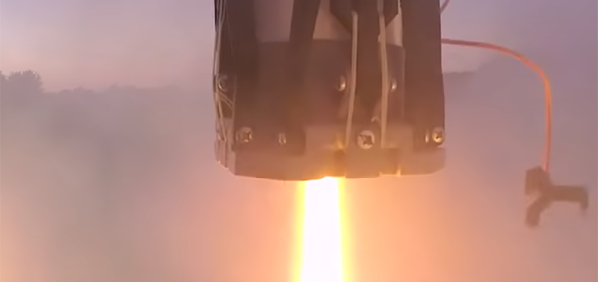
On January 21st, 2018 at 1:43 GMT, Rocket Lab’s Electron rocket lifted off from New Zealand’s Mahia Peninsula. Roughly eight minutes later ground control received confirmation that the vehicle entered into a good orbit, followed shortly by the successful deployment of the payload. On only their second attempt, Rocket Lab had become the latest private company to put a payload into orbit. An impressive accomplishment, but even more so when you realize that the Electron is like no other rocket that’s ever flown before.

Not that you could tell from the outside. If anything, the external appearance of the Electron might be called boring. Perhaps even derivative, if you’re feeling less generous. It has the same fin-less blunted cylinder shape of most modern rockets, a wholly sensible (if visually unexciting) design. The vehicle’s nine first stage engines would have been noteworthy 15 years ago, but today only serve to draw comparisons with SpaceX’s wildly successful Falcon 9.

But while the Electron’s outward appearance is about as unassuming as they come, under that jet-black outer skin is some of the most revolutionary rocket technology seen since the V-2 first proved practical liquid fueled rockets were possible. As impressive as its been watching SpaceX teach a rocket to fly backwards and land on its tail, their core technology is still largely the same as what took humanity to the Moon in the 1960’s.

Vehicles that fundimentally change the established rules of spaceflight are, as you might expect, fairly rare. They often have a tendency to go up in a ball of flames; figuratively if not always literally. Now that the Electron has reached space and delivered its first payload, there’s no longer a question if the technology is viable or not. But whether anyone but Rocket Lab will embrace all the changes introduced with Electron may end up getting decided by the free market.

Continue reading “Smaller And Smarter: The Electron Rocket Takes Flight”