Inside A Pair Of Smart Sunglasses

If you’re willing to spend $200 USD on nothing more than 100 grams of plastic, there are a few trendy sunglasses brands that are ready to take your money before you have time to think twice. Sure, you can get a pair of sunglasses for an order of magnitude less money that do the exact same job, but the real value is in the brand stamped into the plastic and not necessarily the sunglasses themselves. Not so with this pair of Ray-Bans, though. Unlike most of their offerings, these contain a little bit more than a few bits of stylish plastic and [Becky Stern] is here to show us what’s hidden inside.

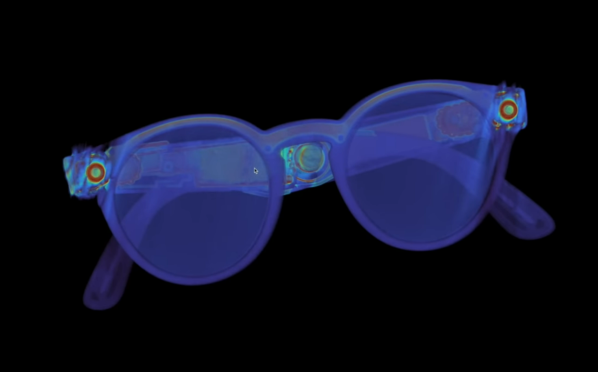
At first glance, the glasses don’t seem to be anything other than a normal pair of sunglasses, if a bit bulky But on closer inspection they hide a pair of cameras and a few other bits of electronics similar to the Google Glass, but much more subtle. The teardown demonstrates that these are not intended to be user-repairable devices, and might not be repairable at all, as even removing the hinges broke the flexible PCBs behind them. A rotary tool was needed to remove the circuit boards from the ear pieces, and a bench vice to remove the camera modules from the front frame. We can presume these glasses will not be put back together after this process.

Hidden away inside is a pair of cameras, a Snapdragon quad-core processor, capacitive touch sensors, an amplifier for a set of speakers. Mostly this is to support the recording of video and playback of audio, and not any sort of augmented reality system like Google Glass attempted to create. There are some concerning ties with Facebook associated with this product as well which will be a red flag for plenty of us around here, but besides the privacy issues, lack of repairability, and lack of features, we’d describe it as marginally less useful as an entry-level smartwatch. Of course, Google Glass had its own set of privacy-related issues too, which we saw some clever projects solve in unique ways.

Continue reading “Inside A Pair Of Smart Sunglasses”

NVIDIA Jetson Powers Real-Time Iron Man HUD

If you could recreate any of the capabilities of Tony Stark’s Iron Man suit in real life, it would probably be the ability to fly, the super strength, or maybe even the palm-mounted lasers that can cut through whatever obstacle is in your path. But let’s be real, all that stuff is way too hard to try and pull off. Plus you’ll probably just end up accidentally killing yourself in the backyard.

But judging by the videos he’s been posting, [Kris Kersey] is doing one hell of a job creating a functional heads-up display (HUD) similar to the one Tony uses in the films. He’s even building it into a 3D printed Iron Man helmet, with the NVIDIA Jetson board that’s powering the show inside a chest-mounted “Arc Reactor”. He goes into a bit more detail about the project and his goals in an interview recently published on NVIDIA’s own blog. Continue reading “NVIDIA Jetson Powers Real-Time Iron Man HUD”

Hackaday Prize 2023: Eye Tracking On A Budget

There is a lot to be learned from the experience of building something functional, and even better if doing so doesn’t break the bank. [Sergej Stoetzer]’s 20€ DIY-Eyetracker aims to be an educational process that covers everything from hardware to functional software in an accessible way.

Hardware based on an economical USB endoscope, and can be used as-is or repackaged with IR illumination.

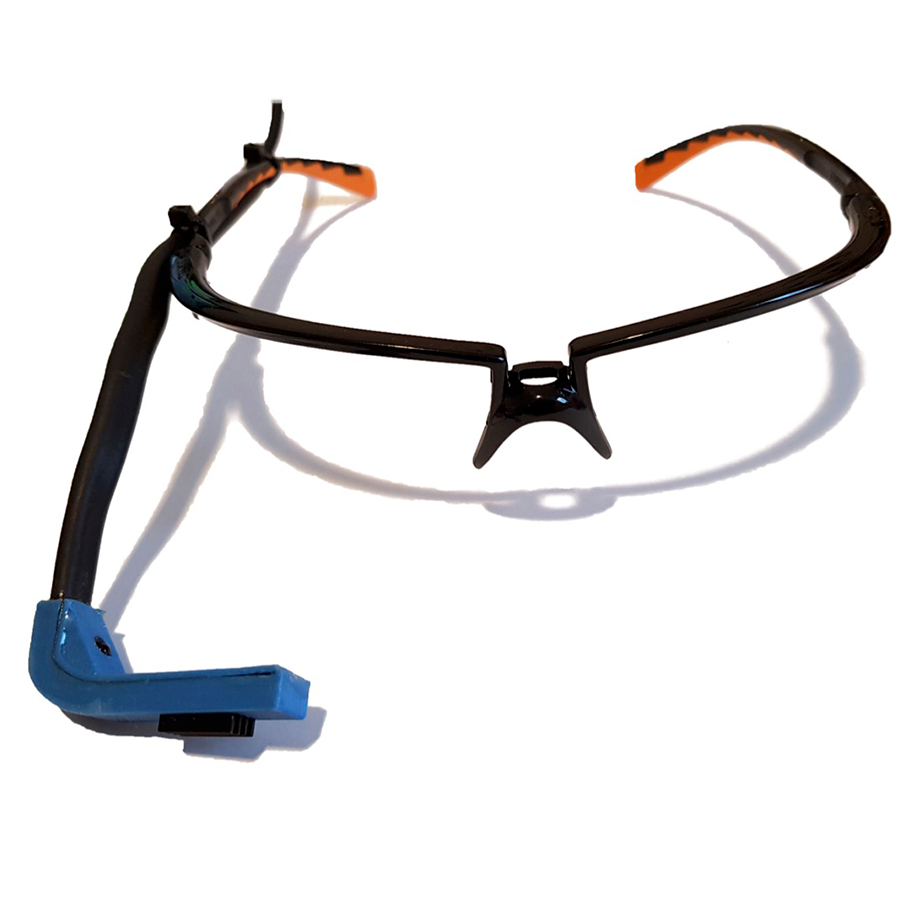
The eye tracker is based on an economical USB endoscope, which is a small camera optimized for up-close applications. By attaching the camera to a pair of common safety glasses so that it looks at one’s eye, some OpenCV and Python code can do simple tracking and interfacing with other projects.

Basic eye tracking — like determining whether a user is looking up, down, left, or right — can be all that’s needed depending on one’s application. That means that it’s possible to get something working with very little hardware and some easy-to-use OpenCV functions.

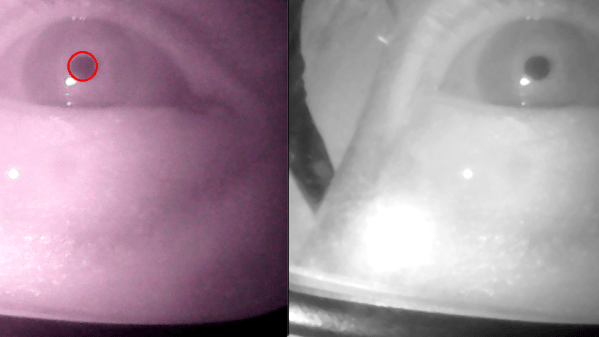
Even better performance can be had by adding IR illumination and repackaging the camera into a 3D printed enclosure. The pupil of the eye is an aperture in the iris that appears as a black circle, and that’s even more true under IR illumination which is invisible to the naked eye. If you’re curious about what’s inside those USB endoscope cameras and how to remove their IR filter, there are some good pictures of that process in this project.

The ability to get something prototyped quickly and working well enough to learn new things is a valuable skill, and that’s why re-engineering Education is one of the challenges in the 2023 Hackaday Prize.

Tactile Feedback In VR, No Cumbersome Gloves Or Motors Required

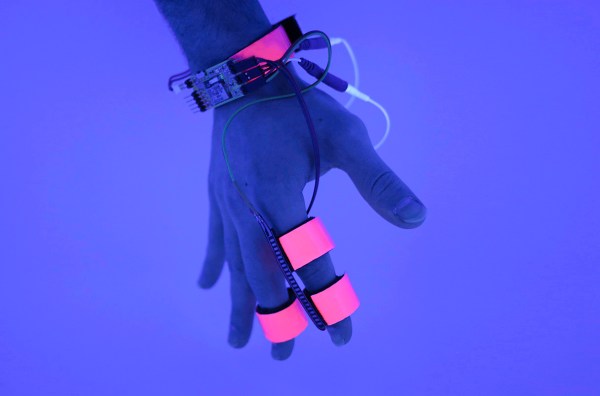
This clever research from the University of Chicago’s Human Computer Integration Lab demonstrates a fascinating way to let users “feel” objects in VR, without anything getting in the way of using one’s hands and fingers normally. Certainly, the picture here shows hands with a device attached to them, but look closely and you’ll see that it’s on the back of the hand only.

There’s hardware attached to the hands, yes, but only to the backs. Hands and fingers can be used entirely normally while receiving tactile feedback.

The unique device consists of a control box, wires, and some electrodes attached to different spots on the back of the hand and fingers. Carefully modulated electrical signals create tactile sensations on the front, despite originating from electrodes on the back. While this has clear applications for VR, the team thinks the concept could also have applications in rehabilitation, or prosthetics.

Continue reading “Tactile Feedback In VR, No Cumbersome Gloves Or Motors Required”

An orange m5stickc plus strapped to a wrist in the foreground with the persons other hand pressing down on the top of an installed hat, communicating with another m5stickc plus in the background on the table.

M5StickC Turned Wearable Morse Code Trainer

Have you ever felt the options for Morse code communication were too limited? Well, look no further than [marsPRE]’s open source WristMorse communicator that can connect over WiFi, can act as a Bluetooth keyboard or just be used as a Morse Code trainer.

a 'hat' for an m5stickc plus with a single row pin header exposted, a 2.5mm jack and two capacitive touch buttons on the top and bottom of the hat.

[marsPRE] uses the M5StickC Plus as the base device and attaches a custom “hat” consisting of a 2.5 mm plug for a radio connection and two capacitive touch paddles that act as the Morse Code keyer. The add-on is housed in what looks like a custom 3D print and hangs off of the end of the M5StickC Plus, connecting the hat through an eight 0.1 inch pin header.

Using the M5StickC Plus allows [marsPRE] to focus on the software, providing different options for training, communication and even using the device as a Bluetooth keyboard. The two touch sensors allow for a semi automatic keying, with the top sensor used for long dashes and the bottom sensor used for short dashes.

[marsPRE] took inspiration from the Morserino-32 and has made the wrist morse code trainer open source software and available through GitHub for anyone wanting to take a look. Morse code may an old encoding method but it’s one that’s worthy of respect. You never know when you might need to send a message from your dreams or to translate spoken word Morse code.

Continue reading “M5StickC Turned Wearable Morse Code Trainer”

Circumvent Facial Recognition With Yarn

Knitwear can protect you from a winter chill, but what if it could keep you safe from the prying eyes of Big Brother as well? [Ottilia Westerlund] decided to put her knitting skills to the test for this anti-surveillance sweater.

[Westerlund] explains that “yarn is a programable material” containing FOR loops and other similar programming concepts transmitted as knitting patterns. In the video (after the break) she also explores the history of knitting in espionage using steganography embedded in socks and other knitwear to pass intelligence in unobtrusive ways. This lead to the restriction of shipping handmade knit goods in WWII by the UK government.

Back in the modern day, [Westerlund] took the Hyperface pattern developed by the Adam Harvey and turned it into a knitting pattern. Designed to circumvent detection by Viola-Jones based facial detection systems, the pattern presents a computer vision system with a number of “faces” to distract it from covered human faces in an image. While the knitted jumper (sweater for us Americans) can confuse certain face detection systems, [Westerlund] crushes our hope of a fuzzy revolution by saying that it is unsuccessful against the increasingly prevalent neural network-based facial detection systems creeping on our day-to-day activities.

The knitting pattern is available if you want to try your hands at it, but [Westerlund] warns it’s a bit of a pain to actually implement. If you want to try knitting and tech mashup, check out this knitting clock or this software to turn 3D models into knitting patterns.

Continue reading “Circumvent Facial Recognition With Yarn”

A milled PCB next to a woman wearing a dress that includes it

Elegant Evening Dress Sports Servo-Actuated Flowers

There’s been plenty of research into “smart fabrics”, and we’ve seen several projects involving items of clothing with electronics integrated inside. These typically include sensors and simple actuators like LEDS, but there’s no reason you can’t integrate moving electromechanical systems as well. [Rehana Al-Soltane] did just that: she made an elegant evening dress with flowers that open and close on command.

It took [Rehana] a bit of experimentation to figure out a floral design that opens and closes smoothly without crumpling the fabric or requiring excessive force to actuate. She finally settled on a plastic sheet sandwiched between two layers of fabric, with pieces of fishing line attached that pull the edges inward. The lines are guided through a tube down the back of the dress, where a servo pulls or releases them.

The mechanical flower can be operated by touch — [Rehana] made one of the other flowers conductive by embedding copper tape between its petals and connected it to the capacitive touch sensor interface of an Atmel microcontroller. The micro is sitting on a custom PCB that’s worn on the hip, with wires going to the servo at the back. You can see how the system operates in the video embedded below.

The dress is [Rehana]’s final project for the famous “How To Make (almost) Anything” course at MIT, and required a wide variety of skills: the cable guide was 3D printed, the flower petals were laser cut, the PCB was milled, and the end product was sewn together. [Rehana] has a knack for making electronics-infused clothes and accessories, including the flexible PCB crown that she’s wearing in the image above. Continue reading “Elegant Evening Dress Sports Servo-Actuated Flowers”