Learning Software In A Soft Exosuit

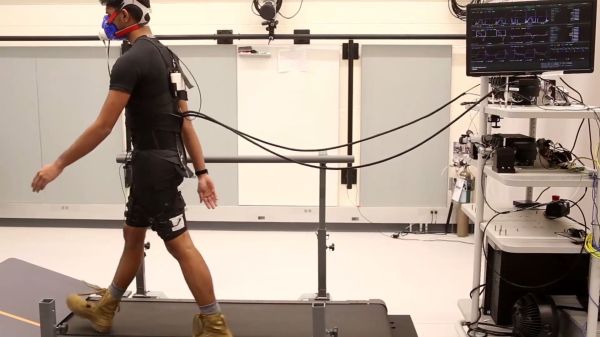
Wearables and robots don’t often intersect, because most robots rely on rigid bodies and programming while we don’t. Exoskeletons are an instance where robots interact with our bodies, and a soft exosuit is even closer to our physiology. Machine learning is closer to our minds than a simple state machine. The combination of machine learning software and a soft exosuit is a match made in heaven for the Harvard Biodesign Lab and Agile Robotics Lab.

Machine learning studies a walker’s steady gait for twenty periods while vitals are monitored to assess how much energy is being expended. After watching, the taught machine assists instead of assessing. This type of personalization has been done in the past, but the addition of machine learning shows that the necessary customization can be programmed into each machine without a team of humans.

Exoskeletons are no stranger to these pages, our 2017 Hackaday Prize gave $1000 to an open-source set of robotic legs and reported on an exoskeleton to keep seniors safe.

Continue reading “Learning Software In A Soft Exosuit”

A Machinist’s Foray Into Jewelry Making

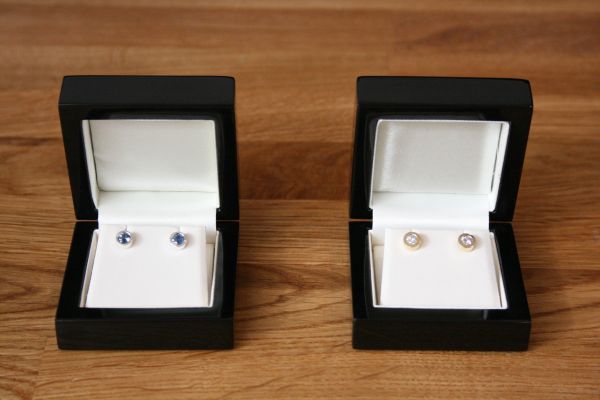
Machinists are expected to make functional items from stock material, at least hat’s the one-line job description even though it glosses over many important details. [Eclix] wanted a birthday gift for his girlfriend that wasn’t just jewelry, indeed he wanted jewelry made with his own hands. After all, nothing in his skillset prohibits him from making beautiful things. He admits there were mistakes, but in the end, he came up with a recipe for two pairs of earrings, one set with sapphires and one with diamonds.

He set the gems in sterling silver which was machined to have sockets the exact diameter and depth of the stones. The back end of the rods were machined down to form the post for the clutch making each earring a single piece of metal and a single gemstone. Maintaining a single piece also eliminates the need for welding or soldering which is messy according to the pictures.

This type of cross-discipline skill is one of the things that gives Hackaday its variety. In that regard, consider the art store for your hacking needs and don’t forget the humble library.

Cracking A Bluetooth Credit Card

You might be surprised to find out that it’s actually not a good idea to put all of your credit card information on a little Bluetooth enabled device in your pocket. Oh, what’s that? You knew already? Well in that case you won’t find the following information terribly shocking, but it’s still a fascinating look at how security researchers systematically break down a device in an effort to find the chinks in its armor.
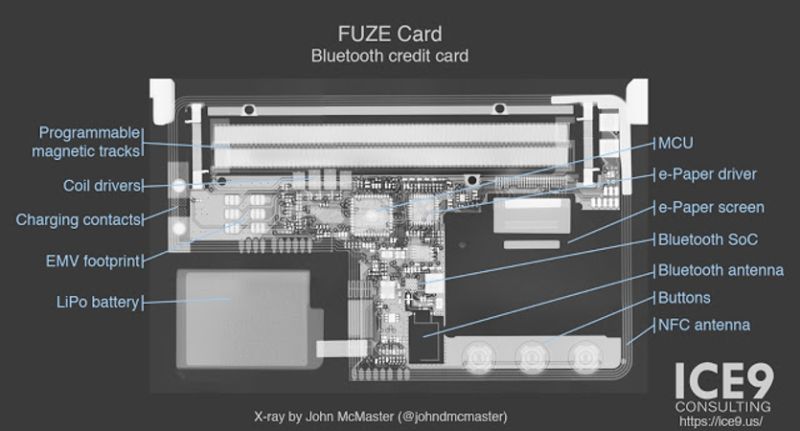
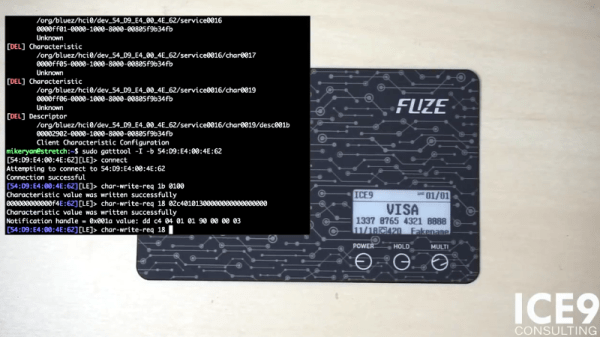
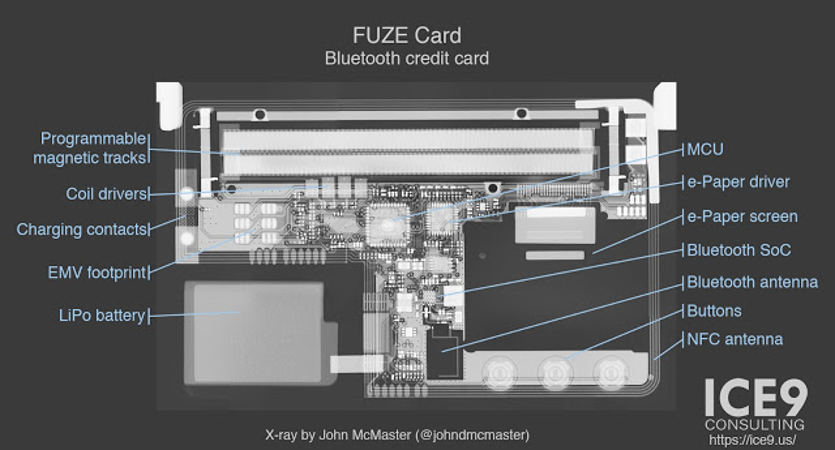
[Mike Ryan] of ICE9 Consulting has recently published an article detailing the work done to examine and ultimately defeat the security on the FUZE Card. From using an x-ray machine to do non-destructive reconnaissance on the device’s internals to methodically discovering all the commands it responds to over Bluetooth, it’s safe to say the FUZE Card is cracked wide open at this point.

To be clear, the attacker must still pair with FUZE, so physical access is required. But as pointed out by [Mike] in the blog post, handing your card over to a merchant is standard operating procedure in many cases. It isn’t as if it would be hard to get a hold of one of these FUZE cards for a minute or two without the owner becoming suspicious. Pairing FUZE to the Linux device to continue to the next step of the attack only takes a few seconds, as demonstrated in the video after the break.

Once paired, the attacker can simply send a BLE command to FUZE which disables the lock screen. It’s really that simple. The attacker can also send commands to dump credit card info over Bluetooth, meaning they could download your information even when the card is “safely” back in your pocket. The inherent failure in the FUZE design is that you don’t need to provide any sort of authentication to pair it to a new Bluetooth device. It makes the (very dangerous) assumption that the person holding it is entitled to do so.

Even if you know better than to ever buy a device like this, the post [Mike] has written up is really a must-read for anyone who’s ever looked at a device and tried to figure out what was going on in its little silicon brain. We especially liked his assertion that reverse engineering a device essentially boils down to: “staring, thinking, a little experimentation, but mostly staring and thinking.” We’re having an internal debate here at Hackaday HQ about making that the site’s tagline.

Incidentally, this is very similar to the Bluetooth gun “safe” that was cracked not so long ago. At this point, it might be wise to just stay away from anything with that little blue logo on it if you intend to trust it with your identity and/or deadly weapon.

Continue reading “Cracking A Bluetooth Credit Card”

A Gif-Playing Top Hat For FRC 2018!

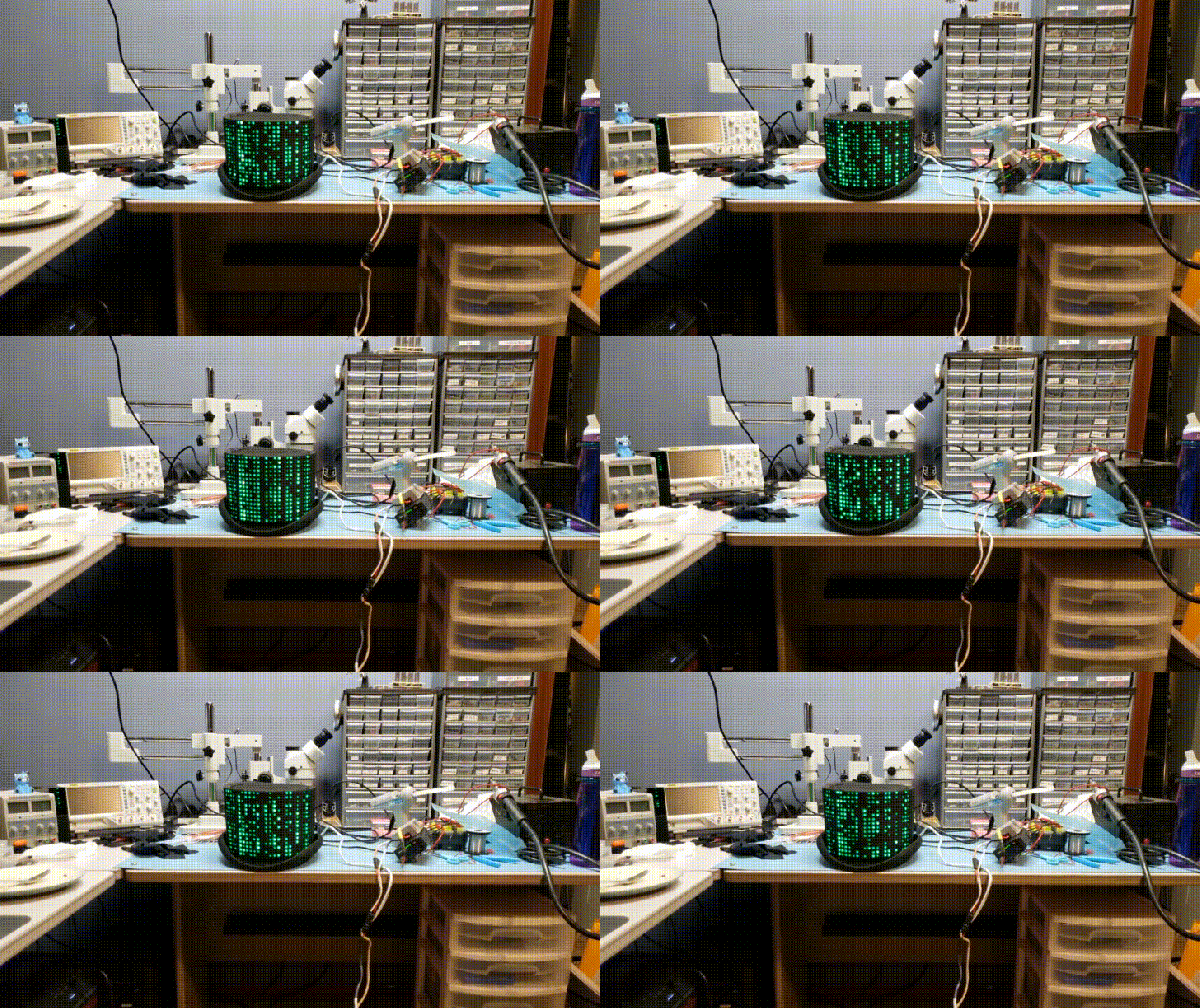
In gearing up to mentor a team at the 2018 FIRST Robotics Competition, redditor [dd0626] wanted to do something cool that resonated with this year’s 8-bit gaming theme. Over the course of a few days, they transformed a top hat into a thematically encapsulating marquee: a LED matrix display loaded with gifs!

The display is actually a sleeve — made from shipping foam, a pillow case, and an old t-shirt — that fits over the hat, leaving it intact and wearable for future events. A Teensy3.6 displays the gifs on four WS2812 16×16 RGB LED matrices, and while a sheer black fabric diffuses the light, it’s still best viewed from several feet away. This is decidedly not intended to be a stealthy hat display.

To mitigate current draw, [dd0626] is using a 5V 30A DC/DC converter and keeping the brightness at a minimum — otherwise, each panel can pull up to 15A! To offset any dip in performance, they’ve bundled in a massive 22,400mAh, 24V battery pack to keep the hat running for a while. Despite all the hardware, the hat weighs under two pounds — eminently wearable for a long day of competition. Continue reading “A Gif-Playing Top Hat For FRC 2018!”

HairIO: An Interactive Extension Of The Self

Most of what we see on the wearable tech front is built around traditional textiles, like adding turn signals to a jacket for safer bike riding, or wiring up a scarf with RGB LEDs and a color sensor to make it match any outfit. Although we’ve seen the odd light-up hair accessory here and there, we’ve never seen anything quite like these Bluetooth-enabled, shape-shifting, touch-sensing hair extensions created by UC Berkeley students [Sarah], [Molly], and [Christine].

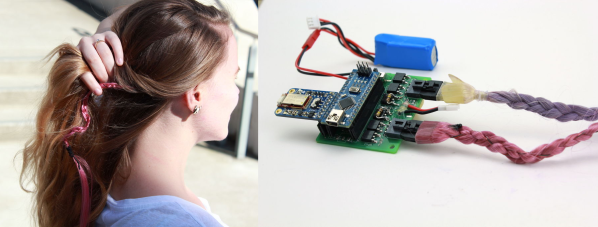
HairIO is based on the idea that hair is an important part of self-expression, and that it can be a natural platform for sandboxing wearable interactivity. Each hair extension is braided up with nitinol wire, which holds one shape at room temperature and changes to a different shape when heated. The idea is that you could walk around with a straight braid that curls up when you get a text, or lifts up to guide the way when a friend sends directions. You could even use the braid to wrap up your hair in a bun for work, and then literally let it down at 5:00 by sending a signal to straighten out the braid. There’s a slick video after the break that demonstrates the possibilities.

HairIO is controlled with an Arduino Nano and a custom PCB that combines the Nano, a Bluetooth module, and BJTs that drive the braid. Each braid circuit also has a thermistor to keep the heat under control. The team also adapted the swept-frequency capacitive sensing of Disney’s Touché project to make HairIO extensions respond to complex touches. Our favorite part has to be that they chalked some of the artificial tresses with thermochromic pigment powder so they change color with heat. Makes us wish we still had our Hypercolor t-shirt.

Nitinol wire is nifty stuff. You can use it to retract the landing gear on an RC plane, or make a marker dance to Duke Nukem.

Continue reading “HairIO: An Interactive Extension Of The Self”

“Attempt” At Wristwatch Is A Solid Success

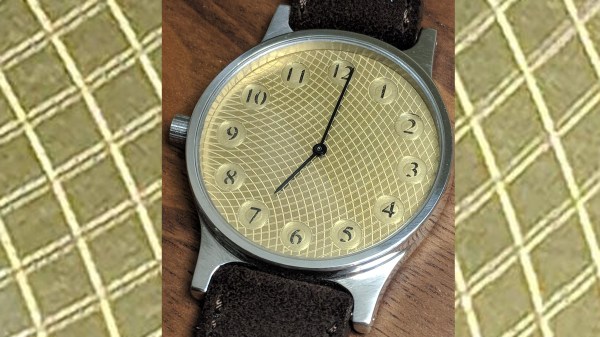
Sometimes silence is the best compliment to a DIY project, and that doesn’t just apply to homemade lockjaw toffee. When a watch is so well-made that it looks like one from a jewelry store, it is easy to keep quiet. [ColinMerkel] took many pictures of his fourth wristwatch attempt but “attempt” is his word because we call this a success. This time around he didn’t forget the crown for adjusting the time so all the pieces were in place.

His second “attempt” at wristwatch making was featured here and it had a classical elegance. Here, the proverbial game has been stepped up. Instead of using stock steel, the body is constructed of 303 stainless steel. The watch dial will definitely draw compliments if its DIY nature is revealed, which is equally mathematical and charming. Pictures of this process were enough to convey the build without words which is always a bonus if you only want a quick look or English isn’t your first choice for language.

Not only is [Colin] an upstanding horologist, he has a reputation with aftermarket door security and a looping guitar pedal.