FPGA Rescues Scope From The Dumpster

I’m always on the lookout for a quality addition to my lab that would respect my strict budget. Recently, I’ve found myself pushing the Hertz barrier with every other project I do and hence desperately wanted a high bandwidth scope. Unfortunately, only recently have 70 MHz to 100 MHz become really affordable, whilst a new quad channel oscilloscope in the 500 MHz to 1 GHz range still costs a fortune to acquire. My only option was to find an absolute miracle in the form of an old high bandwidth scope.

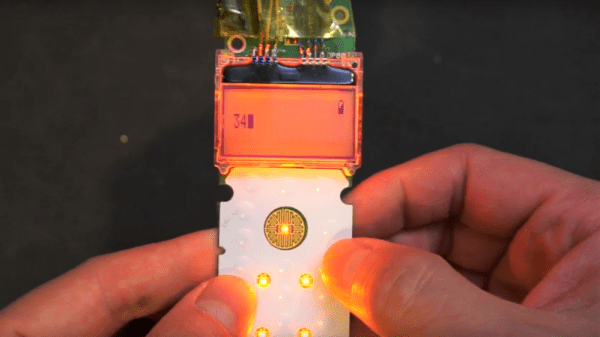
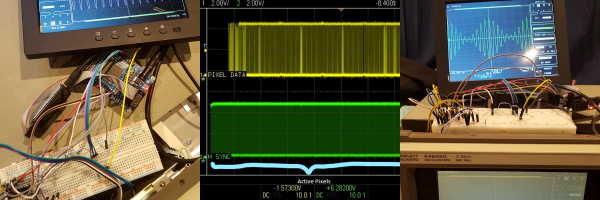
It seemed the Gods of Hand Me Down electronics were smiling upon me when I found this dumpster destined HP 54542C. It appeared to be in fairy good shape and was the Top Dog in its day. But something had to be broken right? Sure enough, the screen was clearly faulty and illegible. Want to know how I fixed it? Four letters: FPGA.

Continue reading “FPGA Rescues Scope From The Dumpster”

Manual LCD Makes Information Display Tedious, Educational

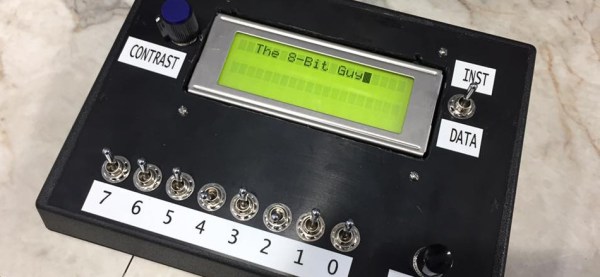
The HD44780 is one of the first chips we learned about as a kid, and chances are good you’ve used one in your project at some point, and almost certain that you’ve interacted with one in your life. The character LCD is ubiquitous, easy to interface, and very robust. They come in sizes from 8 x 1 to 20 x 4 and even larger, but they almost all have the same pinout, and there are libraries in many embedded environments for interacting with them. [The 8-Bit Guy] decided to interface with one using just switches and a button, (YouTube, embedded) with the intent of illustrating exactly how to use them, and how easy they are.

Continue reading “Manual LCD Makes Information Display Tedious, Educational”

DIY Conductive Glass You Could Actually Make

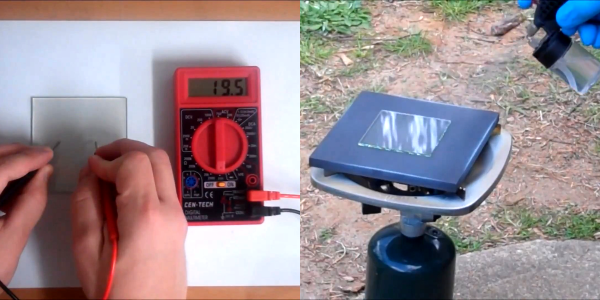
Transparent, conductive glass is cool stuff and enables LCD panels and more. But the commercial method involves sputtering indium-tin oxide, which means a high vacuum and some high voltages, which is doable, but not exactly hacker-friendly. [Simplifier] has documented an alternative procedure that uses nothing more than a camp-stove hotplate and an airbrush. And some chemistry.

Make no mistake, this is definitely do-it-outside chemistry. The mixture that [Simplifier] has settled on includes stannous (tin) chloride and ammonium bifluoride in solution. This is sprayed uniformly onto the heated glass (350-400° C), and after it’s evaporated there is a thin, strong, and transparent layer of fluorine-doped tin oxide. [Simplifier] reports resistances down in the single-digit Ohms per square, which is pretty awesome. [Simplifier] didn’t get the mix down perfectly on the first pass, of course, so it’s also interesting to read up on the intermediate steps.

Our thoughts immediately spring to masking sections of glass off and building DIY transparent circuits and panels, but we suspect that we’re getting ahead of ourselves. Still, this is an incredible early result, and we hope that it opens up the way to crazy transparent-conductive applications. What would you do if you could make glass circuits? Well, now you can, and it doesn’t look too hard.

Continue reading “DIY Conductive Glass You Could Actually Make”

Portable RetroPie Suitcase For Multiplayer On The Go!

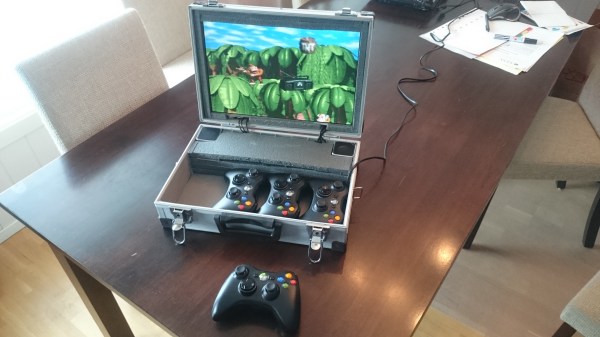
Portable gaming — and gaming in general —  has come a long way since the days of the original Game Boy. With a mind towards portable multiplayer games, Redditor [dagcon] has assembled a RetroPie inside a suitcase — screen and all!

This portable console has almost everything you could need. Four controllers are nestled beside two speakers. Much of the power cabling is separated and contained by  foam inserts. The screen fits snugly into the lid with a sheet of rubber foam to protect it during transport.

Tucked behind the monitor rests the brains of this suitcase console: a Raspberry Pi and the associated boards. [Dagcon] resorted to using a dedicated sound card for the speakers, diverting the output from the HDMI port. An LCD screen controller was also necessary as the screen had been re-purposed from its previous life as a laptop screen. [Dagcon] offers some tips on how to go about accomplishing this yourself and a helpful Instructables link.

Continue reading “Portable RetroPie Suitcase For Multiplayer On The Go!”

Old Thermometer Gets New Eyes

As much as we’d like to have the right tools for the right job all of the time, sometimes our parts drawers have other things in mind. After all, what’s better than buying a new tool than building one yourself from things you had lying around? That’s at least what [Saulius] must have been thinking when he needed a thermometer with a digital output, but only had a dumb, but feature-rich, thermometer on hand.

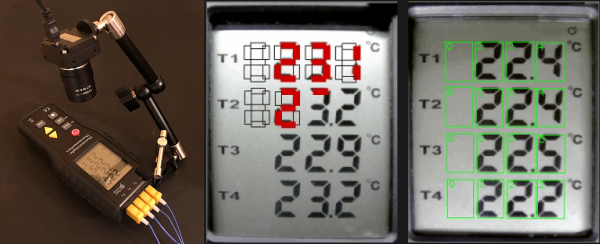
Luckily, [Saulius] had a webcam lying around as well as an old thermometer, and since the thermometer had a LCD display it was relatively straightforward to get the camera to recognize the digits in the thermometer’s display. This isn’t any old thermometer, either. It’s a four-channel thermometer with good resolution and a number of other useful features (with an obvious lack of communications abilities), so it’s not something that he could just overlook.

Once the camera was mounted to an arm and pointed at the thermometer’s screen, an algorithm running on a computer detects polygons and reports its information into a CSV file. This process is made simpler by the fact that LCD screens like this are very predictable. From there, the data is imported into LibreOffice and various charts and graphs can be made.

Although perhaps not the most elegant of hacks, sometimes you have to work with the supplies that are on hand at the time. Sometimes the tools you need are too expensive, politically dangerous, or too impractical to obtain. To that end [Saulius]’s hack is a great example of what hacks are possible with the right mindset.

Inside The Printrbot Printrhub

A new version of the Printrbot Simple was released this summer, and this sleek new model includes a few highly desirable features. The metal enclosure was improved, linear rails added, a power switch was thrown in, and the biggest feature — a touch screen — makes headless printing easy.

Adding a usable display and achieving reliable WiFi are big engineering challenges, and thanks to the Internet of Things it’s only going to become more common to expect those features. How did the Printrbot team implement this? [Philip Shuster] recently released a write-up of how the Printrbot Printrhub came together.

The story of the display and WiFi module in the newest Printrbot begins about a year ago with a post on Hackaday. [Philip] built the Little Helper, a little electronic Swiss Army knife capable of basic IO, sending out PWM pulses, sniffing I2C, and a few other handy features. The Printrbot team reached out to [Philip], and after a few conversations, he was roped into the development team for the Printrhub.

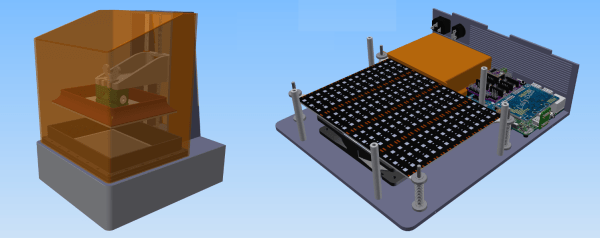
Departing slightly from the Little Helper, the Printrhub features the same microcontroller found in the Teensy 3, a 2.8 inch TFT display, capacitive touch sensor, microSD card slot, and an ESP-12 module to handle the WiFi connection. The display system was tricky, but the team eventually got it working. Using an ESP8266 as the WiFi module for a printer is more difficult than you would think, but that works too.

One of the more interesting challenges for 3D printers in the last few years is the development of a good printer display with wireless connectivity. Yes, those graphic LCDs attached to an Arduino still work, but a display from 1980 doesn’t sell printers. In just a few months, the Printrbot team came up with a relatively simple, very elegant display that does everything and they’re releasing all the hardware as open source. That’s great news, and we can’t wait to see similar setups in other makes of 3D printers.

Craziest Pin-Saving LCD Trick Ever!

We love squeezing every last bit of silicon goodness out of a tiny chip, or at least we delight in seeing it done. Today’s analog/digital hack is one of the sweetest we’ve seen in a while. And it’s also a little bit of a puzzle, so don’t scroll down to the answer until you’ve given the schematic a good think-over.

Continue reading “Craziest Pin-Saving LCD Trick Ever!”