Spy Video TRAKR: Software And First Hack

Our initial view of the Spy Video TRAKR “App BUILDR” site had us believing this would be an internet-based code editor and compiler, similar to the mbed microcontroller development tools. Delving deeper into the available resources, we’re not entirely sure that’s an accurate assessment — TRAKR may well permit or even require offline development after all. Regardless of the final plan, in the interim we have sniffed out the early documentation, libraries and standalone C compiler and have beaten it into submission for your entertainment, in order to produce our first TRAKR hack!
Continue reading “Spy Video TRAKR: Software And First Hack”

LED Suit Lights Up The Night

When the tipline popped up with this LED suit, part two, by [Marc DeVidts] we were expecing a simple led version of the previously known EL coat.

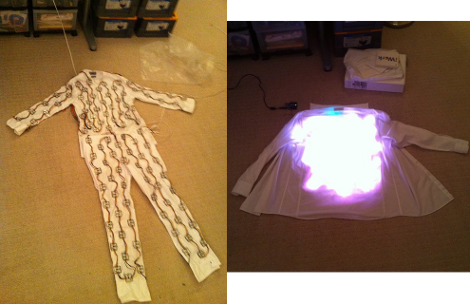
Well we were right and wrong in the same instance. Correct in that like predictions, the outcome is stonking great. Wrong in that this suit far outpaces EL in abilities we weren’t expecting. Namely to start off, an iPhone app over WiFi dictates to some 200 Arduino multiplexed RGB LED modules to dance randomly or follow patterns; an accelerometer and microphone are also implanted to further some effects. And finally if the suit isn’t enough to make you giddy, his PCB and enclosure milling surely will. Catch a video of the entire setup after the break.

Continue reading “LED Suit Lights Up The Night”

Controlling An AC Drill Using One PWM Connection

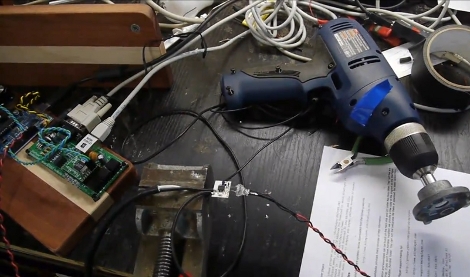
This peculiar setup allows [Ben Krasnow] to control an alternating current device using one pin on a microcontroller. He’s experimenting with a power drill and has relocated the trigger circuitry that makes it spin. On that board he found a variable resistor combined with a capacitor which control a triac, actuating the speed of a drill. [Ben’s] solution works great and isolates the drill from the control circuitry. He replace the variable resistor with a cadmium sulfide photoresistor (basically a variable resistor whose resistance depends on the intensity of light). Pulse-width modulation is used to adjust the brightness of an LED shining on that photoresistor and thereby affect the speed of the drill. This is such as simple alteration to the drill we’d call it MacGyver-esque.

See a demonstration after the break.

Continue reading “Controlling An AC Drill Using One PWM Connection”

DWex Watch Looks For Future Development

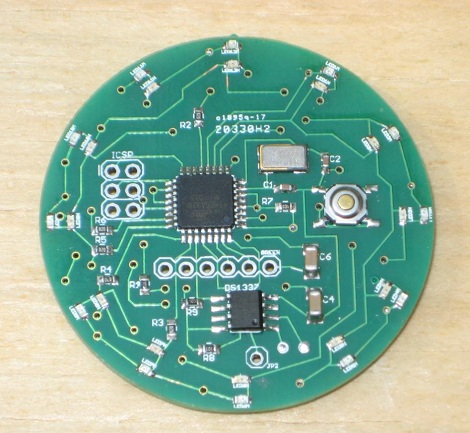
[FlorinC] sent in his DWex Arduino watch, with intentions for it double as an experimenting base. Inspired by the MakerBotWatch, it runs an ATmega328P, DS1337 RTC,and 24 LEDs to display the time. [FlorinC] tells us the (yet to come) case and strap will be similar to Woz’s watch to ensure airport security tackles him. As for experimenting, the PCB contains an ICSP6 and also an FTDI connector for those “other-than-watch purposes”. We’re not all sure what else could be done with a watch; we racked our brains and came up with a compass, but with the source code and Eagle files available maybe you have a better idea?

Prototyping The Bulbdial Clock

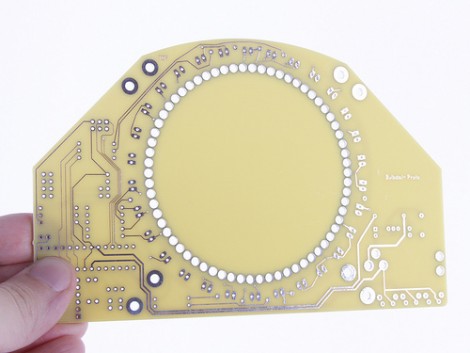
Evil Mad Scientist posted a story about what went into developing the Bulbdial clock. We think the Bulbdial is one of the best pieces of kit out there for many reasons; using colored shadows for each hand is a brilliant idea, the design is clever and uses a low parts count, and the concentric rings that make it work also add to the aesthetic. But after seeing the original wood prototype it had crossed our minds that developing those circular PCBs isn’t the easiest thing to pull off. To save on board cost, the first run didn’t have the center routed out, but rather used almost-touching holes drilled during manufacture and finished by hand during assembly. They also go on to discuss the use of Charlieplexing to reduce part count and the search for a suitable diffuser for the clock face.

Take Better Pictures Of Your Projects

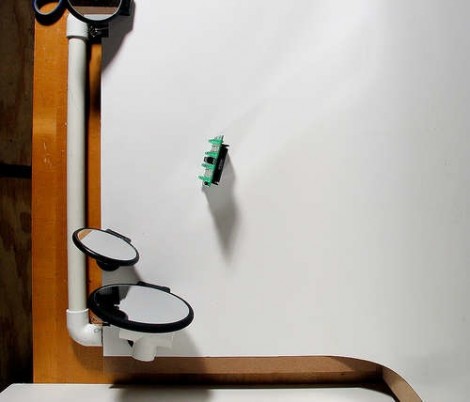
[PT] let us know about a fantastic guide to taking better photographs of your projects. It’s a hefty read but well worth the effort. Author [Johngineer] helps us understand how to use simple (and possibly inexpensive) tools like lights, mirrors, and a background material. He also gives some tips on how to recognize what your image processing software is telling your about your photography skills (get the correct camera setup and you won’t need correct your levels in The GIMP). There’s even some tips on photographing LEDs, a topic we’ve seen before, which you’re bound to find useful when trying to make that blinky thing you built into an Internet sensation.

Wristwatch Board With Throwback Digits

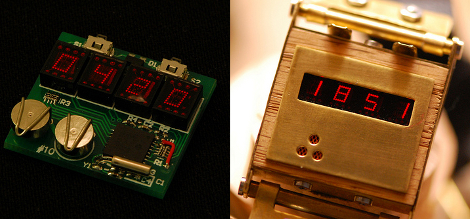
This wristwatch circuit board has some pretty interesting digits. They’re older components that give a classic look to your wristwatch display. On board you’ll find a PIC 16F628A running with an external clock crystal. The display isn’t always illuminated (kind of like Woz’s watch) in order to save the batteries, but can be woken up for a short time with the push of a button. The steam-punk-ish body seen to the left is the just first try. This guy has four more boards left so it should be fun to see what he comes up with.

[Via Hackaday Flickr Pool]