Featured Image

Ever Hear Of The Ford Cylon?

OK, we haven’t heard of a Ford Cylon either. However, there is now a Mustang Cobra out there that has been given a famous Cylon characteristic. [Monta Elkins] picked himself up an aftermarket third brake light assembly, hacked it, and installed it on said Mustang.

The brake light assembly contains 12 LEDs, which unfortunately, are not individually addressable. Additionally, by the looks of it, the brake light housing was not meant to be opened up. That didn’t get [Monta] down though. There’s more than one way to skin a cat, but he chose to use a hot knife to open the assembly, which worked quite well. A rotary cutter tool was used to cut the traces between the LEDs allowing them to be individually controlled with an Arduino. A Bluetooth module allows him to control the new brake light from his smartphone. There are different modes (including a special mode that he shows off at the end of the video) that can be selected via a Bluetooth Terminal app.

There is no schematic or code link in the video itself or the description, but [Monta] did hit the high points. Therefore, it shouldn’t be too hard to replicate.

This isn’t the first brake light hack we’ve featured. This one goes way beyond just animated lightsThis one requires no programming. Rather wear your brake light? We’ve got your back(pack).

LED Tail Lights For Improved Motorcycle Visibility

Motorcycles are hard to see at the best of times, so riders are often concerned with making themselves as visible as possible at all times. [Josh] wanted to do this by creating a custom tail light for his Ducati 749.

The tail light is based around SMD LEDs, mounted in acrylic to diffuse the light. The construction is beautiful, using custom PCBs and carefully machined acrylic to match the lines of the bike.

As far as warning lights go, a brighter light will be more obvious in the day time, but could actually hinder visibility at night by blinding other road users. To this end, [Josh] built the tail light around an ATtiny 45, which could be programmed with various routines to optimise the light level depending on ambient conditions. Another feature is that the light’s brightness pulses at high frequency in an attempt to attract the eye. Many automakers have experimented with similar systems. The ATtiny controls the lights through a PCA9952 LED controller over I2C. This chip has plenty of channels for controlling a bunch of LEDs at once, making the job easy.

Overall, it’s a very tidy build that lends a very futuristic edge to the bike. We’ve seen [Josh]’s work in this space before, too – with this awesome instrument display on a Suzuki GSX-R.

A Smart Table For Gamers

When makers take to designing furniture for their own home, the results are spectacular. For their senior design project, [Phillip Murphy] and his teammates set about building a smart table from the ground up. Oh, and you can also use it to play games, demonstrated in the video below.

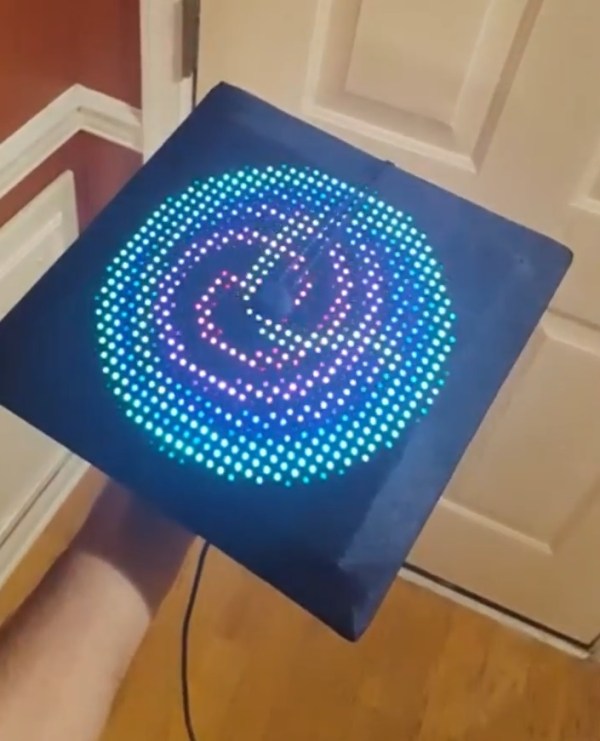
The table uses 512 WS2812 pixels in a 32 x 16 array which has enough resolution to play a selection of integrated games — Go, 2-player Tetris, and Tron light cycle combat — as well as some other features like a dancing bird party mode — because what’s the point of having a smart table if it can’t also double as rave lighting?

A C2000-family microcontroller on a custom board is the brains, and is controlled by an Android app via Bluetooth RN-42 modules. The table frame was designed in Sketchup, laser-cut, and painstakingly stained. [Murphy] and company used aluminum ducting tape in each of the ‘pixels’, and the table’s frame actually forms the pixel grid. Check out the overview and some of the games in action after the break.

Continue reading “A Smart Table For Gamers”

A LED Strip Clock As Linear As Time

We love custom clocks here at Hackaday, and are always thrilled to see each inventive means of time-keeping. In a seldom-seen take on the familiar device, the [Bastel Brothers]’s LED Strip Clock’s sleek profile finds itself in good company.

The clock is a two-metre strip of 60 LEDs; every minute past the current hour corresponds to one lit LED, every fifth LED is turned to red in order to make reading minutes easier. So 3 red LEDs +3 green LEDs=18 minutes, with the hour marked by a third color. Sounds complex, but the [Brothers] are quick to say you get used to it quickly, especially when the 6 o’clock LED is centered at some noticeable object or feature.

Continue reading “A LED Strip Clock As Linear As Time”

Hackaday Prize Entry: Brightenmacher

We have all at some point have made a flashlight. It used to be a staple of childhood electronics, the screw-in bulb in a holder, and a cycle lamp battery. If you were a particularly accomplished youthful hacker you might even have fitted a proper switch, otherwise, you probably made do with a bent paperclip and a drawing pin.

So you might think that flashlights offer no challenges, after all, how many ways can you connect a bulb or an LED to a battery? [Peter Fröhlich] though has a project that should put those thoughts out of your mind. It uses a power LED driven by a TI TPS61165 boost driver, with an ATTiny44 microcontroller providing control, battery sensing, and button interface. The result is a dimmable flashlight in a 3D printed case housing both control circuitry and a single 18650 cell which he sourced from a dead laptop. Suddenly that bent paperclip doesn’t cut it anymore.

The result is a flashlight that is the equal of any commercial offering, and quite possibly better than most of them. You can build one yourself, given that he’s published the physical files necessary, but probably because this is a work in progress there are as yet no software files.

We’ve featured a lot of flashlights over the years, but it’s fair to say they usually tend towards the more powerful. Back in 2015 we published a round-up of flashlight projects if it’s a subject that captures your interest.


Ask Hackaday: What About The Diffusers?

Blinky LED projects: we just can’t get enough of them. But anyone who’s stared a WS2812 straight in the face knows that the secret sauce that takes a good LED project and makes it great is the diffuser. Without a diffuser, colors don’t blend and LEDs are just tiny, blinding points of light. The ideal diffuser scrambles the photons around and spreads them out between LED and your eye, so that you can’t tell exactly where they originated.

We’re going to try to pay the diffuser its due, and hopefully you’ll get some inspiration for your next project from scrolling through what we found. But this is an “Ask Hacakday”, so here’s the question up front: what awesome LED diffusion tricks are we missing, what’s your favorite, and why?

Continue reading “Ask Hackaday: What About The Diffusers?”

Hackaday Prize Entry: Portable LED Flash For Photography

Photography is all about light. It’s literally right there in the name – stemming from the Greek word, photos. This is why photographers obsess over the time of day of a shoot, why Instagrammers coalesce around landmarks at sunset, and why a flash helps you take photos in darkness. Historically, flashes have worked in all manner of ways – using burning magnesium or xenon lamps for example. For this Hackaday Prize entry, [Yann Guidon] is developing a portable flash using LEDs instead.

By this point in time, you might be familiar with LEDs as flash units from your cellphone. However, [Yann] is taking this up a notch. The build is based around 100W LED modules, which obviously can pump out a lot of light. The interesting part of the build is its dual nature. The LEDs are intended to operate in one of two ways. The first is in a continuous lighting mode, running the modules well below their rated power to reduce the stress on the LEDs and power supply, and to enable the flash to run on the order of an hour. In this mode, temperature feedback will be used to control the LEDs to manage power use. The other is a pulsed mode, where the LED will be overvolted for a period of milliseconds to create a much more powerful flash.

It’s this dual nature which gives the LED-based flash a potential advantage over less versatile xenon-based units, which are limited to pulsed operation only. We can see the continuous lighting mode being particularly useful for videographers needing a compact, cheap lighting solution that can also work as a pulsed unit as well.We’re excited to see how [Yann] tackles the packaging, thermal and control issues as this project develops!