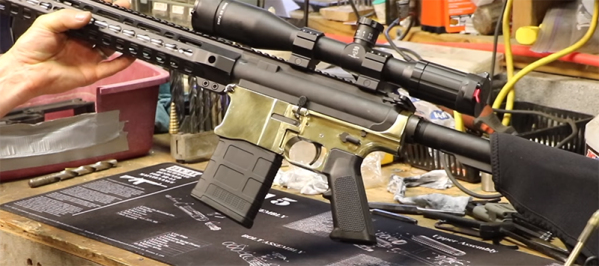
Is It A Golden Gun If It’s Made Out Of Brass?

On today’s episode of ‘this is a really neat video that will soon be demonetized by YouTube’ comes this fantastic build from [John]. It is the Golden Gun, or at least it looks like a Golden Gun because it’s made out of melted down brass casings. It’s a masterclass demonstration of melting stuff down and turning a thirteen-pound blob of metal into a two-pound precision machined instrument.

This build began by simply cutting a wooden block, packing it in sand, and melting approximately 1425 shell casings of various calibers in a DIY furnace. The molten brass was then simply poured into the open mold. This is standard yellow brass, with about 70% copper and 30% zinc. There’s a bit of aluminum in there from the primers, and the resulting block isn’t terribly great for machining. [John] says this could be fixed by adding a few percent of lead to the melt. To all the jokesters suggesting he add some unfired bullets to the melt, don’t worry, we already have that covered.
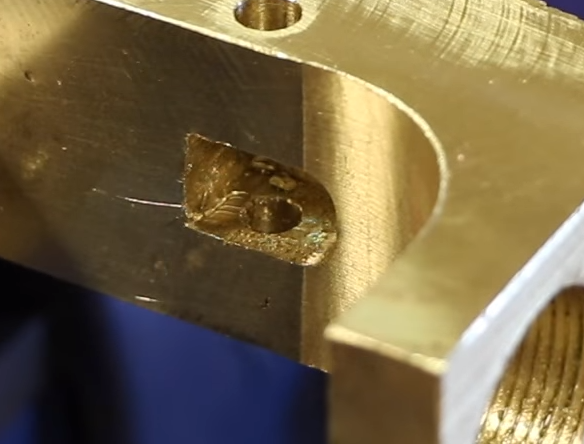
chiseling a hole square, with a chisel.

The machining went as you would expect it would with a large mill, but there are a few things that made this entire video worthwhile. For some of the holes, [John] had to square up the corners. The simplest and easiest way to do this is to break out a file. This is brass, though, and with some steel chisels hanging around the shop your mortise and tenon skills might come in handy. With the very careful application of force, [John] managed to put corners on a circle with a standard wood chisel. A bit later in the build video, a few more sharp corners were created by shoving a broach in the mill and jamming it down into the work.

When it comes to machining builds, this is high art. Yes, it’s the same as building an AR-15 out of a few hundred soda cans, but this one is made out of brass. It looks just great, and that final polish turns the entire project into something that looks like it’s out of a video game. Simply amazing.

If you’re looking for more ways to push your metalwork boundaries, give cast iron a try!

Continue reading “Is It A Golden Gun If It’s Made Out Of Brass?”

Mechanisms: Abrasives

In our “Mechanisms” series, we’ve featured the fascinating bits and pieces that go into making our mechanical world work. From simple machines such as screws and levers, from springs to couplings, and even more complex mechanisms like zippers and solenoids, we’ve covered the gamut. But we haven’t talked about one of the very earliest mechanisms, captured from nature by our clever ancestors to do useful work like grinding grain and shaping materials into tools: grit, sand, abrasives.

Continue reading “Mechanisms: Abrasives”

Shutter Bug Goes Extreme With Scratch-Built Film Camera

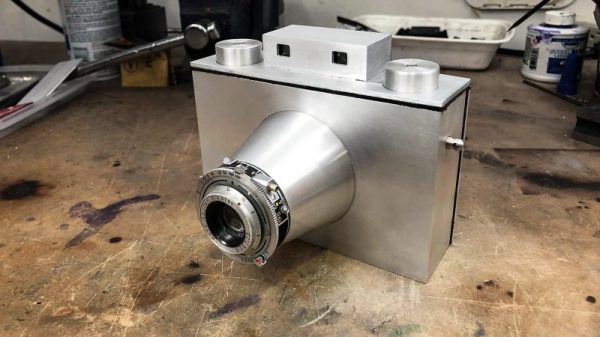
Should a camera build start with a sand mold and molten aluminum? That’s the route [CroppedCamera] took with this thoroughly impressive camera project.

When we think of cameras these days, chances are we picture the ones that live inside the phones in our pockets. They’re the go-to image capture devices for most of us, but even for the more photographically advanced among us, when a more capable camera is called for, it’s usually an off-the-shelf DSLR from Canon, Nikon, or the like. Where do hand-built cameras fall in today’s photography world? They’re a great way to add a film option to your camera collection.

[CroppedCamera] previously built a completely custom large-format view camera, but for this build he decided that something a bit more portable might do. The body of the camera is scratch-built from aluminum, acting as the lightproof box to hold the roll film and mount the leaf-shutter lens. There’s an impressive amount of metalwork here — sand casting, bending, TIG welding, and machining all came into play, and most of them new skills to [CroppedCamera]. We were especially impressed with the shrink-fit of the lens cone to the body. It’s unconventional looking for sure, but not without its charm, and it’s sure to make a statement dangling around his neck.

It’s tough to find non-digital DIY camera builds around here — best we could do were these laser-cut plywood modular cameras. Then again, you can’t beat this wearable camera for functional style.

Continue reading “Shutter Bug Goes Extreme With Scratch-Built Film Camera”

Rotary Electric Gun Might Not Put Your Eye Out, Kid

This one is clearly from the “it’s all fun and games until someone loses an eye” file, and it’s a bit of a departure from [Make It Extreme]’s usual focus on building tools for the shop. But what’s the point of having a well-equipped shop if you don’t build cool things, like this unique homebrew electric gun?

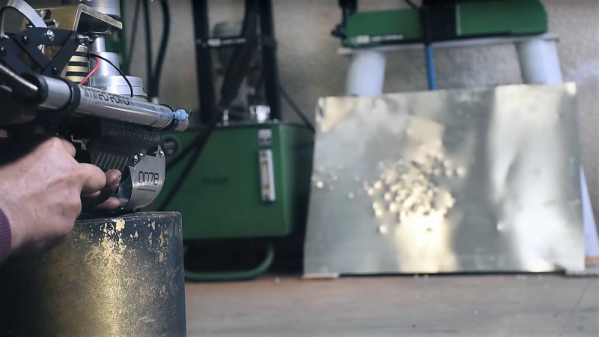
When we hear “electric gun” around here, we naturally think of the rail guns and coil guns we feature on a regular basis, which use stored electric charge to accelerate a projectile using electromagnetic forces. This gun is much simpler than that, using purely mechanical means to accelerate the projectiles. The heart of the unit is a machined aluminum spiral from an old scroll compressor, which uses interleaved orbiting spirals to compress gasses. This scroll was cut down to reduce its mass and fixed to a complex shaft assembly allowing it to spin up to tremendous speed with a powerful electric motor. A hopper feeds the marble-sized ammo into the eye of the scroll, which spits it out at high speed. Lacking a barrel, the gun can only spew rounds in the general direction of the target, but it makes up for inaccuracy with an impressive rate of fire — 100 rounds downrange in two seconds. It’s pretty powerful, too, judging by the divots in the sheet steel target in the video below.

Like all of [Make It Extreme]’s build, a lot of effort went into this, and it shows. Their other fun builds of dubious safety include these electromagnetic wall climbers and these “Go Go Gadget” legs.

Continue reading “Rotary Electric Gun Might Not Put Your Eye Out, Kid”

Touchless Shop Doors Over-Engineered To A Blissful Level

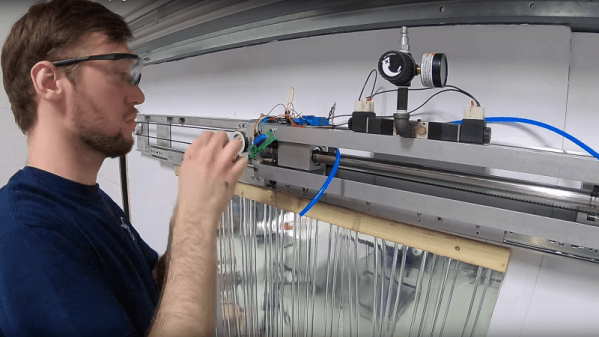
When [John Saunders] wanted an automatic door for his shop, rather than settle for a commercial unit, he designed and built a proximity-sensing opener to ease his passing. Sounds simple, right?

Fortunately for us, there are no half-measures at Saunders Machine Works, thanks to the multiple Tormach workcells and the people who know how to use them. The video below treats us to quite a build as a result; the first part is heavy on machining the many parts for the opener, so skip ahead to 8:33 if you’re more interested in the control electronics and programming.

The opener uses time-of-flight distance sensors and an Arduino to detect someone approaching, with a pneumatic cylinder to part a plastic strip curtain. [John] admits to more than a little scope creep with this one, which is understandable when you’ve got easy access to the tools needed to create specialized parts at will.

In the end, though, it works well for everyone but [Judd], the shop dog, and it certainly looks like it was a fun build to boot. [John]’s enthusiasm for mixing machining and electronics is infectious; check out his automated bowl feeder for assembly line use.

Continue reading “Touchless Shop Doors Over-Engineered To A Blissful Level”

The King Of Machine Tools

The lathe is known as the King of Machine Tools for a reason. There are very few things that you can’t make with one. In fact, people love to utter the old saw that the lathe is the only machine tool that can make itself. While catchy, I think that’s a bit disingenuous. It’s more accurate to say that there are parts in all machine tools that (arguably) only a lathe can make. In that sense, the lathe is the most “fundamental” machine tool. Before you harbor dreams of self-replication, however, know that most of an early lathe would be made by hand scraping the required flat surfaces. So no, a lathe can’t make itself really, but a lathe and a skilled craftsperson with a hand-scraper sure can. In fact, if you’ve read the The Metal Lathe by David J. Gingery, you know that a lathe is instrumental in building itself while you’re still working on it.

We’re taking trip through the machining world with this series of articles. In the previous article we went over the history of machine tools. Let’s cut to the modern chase now and help some interested folks get into the world of hobby machining, shall we? As we saw last time, the first machine tools were lathes, and that’s also where you should start.

Continue reading “The King Of Machine Tools”

Mini Lathe Makes Tiny Hydraulic Cylinders For RC Snow Plow

You can get pretty much any part you need online these days, but some specialty parts are a little hard to come by. So if your needs are esoteric, like tiny hydraulic cylinders for RC snow plows, you might just have to roll your own.

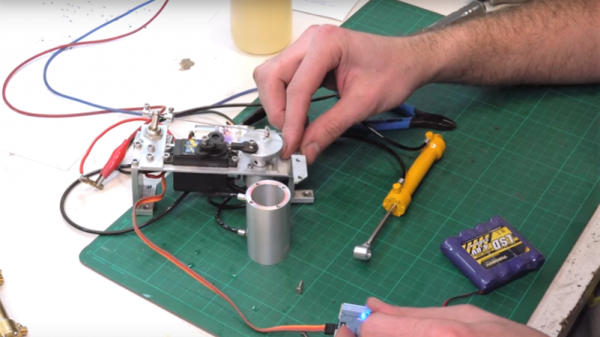
To be honest, we never really knew that realistic working hydraulics on such a small scale were a thing, but [tintek33]’s video below opened our eyes to a new world of miniature mechanicals. You’d think a linear actuator would be a fine stand-in for the hydraulic ram on a tiny snow plow for an RC truck, but apparently no detail is too small to address in painstaking detail. And as with many things in life, the lathe is the way to get there. Every part is scratch-built from raw brass, aluminum and steel on a mini lathe, with the exception of a few operations that were sent over to the mill that could have been done with hand tools in a pinch. The video is longish, so if you’re not into machining you can skip to 16:40 or so and pick the action up at final assembly. The finely finished cylinder is impressively powerful when hooked up to [tintek33]’s hydraulic power pack, and looks great on the plow. He’s got some other videos on his site of the RC snow plow in action that are worth a look, too.

Ready to take the plunge with a lathe but don’t know where to start? We’ve covered the basics of adopting a new lathe before.

Continue reading “Mini Lathe Makes Tiny Hydraulic Cylinders For RC Snow Plow”