Poké Ball Plus Teardown Reveals No Pikachu Inside

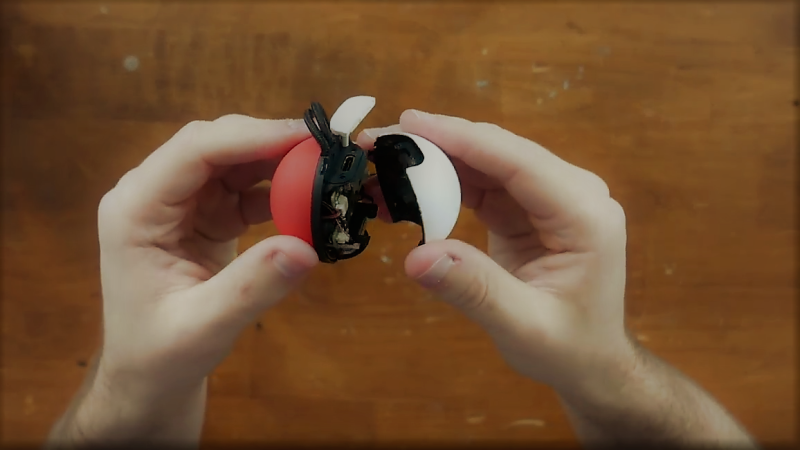
The latest entry in the fan favorite franchise Pokémon saw release earlier this month alongside a particularly interesting controller. Known as the Poké Ball Plus, this controller is able to control Pokémon games that are available on completely separate platforms, as well as transfer data between them. It rumbles, It talks, it lights up, it’s wireless, and [Spawn] uploaded a video that reveals what’s really inside.

Continue reading “Poké Ball Plus Teardown Reveals No Pikachu Inside”

“Yell To Press B” Mod Makes N64 Controller Worse

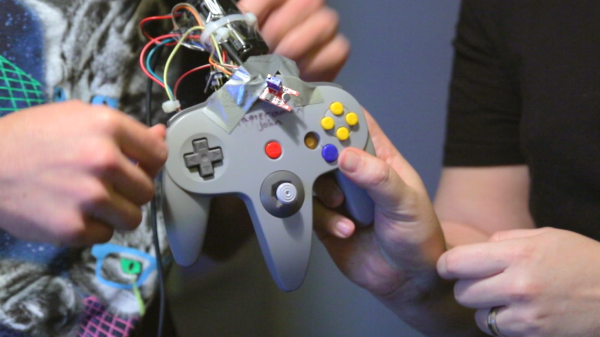
There’s probably no reason anyone would actually desire a mod like this. Well, no good reason. But [William Osman] had been pondering what it would be like to play some classic games with inputs other than buttons, and decided to make an audio sensor responsible for pressing the B button on an old N64 controller. This “Yell To Press B” mod was also something unique to show his hosts when he visited the YouTube video game aficionados, [Game Grumps].

[William] acknowledges that the build is a bit of a hack job, but the project page does a good job of documenting his build process and covering the kinds of decisions involved in interfacing to a separate piece of hardware. After all, most budding hackers have sooner or later asked themselves “how do I make my gadget press a button on this other thing?” [William] ends up using a small relay to close the connection between the traces for the B button when triggered by a microphone module, but he points out that it should be possible to do a non-destructive version of the mod. Examples exist of reading the N64 controller’s state with an Arduino, which could form the basis of a man-in-the-middle approach of “Yell To Press B” (or anything else) instead of soldering to the button contacts. A video is embedded below, in which you can watch people struggle to cope with the bizarre mod.

Continue reading ““Yell To Press B” Mod Makes N64 Controller Worse”

That Time Atari Cracked The Nintendo Entertainment System

It was darkest hour for the video game industry following the holiday shopping season of 1982. The torrent of third party developed titles had flooded the home video game console market to the point of saturation. It incited a price war amongst retailers where new releases were dropped to 85% off MSRP after less than a month on the shelves. Mountains of warehouse inventory went unsold leaving a company like Atari choosing to dump the merchandise into the Chihuahuan desert rather than face the looming tax bill. As a result, the whole home video game industry receded seemingly overnight.

One company single-handedly revived video games to mainstream prominence. That company was Nintendo. They’re ostensibly seen as the “savior” of the video games industry, despite the fact that microcomputer games were still thriving (history tends to be written by the victors). Nevertheless their Nintendo Entertainment System (NES) was an innovative console featuring games with scrolling screens, arcade-like sprites. But the tactic they used to avoid repeating the 1983 collapse was to tightly control their market using the Nintendo Seal of Quality.

From the third party developer perspective, Nintendo’s Seal of Quality represented more than just another logo to throw on the box art. It represented what you could and couldn’t do with your business. Those third party licensing agreements dictated the types of games that could be made, the way the games were manufactured, the schedule on which the games shipped to retail, and even the number of games your company could make. From the customer side of things that seal stood for confidence in the product, and Nintendo would go to great lengths to ensure it did just that.

This is the story of how an Atari subsidiary company cracked the hardware security of the original Nintendo and started putting it into their unofficial cartridges.

Continue reading “That Time Atari Cracked The Nintendo Entertainment System”

Listen To A Song Made From Custom Nintendo LABO Waveform Cards

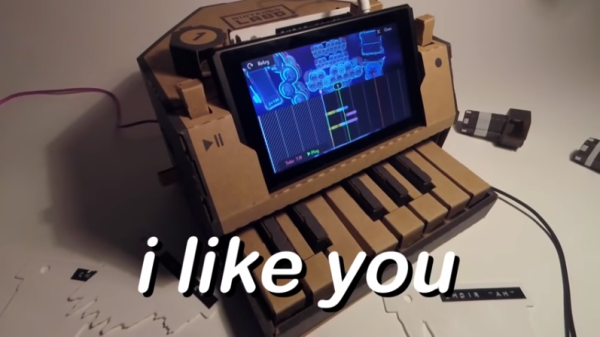
[Hunter Irving] has been busy with the Nintendo LABO’s piano for the Nintendo Switch. In particular he’s been very busy creating his own custom waveform cards, which greatly expands the capabilities of the hackable cardboard contraption. If this sounds familiar, it’s because we covered his original method of creating 3D printed waveform cards that are compatible with the piano, but he’s taken his work further since then. Not only has he created new and more complex cards by sampling instruments from Super Nintendo games, he’s even experimented with cards based on vowel sounds in an effort to see just how far things can go. By layering the right vowel sounds just so, he was able to make the (barely identifiable) phrases I-LIKE-YOU, YOU-LIKE-ME, and LET’S-A-GO.

Those three phrases make up the (vaguely recognizable) lyrics of a song he composed using his custom waveform cards for the Nintendo LABO’s piano, appropriately titled I Like You. The song is at the 6:26 mark in the video embedded below, but the whole video is worth a watch to catch up on [Hunter]’s work. The song is also hosted on soundcloud.

Continue reading “Listen To A Song Made From Custom Nintendo LABO Waveform Cards”

World’s Smallest Wii Is Also World’s Worst

As far as game consoles go, the Nintendo Wii was relatively small. Probably owing at least somewhat to the fact that it wasn’t a whole lot more than a slightly improved GameCube in a new case, but that’s another story entirely. So it’s not much of a surprise that people have modded Nintendo’s infamous money printing machine into handheld versions. But this…this is just something else.

We’re going to go out on a limb and say that this absolutely preposterous build by [Shank] which puts a fully functional Nintendo Wii into an Altoids tin wins the title of “World’s Smallest Wii”. We’re also going to put money on the fact that this record doesn’t get beaten because…well, come on. There’s a reason he’s named his diminutive creation the “Kill Mii”.

You’re probably wondering how this is possible. That’s an excellent question. As it turns out, hackers have discovered that you can cut off the majority of the Wii’s motherboard and still have a functioning system, albeit missing non-essential functions like the GameCube controller ports and SD card slot. From there, you just need to install a new firmware on the now heavily trimmed down Wii that tells it to ignore the fact it has no disc drive and load games as ISOs from an attached USB flash drive. That’s the high level summary anyway, the reality is that this a mod of crushing difficulty and should only be attempted by true masochists.

As for this particular build, [Shank] went all in and even relocated the Wii’s NAND chip to make everything fit inside the tin. There’s also custom PCBs which interface the Wii’s motherboard with the Nintendo 3DS sliders he’s using for control sticks. Underneath everything there’s a battery that can run the whole device for a grand total of about 10 minutes, but given the general shape of the “Kill Mii” and the fact that most of the buttons are tactile switches, that’s probably about as long as you’d want to play the thing anyway.

Yes, this is the worst Wii ever made. But that was also the point. In the words of the creator himself “This portable is not logical, comfortable, or practical. But it must be done… for the memes.” Truly an inspiration to us all.

Incidentally, this isn’t the first “trimmed” Wii portable we’ve seen; though that one was considerably more forgiving internally, and just a bit more practical.

Continue reading “World’s Smallest Wii Is Also World’s Worst”

Metroid, Zelda, And Castelvania Auto-Mapped With NES Emulation & Heuristics

The NES was one of the flagship consoles of the glorious era that was the 1980s. Many of the most popular games on the platform involved some sort of adventure through scrolling screens — Metroid, Super Mario, and Zelda all used this common technique. For many games, keeping track of the map was a huge chore and meant mapping by hand on graph paper or using the screenshots published in Nintendo Power magazine. These day’s there’s a better way. [Daniel] set out to automatically map these huge two-dimensional worlds, developing software he calls WideNES to do it.

WideNES is an add-on to [Daniel]’s own NES emulator, ANESE. As part of the emulator, WideNES can easily read the various registers of the NES’s Picture Processing Unit, or PPU. The registers of the PPU are used to control the display of the background and sprite layers of NES graphics, and by monitoring these, it is possible to detect and map out the display of levels in various NES games.

It’s an interesting piece of software that relies on a thorough understanding of the NES display hardware, as well as the implementation of some neat tricks to deal with edge cases such as vertical scrolling in The Legend of Zelda or room changes in games like Castlevania — the use of perceptual hashing is particularly genius. There’s source and more available on the project page, including a GitHub link, if you’re interested in getting down to brass tacks.

We’re impressed by the manner in which WideNES is able to so neatly map out these games of yesteryear, and can’t wait to see where the project goes next. [Daniel] notes that it should be possible to integrate into more popular emulators without too much trouble. If that’s not enough, check out this reverse-emulation Nintendo hack.

[Thanks to Michael for the tip!]

Using Modern Nintendo Controllers On The C64

There are plenty of people out there who still enjoy playing games on vintage computers like the Commodore 64. But while they likely return to these classic games themselves out of a sense of nostalgia, the feeling doesn’t always extend to the hardware itself. For example, one can enjoy playing Impossible Mission without having to use a contemporary C64 joystick.

Thanks to an open source project developed by [Robert Grasböck], C64 owners who want to take advantage of the improvements made to gaming controllers in the nearly 40 years since the system’s release now have another option. Called Nunchuk64, it allows you to use various Nintendo controllers which make use of the Wii “Nunchuk” interface on original C64 hardware. This includes the controllers from the recent “Classic Edition” NES and SNES systems, which offer a decidedly retro feel with all the benefits of modern technology and construction techniques.

Both the hardware and software for Nunchuck64 are open source, and everything you need to build your own version is in the project’s repository. [Robert] even has assembly instructions, complete with images, which walk you through building your own copy of the hardware and flashing the firmware onto it. This is a nice touch that we very rarely see even in open source projects. The board is populated with a ATmega328P microcontroller and a handful of passive components, making assembly fairly straightforward assuming you are comfortable with SMD work.

Bringing more modern controllers to classic systems seems to be gaining popularity recently, within the last few months we’ve seen Xbox 360 controllers on the Nintendo 64, and newly manufactured pads for the Atari 5200.

Continue reading “Using Modern Nintendo Controllers On The C64”