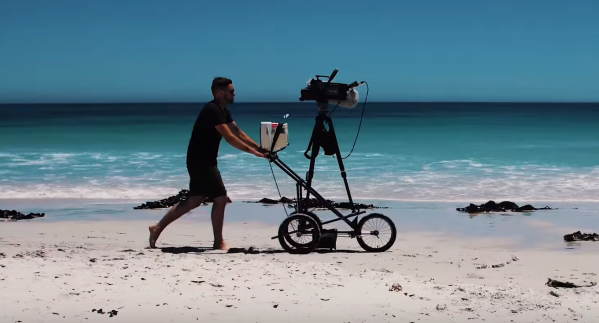
[Dan Mace] decided to try vlogging 1980s style. To do this, he built Pram Cam — a one-man mobile video recording setup using vintage gear. [Dan] is a YouTuber from Cape Town, South Africa. His goal for this project was to motivate people to get out there and make videos. Smartphones, action cams, and modern video equipment all have made it incredibly easy to create content.
[Dan] reminds us of this by grabbing a vintage 1984 video camera – a Grundig vs150 VHS recorder. He couples the camera with a sturdy video tripod, blimp microphone, CRT TV as a monitor, and everything else needed for a period-accurate recording setup.
In a build sequence even the A-Team would appreciate, [Dan] tears down a rusty old three wheel pram, or baby carriage for the Americans out there. He then mounts the video setup to the pram frame using duct tape, zip ties, and a few odd pieces of wood. The result is a proper hacked off-road rolling video studio.
He then uses Pram Cam to film some of the great scenery in Cape Town — beaches, rocky cliffs, and even a helicopter ride. To say the pram was a bit more cumbersome than a cell phone would be the understatement of the year.
The video quality from the camera looks quite a bit worse than we would expect. Some of this may be due to Dan’s digitizing system though the chances are it’s from the camera itself. The Grundig captured video using a Saticon, which was Hitachi’s version of the video camera tube. That’s right, this is a tube based camera – no CMOS sensor, nor CCD. Tubes might not have Jello effect, but they do have all the blooming, motion blur, and other problems one might expect from a 34-year-old device.
What becomes of the Pram Cam? You’ll have to watch the video below to find out. Dan’s message is clear though: get out there and film something. Of course this is Hackaday, so if we’ll add that you should build something — then film it!