Six Wheels (En)rolling: Mars Rovers Going To School

Few things build excitement like going to space. It captures the imagination of young and old alike. Teachers love to leverage the latest space news to raise interest in their students, and space agencies are happy to provide resources to help. The latest in a long line of educator resources released by NASA is an Open Source Rover designed at Jet Propulsion Laboratory.

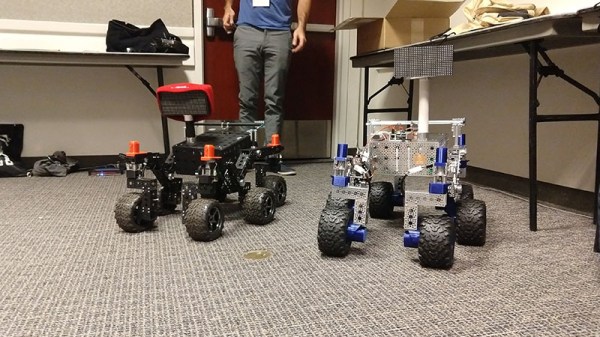
JPL is the birthplace of Mars rovers Sojourner, Spirit, Opportunity, and Curiosity. They’ve been researching robotic explorers for decades, so it’s no surprise they have many rovers running around. The open source rover’s direct predecessor is ROV-E, whose construction process closely followed procedures for engineering space flight hardware. This gave a team of early career engineers experience in the process before they built equipment destined for space. In addition to learning various roles within a team, they also learned to work with JPL resources like submitting orders to the machine shop to make ROV-E parts.

Once completed, ROV-E became a fixture at JPL public events and occasionally visits nearby schools as part of educational outreach programs. And inevitably a teacher at the school would ask “The kids love ROV-E! Can we make our own rover?” Since most schools don’t have 5-axis CNC machines or autoclaves to cure carbon fiber composites, the answer used to be “No.”

Until now.

Continue reading “Six Wheels (En)rolling: Mars Rovers Going To School”

Robot Rovers Of The Early Space Race

In the early 1970s, the American space program was at a high point, having placed astronauts upon the surface of the moon while their Soviet competitors had not taken them beyond an Earth orbit. It is however a simplistic view to take this as meaning that NASA had the lead in all aspects of space exploration, because while Russians had not walked the surface of our satellite they had achieved a less glamorous feat of lunar exploration that the Americans had not. The first Lunokhod wheeled rover had reached the lunar surface and explored it under the control of earth-bound engineers in the closing months of 1970, and while the rovers driven by Apollo astronauts had placed American treadmarks in the  lunar soil and been reproduced on newspaper front pages and television screens worldwide, they had yet to match the Soviet achievements with respect to autonomy and remote control.

At NASA’s Jet Propulsion Laboratory there was a project to develop technology for future American rovers under the leadership of [Dr. Ewald Heer], and we have a fascinating insight into it thanks to the reminiscences of [Mike Blackstone], then a junior engineer.
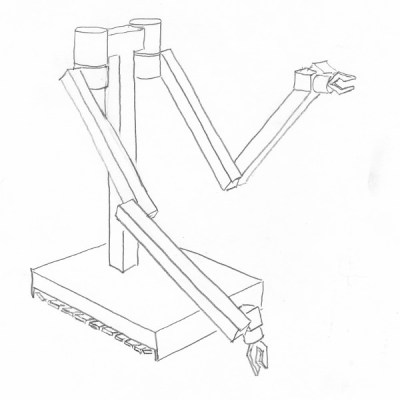
The aim of the project was to demonstrate the feasibility of a rover exploring a planetary surface, picking up, and examining rocks. Lest you imagine a billion dollar budget for gleaming rover prototypes, it’s fair to say that this was to be achieved with considerably more modest means. The rover was a repurposed unit that had previously been used for remote handling of hazardous chemicals, and the project’s computer was an extremely obsolete DEC PDP-1.

We are treated to an in-depth description of the rover and its somewhat arcane control system. Sadly we have no pictures save for his sketches as the whole piece rests upon his recollections, but it sounds an interesting machine in its own right. Heavily armoured against chemical explosions, its two roughly-humanoid arms were operated entirely by chains similar to bicycle chains, with all motors resting in its shoulders. A vision system was added in the form of a pair of video cameras on motorised mounts, these could be aimed at an object using a set of crosshairs on each of their monitors, and their angles read off manually by the operator from the controls. These readings could then be entered into the PDP-1, upon which the software written by [Mike] could calculate the position of an object, calculate the required arm positions to retrieve it, and command the rover to perform the required actions.

The program was a success, producing a film for evaluation by the NASA bigwigs. If it still exists it would be fascinating to see it, perhaps our commenters may know where it might be found. Meanwhile if the current JPL research on rovers interests you, you might find this 2017 Hackaday Superconference talk to be of interest.

Thanks [JRD] for the tip.

Watney: A Fully 3D Printed Rover Platform

We’re getting to the point that seeing 3D printed parts in a project or hack isn’t as exciting as it was just a few years ago. The proliferation of low-cost desktop 3D printers means that finding a printer to squirt out a few parts for your build isn’t the adventure it once was. Gone are the days of heading to a local hackerspace or college hoping their janky Mendel felt like working that day. But all that really means is that hackers and makers now have the ability to utilize 3D printing even more. Forget printing one or two parts of your design, just print the whole thing.

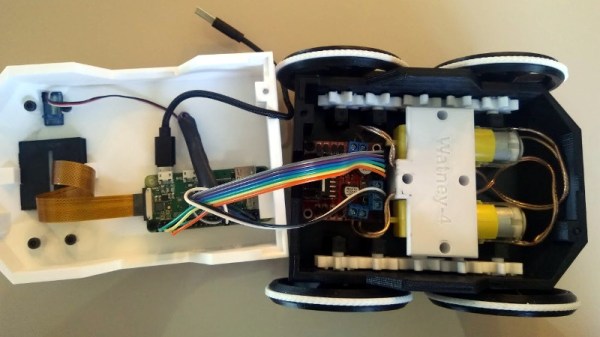
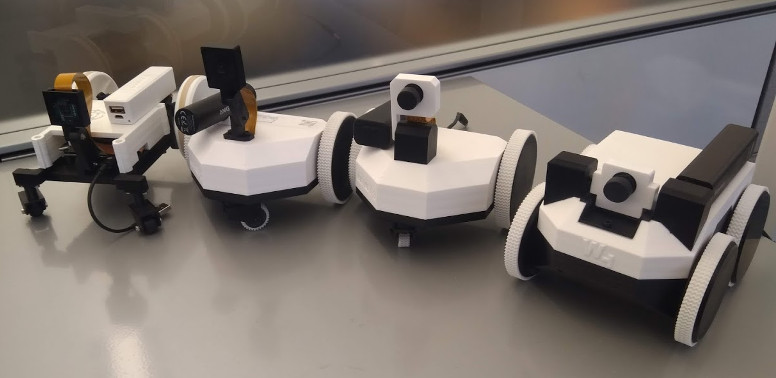
That’s exactly what [Nik Ivanov] did with Watney, his fully 3D printed rover project. After lamenting that many so-called 3D printed rovers were anything but, he set out to design one that was not only made primarily of printed parts, but was robust enough to put some real work in. Over the course of several design iterations, he built a very capable all-wheel drive platform that needs only some electronics and a handful of M3 screws to leap into action.

As long as you’ve got a 3D printer big enough to handle the roughly 120mm x 190mm dimensions of this bot’s body, you’re well on the way to owning your very own video rover. [Nik] recommends printing everything in PETG, no doubt for its increased strength when it comes to things like the drive gears. Plus it’s low warp, which is really going to help when printing the top and bottom sections of the body. TPU is advised for the tires, but if you don’t have any (or your printer chokes on flexible filaments) you can just wrap the wheels with wide rubber bands.

[Nik] is using a Raspberry Pi Zero W as the brains of the operation, but the beauty of an open platform like this is that you could easily swap out the controls for something else to meet your needs. In addition to the Pi, there’s a L298N H-bridge motor controller to interface with the dual geared motors, as well as a servo to provide tilt for the SainSmart camera module.

We’ve often been surprised at just how expensive commercial robotics platforms can be, so we’re keenly interested in seeing if the availability of designs like this spur on DIY rover development. Though if you’re looking for something a little more rough and tumble, we’ve seen a 3D printed rover that looks combat-ready.

Continue reading “Watney: A Fully 3D Printed Rover Platform”

3D Printed Arduino Bot Is Limbo Master

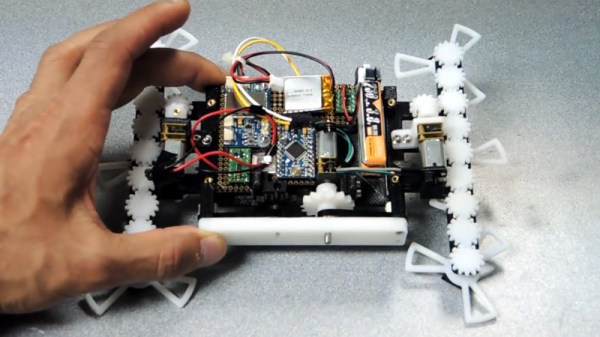
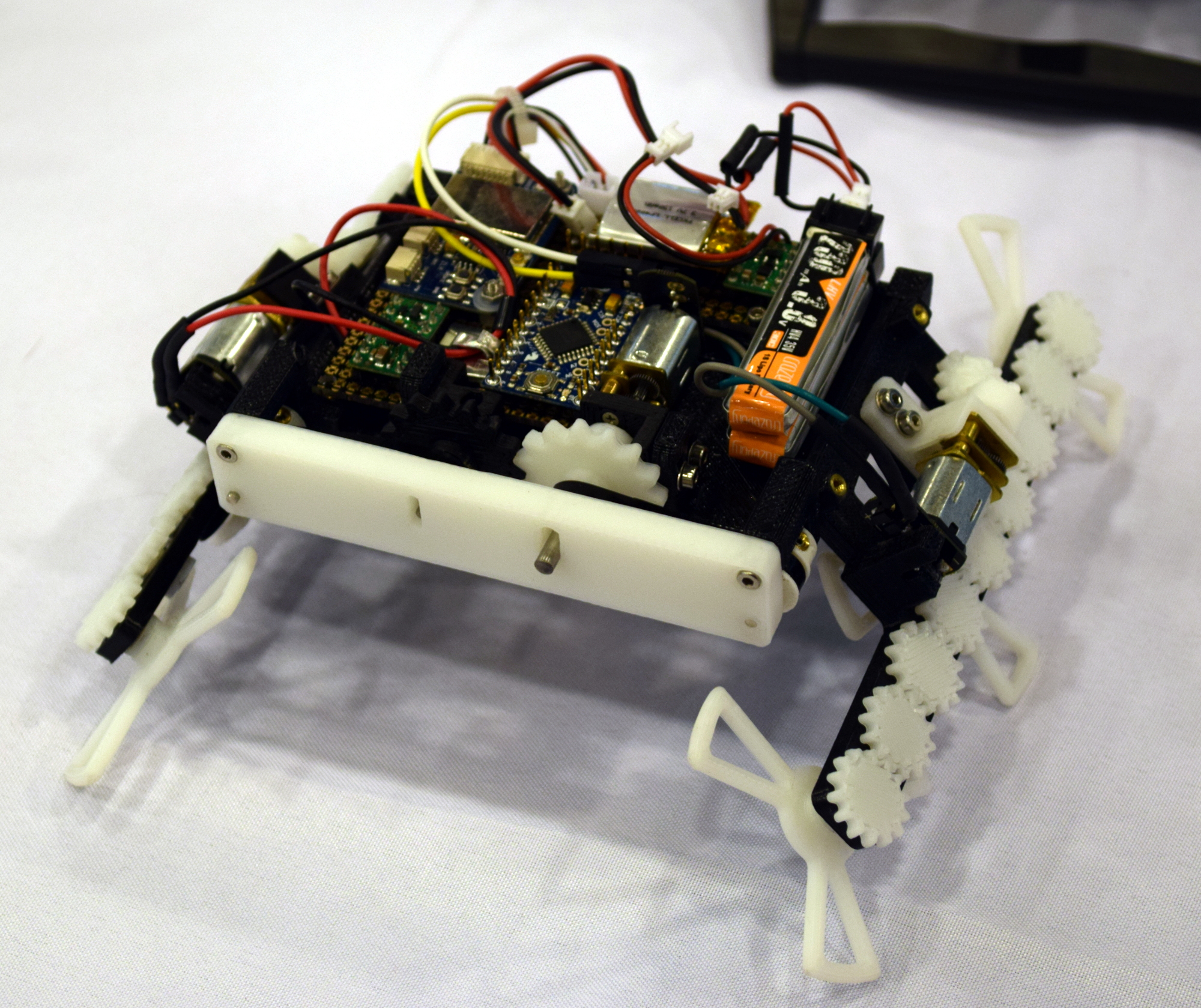
As if we didn’t have enough to worry about in regards to the coming robot uprising, [Ali Aslam] of Potent Printables has recently wrapped up work on a 3D printed robot that can flatten itself down to the point it can fit under doors and other tight spaces. Based on research done at UC Berkeley, this robot is built entirely from printed parts and off the shelf hardware, so anyone can have their own little slice of Skynet.

On display at East Coast RepRap Festival

The key to the design are the folding “wings” which allow the robot to raise and lower itself on command. This not only helps it navigate tight spaces, but also gives it considerable all-terrain capability when it’s riding high. Rather than wheels or tracks, the design uses six rotors which look more like propellers than something you’d expect to find on a ground vehicle. These rotors work at the extreme angles necessary when the robot has lowered itself, and allow it to “step” over obstructions when they’re vertical.

For the electronics, things are about what you’d expect. An Arduino Pro Mini combined with tiny Pololu motor controllers is enough to get the bot rolling, and a Flysky FS-X6B receiver is onboard so the whole thing can be operated with a standard RC transmitter. The design could easily be adapted for WiFi or Bluetooth control if you’d rather not use RC gear for whatever reason.

Want to build your own? All of the STL files, as well as a complete Bill of Materials, are available on the Thingiverse page. [Ali] even has a series of videos on YouTube videos walking through the design and construction of the bot to help you along. Outside of the electronics, you’ll need a handful of screws and rods to complement the 50+ printed parts. Better start warming up the printer now.

As an interesting aside, we got a chance to see this little critter first hand at the recent East Coast RepRap Festival in Maryland, along with a number of other engineering marvels.

Continue reading “3D Printed Arduino Bot Is Limbo Master”

An Arduino Powered Tank Built To Pull Planes

Surely our readers are well aware of all the downsides of owning an airplane. Certainly the cost of fuel is a big one. Birds are a problem, probably. That bill from the traveling propeller sharpener is a killer too…right? Alright fine, we admit it, nobody here at Hackaday owns an airplane. But probably neither do most of you; so don’t look so smug, pal.

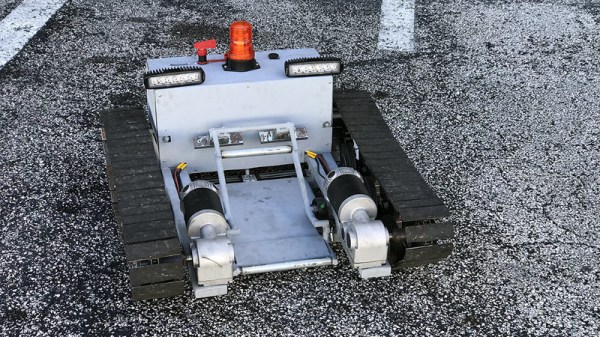
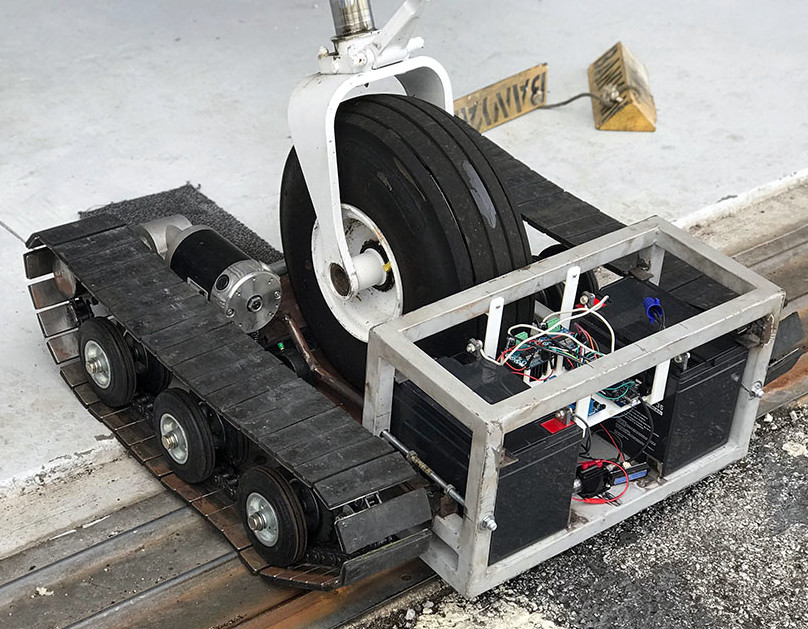
But if you did own a plane, or at least work at a small airport, you’d know that moving the things around on the ground is kind of a hassle. Smaller planes can be pulled by hand, but once they get up to a certain size you’ll want some kind of vehicle to help out. [Anthony DiPilato] wanted a way to move around a roughly 5,200 pound Cessna 310, and decided that all the commercial options were too expensive. So he built his own Arduino powered tank to muscle the airplane around the tarmac (if site is down try Google cache), and his journey from idea to finished product is absolutely fascinating to see.

So the idea here is pretty simple. A little metal cart equipped with two beefy motors, an Arduino Mega, a pair of motor controllers, and a HC-08 Bluetooth module so you can control it from your phone. How hard could it be, right? Well, it turns out combining all those raw components into a little machine that’s strong enough to tow a full-scale aircraft takes some trial and error.

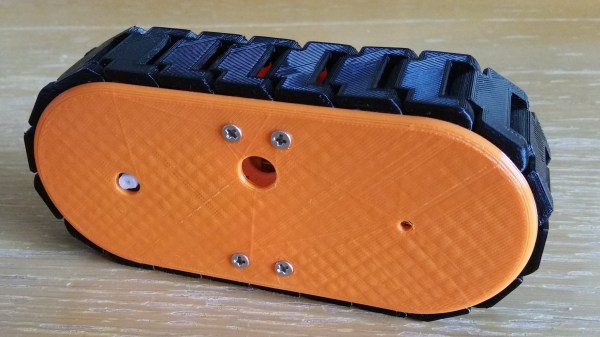
It took [Anthony] five iterations before he fine tuned the design to the point it was able to successfully drag the Cessna without crippling under the pressure. The early versions featured wheels, but eventually it was decided that a tracked vehicle would be required to get enough grip on the blacktop. Luckily for us, each failed design is shown along with a brief explanation about what went wrong. Admittedly it’s unlikely any of us will be recreating this particular project, but we always love to see when somebody goes through the trouble of explaining what went wrong. When you include that kind of information, somewhere, somehow, you’re saving another maker a bit of time and aggravation.

Hackers absolutely love machines with tank treads. From massive 3D printed designs to vaguely disturbing humanoid robots, there’s perhaps no sweeter form of locomotion in the hacker arsenal.

Continue reading “An Arduino Powered Tank Built To Pull Planes”

Control A Swarm Of RC Vehicles With ESP8266

Over at RCgroups, user [Cesco] has shared a very interesting project which uses the ever-popular ESP8266 as both a transmitter and receiver for RC vehicles. Interestingly, this code makes use of the ESP-Now protocol, which allows devices to create a mesh network without the overhead of full-blown WiFi. According to the Espressif documentation, this mode is akin to the low-power 2.4GHz communication used in wireless mice and keyboards, and is designed specifically for persistent, peer-to-peer connectivity.

Switching an ESP8266 between being a transmitter or receiver is as easy as commenting out a line in the source code and reflashing the firmware. One transmitter (referred to as the server in the source code) can command eight receiving ESP8266s simultaneously. [Cesco] specifically uses the example of long-range aircraft flying in formation; only coming out of the mesh network when it’s time to manually land each one.

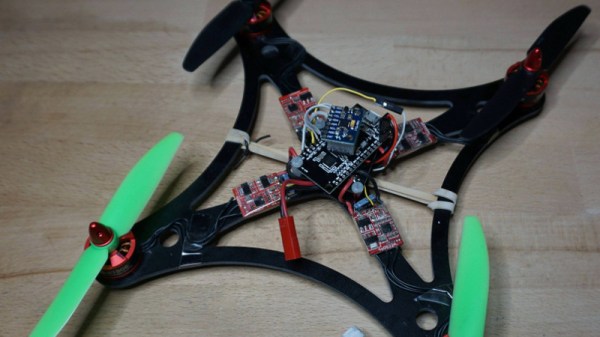
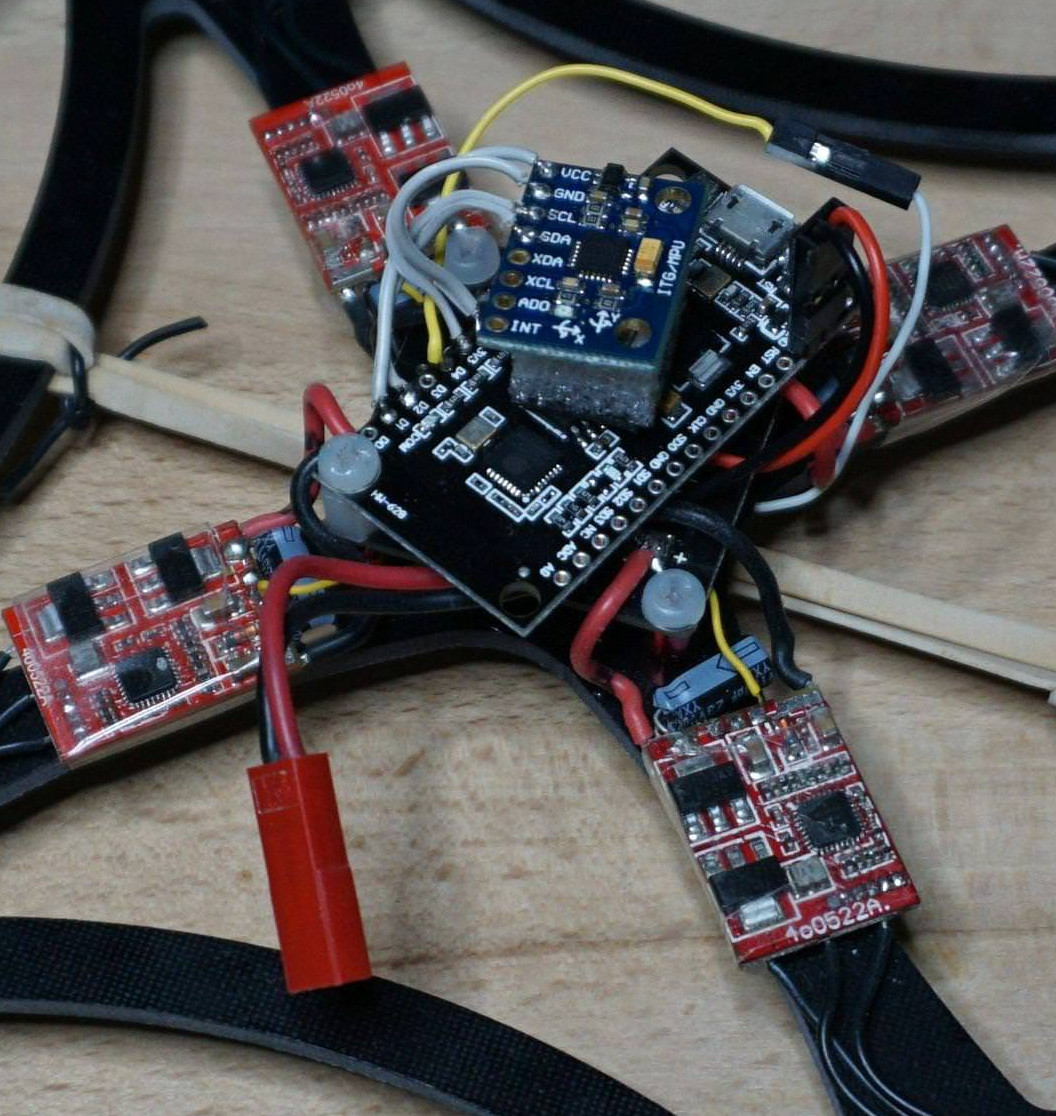
[Cesco] has done experiments using both land and air vehicles. He shows off a very hefty looking tracked rover, as well as a quickly knocked together quadcopter. He warns the quadcopter flies like “a wet sponge”, but it does indeed fly with the ESP’s handling all the over the air communication.

To be clear, you still need a traditional PPM-compatible RC receiver and transmitter pair to use his code. The ESPs are simply handling the over-the-air communication. They aren’t directly responsible for taking user input or running the speed controls, for example.

This isn’t the first time we’ve seen an ESP8266 take the co-pilot’s seat in a quadcopter, but the maniacal excitement we feel when considering the possibility of having our very own swarm of flying robots gives this particular project an interesting twist.

Remember When Scratch-Built Robots Were Hard?

Even simple robots used to require quite a bit of effort to pull together. This example shows how far we’ve come with the tools and techniques that make things move and interact. It’s a 3D printed rover controlled by the touchscreen on your phone. This achieves the most basic building block of wheeled robotics, and the process is easy on you and your pocketbook.

We just can’t stop loving the projects [Greg Zumwalt], aka[gzumwalt], is turning out. We just saw his air-powered airplane engine and now this little rover perks our ears up. The design uses the familiar trick of two powered wheels with a ball bearing to avoid problems with differential turning. But the simplicity is all in the implementation.

This bot is 3D printed using eight very simple pieces: four gears, two axles, a cap and a single tray to mount everything. The cap captures the ball bearing which pokes out a hole in the bottom of the tray to form an omnidirectional wheel. Two 9G servos modified for continuous rotation. The mating teeth of the gears are found on the wheel sections which have grooves for neoprene O-rings to provide traction. The entire thing is driven by an ESP8266 in the form of an Adafruit Feather Huzzah. This is programmed using the Arduino IDE and your phone can connect directly or through a WiFi router.

We’re not crazy, right? Robots didn’t used to be this easy to pull together? This goes for the power of 3D printing versus traditional basement fabrication methods, but in the availability of powerful yet inexpensive embedded systems and the available tools and libraries to program them. Kudos to you [Greg] for showing us how great the currently available building blocks are in the hands of anyone who wants to channel their engineering creativity. He certainly has… this chassis ultimately powers Santa’s sleigh.

Need a bigger printing challenge? Here’s a 3D printed rover that goes all-in with the suspension system.

Continue reading “Remember When Scratch-Built Robots Were Hard?”