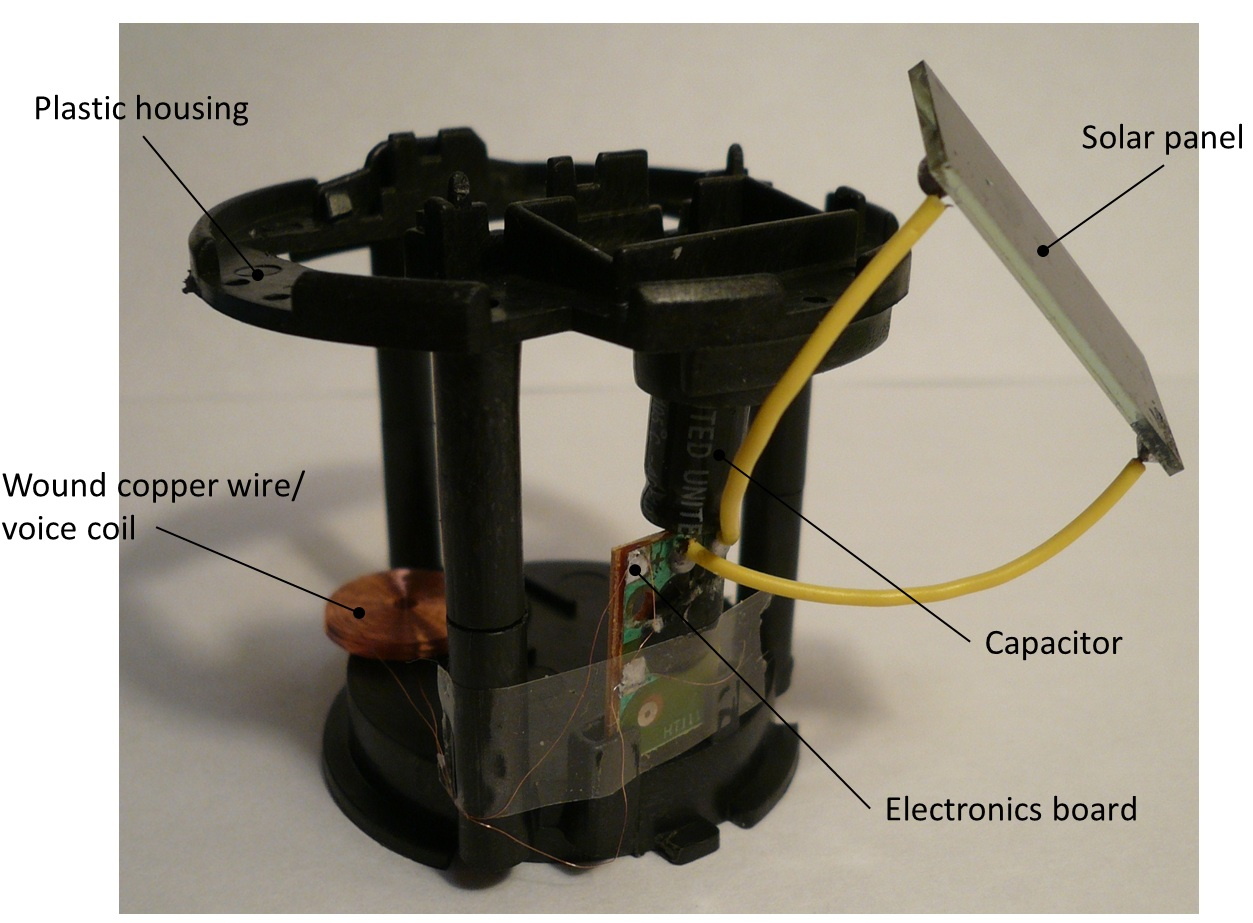
The Linux Throwie: A Non-Spacefaring Satellite

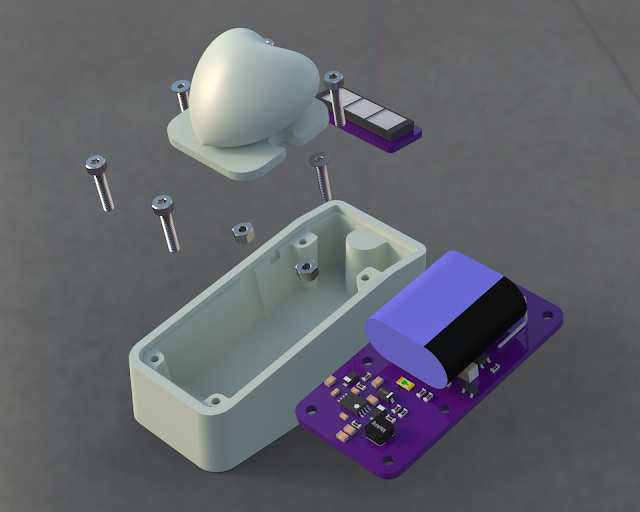
Throwies occupy a special place in hardware culture — a coin cell battery, LED, and a magnet that can be thrown into an inaccessible place and stick there as a little beacon of colored light. Many of us will fondly remember this as a first project. Alas, time marches inevitably on, and launching cheerful lights no longer teaches me new skills. With a nod to those simpler times, I’ve been working on the unusual idea of building a fully functional server that can be left in remote places and remain functional, like a throwie (please don’t actually throw it). It’s a little kooky, yet should still deliver a few years of occasional remote access if you leave it somewhere with sunlight.

A short while ago, I described the power stages for this solar-powered, cloud accessible Linux server. It only activates on demand, so a small solar cell and modest battery are sufficient to keep the whole show running.

Where we left off, I had a solar cell that could charge a battery, and provide regulated 12 V and 5 V output. For it to be a functional device, there are three high level problems to solve:

  1. It must be possible to set up the device without direct physical access
  2. You must be able to remotely turn it on and off as needed.
  3. It needs to be accessible from the Internet.

The funny thing is, this hardware reminds me of a satellite. Of course it’s not meant to go into space, but I do plan to put it somewhere not easy to get to again, it runs off of solar power, and there’s a special subsystem (ESP8266) to tend the power, check for remote activation, and turn the main computer (Raspberry Pi 3) on and off as necessary. This sounds a lot like space race tech, right?

As I have a bit more code than usual to share with you today, I’ll discuss the most interesting parts, and provide links to the full firmware files at the end of the article.

Continue reading “The Linux Throwie: A Non-Spacefaring Satellite”

Weather Station Is A Tutorial In Low Power Design

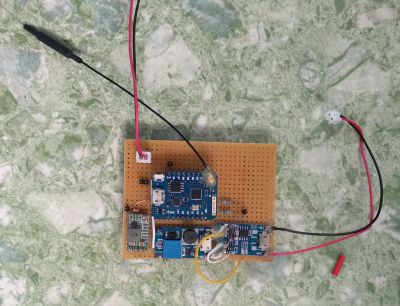
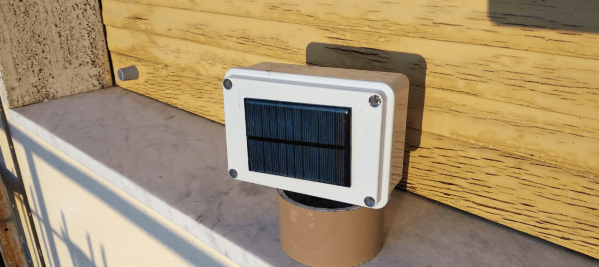
Building your own weather station is a fun project in itself, but building it to be self-sufficient and off-grid adds another set of challenges to the mix. You’ll need a battery and a solar panel to power the station, which means adding at least a regulator and charge controller to your build. If the panel and battery are small, you’ll also need to make some power-saving tweaks to the code as well. (Google Translate from Italian) The tricks that [Danilo Larizza] uses in his build are useful for more than just weather stations though, they’ll be perfect for anyone trying to optimize their off-grid projects for battery and solar panel size.

When it comes to power conservation, the low-hanging fruit is plucked first. [Danilo] set the measurement intervals to as long as possible and put the microcontroller (a NodeMCU) to sleep in between. Removing the power from the sensors when the microcontroller was asleep was another easy step, but the device was still crashing overnight. Then he turned to a hardware solution and added a more efficient battery charger to the setup, which saved even more power. This is all the more impressive because the station communicates via WiFi which is notoriously difficult to run in low-power applications.

Besides the low power optimizations, the weather station itself is interesting for its relative simplicity. It could be built with things most of us have knocking around. Best of all, [Danilo] published the source code on his site, so most of the hard work has been done already. If you’re thinking he seems a little familiar, it’s because we’ve featured some of his projects before, like his cheap WiFi extender antenna and his homemade hybrid tube amplifier.

The Linux Throwie: Powering A Linux Server With A 0.3W Solar Panel

Have you ever had one of those moments, when you’re rummaging through your spare parts heap, and have a rather bizarre project idea that you can’t quite get out of your head? You know, the ones that have no clear use, but simply demand to be born, of glass and steel and silicon?

This time, the stubborn idea in question was sort of like a solar-rechargeable LED throwie, but instead of a blinking light, it has a fully cloud-accessible embedded Linux server in the form of a Raspberry Pi 3 Model B+. Your choice of embedded Linux board should work — I just happen to have a lot of these due to a shipping error.

There were two main challenges here: First, it would have to combine the smallest practical combination of solar panel, power supply, and Li-ion cell that could run the Raspberry Pi. Second, we’ll need to remotely activate and access the Pi regardless of where it is, as well as be able to connect it to WiFi without direct physical access. In this article we’ll be dealing with the first set of problems — stay tuned for the rest.

Continue reading “The Linux Throwie: Powering A Linux Server With A 0.3W Solar Panel”

Perfecting The Solar Powered Web Server

Running a server completely off solar power seems like it would be a relatively easy thing to do: throw up a couple of panels, tack on a charge controller and a beefy battery, and away you go. But the reality is somewhat different. Most of us hackers are operating on a relatively limited budget and probably don’t have access to the kind of property you need to put out big panels; both pretty crippling limitations. Doing solar on a small-scale is hard, and unless you really plan ahead your setup will probably be knocked out on its first cloudy day.

So when [Kris de Decker] wanted to create a solar-powered version of his site “Low-tech Magazine”, he went all in. Every element of the site and the hardware it runs on was investigated for potential power savings, and luckily for us, the entire process was written up in meticulous detail (non-solar version here). The server still does go down from time to time if the weather is particularly poor, but in general it maintains about 90% uptime in Barcelona, Spain.

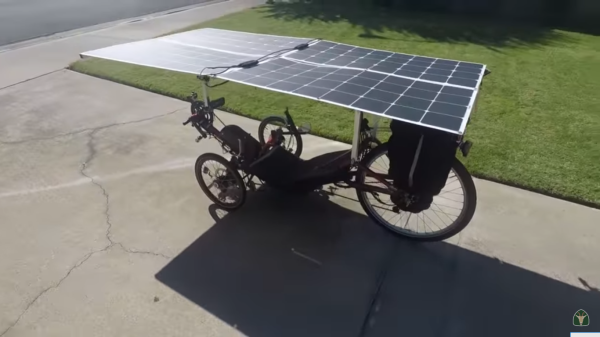
The solar side of the equation is fairly simple. There’s a 50 watt photovoltaic panel charging a 12V 7Ah lead-acid battery though a 20A charge controller. With an average of 4 to 6 hours of sunlight a day, the panel generates 300 Wh of electricity in the best case scenario; which needs to be split between charging the battery and running the server itself.

As for the server, [Kris] chose the Olimex Olinuxino A20 Lime 2 in part because of it being open source hardware, but also because it’s very energy-efficient and includes a AXP209 power management chip. Depending on processor load, the Olimex board draws between 1 and 2.5 watts of power, which combined with charging losses and such means the system can run through two days of cloudy weather before giving up the ghost. A second battery might be added in the future to help improve the run time during low-light conditions, but for now its been working pretty well.

Perhaps the most interesting part of the whole project are the lengths to which the website itself was optimized to keep resource utilization as low as possible. Images are compressed using dithering to greatly reduce their file sizes, and the site eschews modern design in favor of a much less processor intensive static layout. There’s even a battery capacity display integrated into the page through some clever use of CSS. Even if you aren’t looking to set up your own sun worshiping website, there are tips here for building efficient web pages that could absolutely be put to use in other projects.

If you’re interested in solar projects, we’ve got you covered. From an open source charge controller to building DIY photovoltaic panels, there’s plenty of prior art you should find very…illuminating. Please clap.

Solar Power For Chernobyl’s Second Generation Of Electricity

When featuring cool hacks repurposing one thing for something else, we prefer to focus on what we could get our hands on and replicate for ourselves. Not this one, though, as nobody else has the misfortune of being responsible for 2,000 square kilometers (772 square miles) of radioactive contaminated land like the government of Ukraine. Trying to make the best of what they have, they’ve just launched a pilot program working to put up solar power farms inside the Chernobyl Exclusion Zone.

This is sure to invite some jokes in the comments section, but the idea has merit. Thirty years of weather has eroded the worst aftermath of the Chernobyl explosion. That area is no longer immediately lethal and people have been making short visits. Spanning from safety inspectors, to scientists, to curious adventurers with questionable judgement making television shows. Supposedly, by following rules on what not to do, it’s possible to keep radiation exposure of a short visit down to the level experienced by frequent fliers. But that’s still too much radiation for long-term stay. That means no homes, office parks, or factories. No agriculture either, as plants and animals grown in the area should not be eaten.

So what’s left? That’s what Ukraine has been struggling with, as it tried to figure out something positive to offset the headaches of monitoring the area.

Well, next to the defunct power plant is the electric distribution infrastructure it used to feed into, and photovoltaic power generation requires little human oversight. Some maintenance will be required, but hopefully someone has worked out how to keep maintenance workers’ cumulative exposure to a minimum. And if this idea pans out, clean renewable energy would start flowing from the site of one of the worst ecological disasters of our era. That makes it a worthwhile hack on a grand scale.

[via Gizmodo]

Unmanned Sailboat Traverses The North Atlantic

Sailboats have been traversing the Atlantic Ocean since before 1592, sailing through sunshine, wind, and rain. The one thing that they’ve all had in common has been a captain to pilot the ship across this vast watery expanse, at least until now. A company called Offshore Sensing has sailed an unmanned vessel all the way from Canada to Ireland.

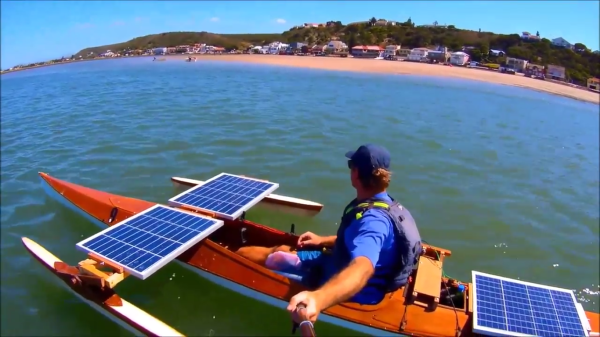
The ship, called the Sailbuoy, attempted the journey last year as well but only made it about halfway before the mission was abandoned. This year, however, the voyage was finally completed, and this craft is officially the first unmanned ship to cross the Atlantic Ocean. The journey took about 80 days using sails and a small set of solar panels to drive the control electronics.

Using this technology, the company can investigate wave activity in specific areas of the ocean without having to send out a manned vessel to install a permanent buoy. The sailbuoy simply uses its autonomy to stay in a particular patch of ocean. There have been other missions that the sailbuoy has been tasked with as well, such as investigating the aftermath of the Deepwater Horizon oil spill in the Gulf of Mexico. With a reliable craft like this, it becomes much easier, safer, and less expensive to explore the ocean’s surface.

Thanks to [Andy] for the tip!

Quadcopter Ditches Batteries; Flies On Solar Power Alone

It seems kind of obvious when you think about it: why not just stick a solar panel on a quadcopter so it can fly on solar power? Unfortunately, physics is a cruel mistress, and it gets a bit more complex when you look at problems like weight to power ratios, panel efficiency, and similar tedious technical details. This group of National University of Singapore students has gone some way to overcome these technical issues, though: they just built a drone that is powered from solar power alone, with no batteries or other power source.

Their creation is a custom-built quadcopter made with carbon fiber that weighs just 2.6kg (about 5.7lbs), but which has about 4 square meters (about 43 square feet) of solar panels. By testing and hand-selecting the panels with the best efficiency, they were able to generate enough power to drive the four rotors, and have managed to achieve altitudes of up to 10 meters. The students have been working on prototypes of this since 2012, when their first version could only generate 45% of the power needed for flight. So, reaching 100% of flight power in the demo shown below is a significant step.

Continue reading “Quadcopter Ditches Batteries; Flies On Solar Power Alone”