Teensy Can School You At Guitar Hero

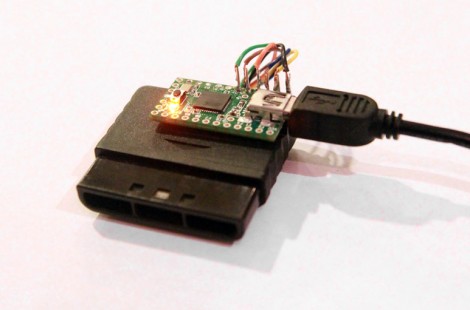
[Johnny Chung Lee] put together a system that is perfect at playing Guitar Hero. He’s using the PlayStation 2 version and, as you can see above he’s combined a controller connector and a Teensy microcontroller board to communicate with the console using its native SPI protocol. This custom guitar controller receives its signals via USB from a computer that is monitoring the video from the console and calculating the controller signals necessary for perfect gameplay. [Johnny] wrote an OpenCV program that monitors the video, removes the perspective from the virtual fretboard, and analyzes color and speed of the notes coming down the screen.

As you can see after the break it works like a charm. It’s fun from a programming standpoint, but if you want a hack you can actually play maybe you should build your own Banjo Hero.
Continue reading “Teensy Can School You At Guitar Hero”

Communicating With An LED Matrix

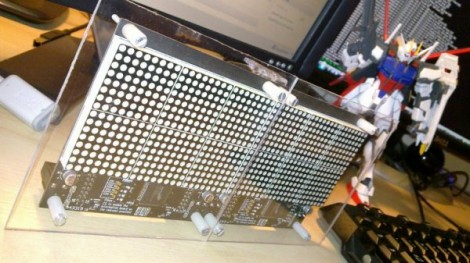
Most of the LED matrix posts we run delve into the hardware design. This time around [J Bremnant] used prefab modules and focused on writing code to address the display. The hardware combines two 24×16 LED boards from Sure Electronics with a Teensy 2.0 to drive the display and provide a USB connection. The firmware comes in just under 8k, leaving graphic manipulation up to a PC.

[J Bremnant’s] Python script offers a lot of flexibility when working with the display. There are three modes selectable through a terminal interface. One just tests the display and then drops into Conway’s Game of Life. The second mode lets you send commands via serial interface so it can be used as a message ticker. The final feature is frame addressing that allows graphics to be dropped into the display. See each of these featured in the video after the break.

Continue reading “Communicating With An LED Matrix”

Input Device Using LED And Four Photoresistors

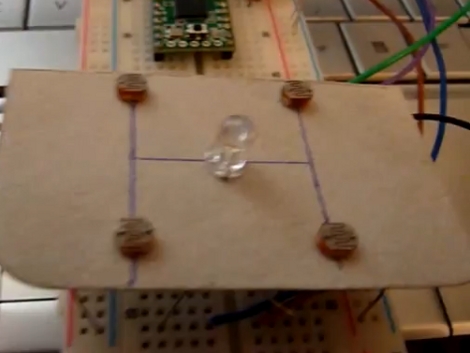
[Julien] built an input device that uses reflected light detected by some photoresistors. Placing your hand above the device will reflect light from the LED back down onto the cadmium-sulfide sensors. The resistance of those sensors is read by four ADC pins on a Teensy microcontroller and translated to mouse movements. In the video after the break you can see that this works rather well in controlling the cursor. The source code is available on pastebin but we’re also going to host the code for posterity.

Continue reading “Input Device Using LED And Four Photoresistors”

PlayStation 3 Exploit Using A TI84 Calculator

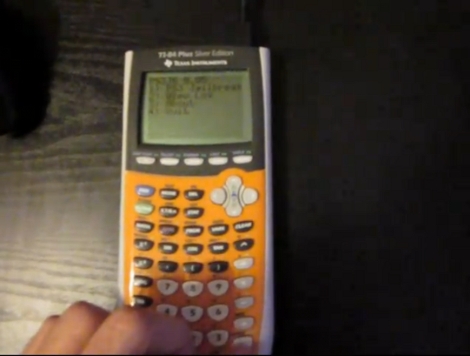
[Brandon Wilson] came up with a way to exploit the Play Station using a TI84 calculator. This uses the same PSGroove open source code that we looked at last week. That package was running on the Teensy, which is currently sold out (we’d guess because people want to run the exploit). There’s a video demonstration of this new trick after the break. The calculator connects via a USB A to USB mini-B cable which comes with the calculator and is also used to charge the PS3 controllers. Once the connection is made, launch the software on the calculator, power cycle the PS3, and turn it on with the familiar power-eject button presses. The only problem with the system is that the calculator needs to be connected every time you boot.

Continue reading “PlayStation 3 Exploit Using A TI84 Calculator”

Open Source Version Of The Play Station 3 Jailbreak

Don’t steal. It’s a lesson that children are taught from the youngest age and a core principle in every society. The PSGroove sets out to follow this mantra in several ways. It is an open source implementation of the PSJailbreak hardware we covered a couple of weeks back. It’s difficult to find a definitive source of information on that hardware but many have speculated that the original device contains stolen code. Whether that’s true or not is moot as the PSGroove doesn’t include the backup manager program alleged to violate copyright.

The device is also aimed at running homebrew, and doesn’t natively allow one to play backups. It runs on a variety of AVR hardware, including the Teensy boards. If you have one of them, it’s just a matter of compiling the code and unlocking the potential of your PlayStation 3.

[Thanks Mark via PS3news]

Teensy Credit Card Reader

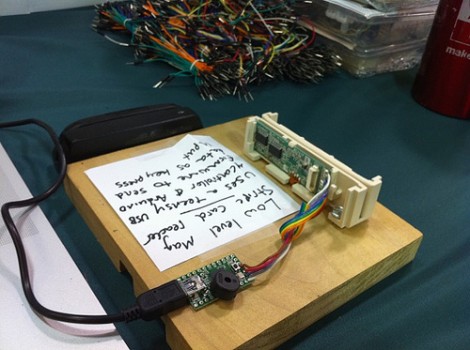
Here’s a hack that makes business sense. [PT] recalls last year’s HOPE conference when their booth was using a virtual credit card terminal for purchases that required manual entry of card information. This year they’ll have the same virtual terminal but this magnetic stripe reader will fill it out automatically.

A magstripe reader (reading only, no funny business here) from Mouser grabs data from the card. A Teensy microcontroller board, which identifies itself as a USB keyboard, automatically fills out the virtual terminal from the parsed data. The real question, are his customers comfortable sliding their plastic through a hacked reader?

Kaossilator On The Cheap

We recently stumbled on a way to turn a regular laptop into a poor man’s Kaossilator. Using the touchpad of your laptop, some PureData software, Touchpad2MIDI and a couple custom patches, [zenpho] has set everyone up to create that crazy electronic music that kids listen to these days.

But what was that? You cant afford a whole laptop, and need to make this happen on an even tighter budget? Oh, we’ve got your back. Using just the trackpad and an Arduino, [Bastiaan] has created a basic PS2 to Arduino to USB link which can be parsed by your favorite language of choice into a working MIDI interface. Good news for all the lazy hackers out there, he’s planning on swapping out the Arduino for a Teensy, and making a real USB to MIDI interface.