Electromagnetic Field: A Cyberpunk Headdress To Be Noticed In

At the recent Electromagnetic Field hacker camp in the UK, one of the highlights was the Null Sector, a cyberpunk-themed zone best described as something close to the set of Blade Runner made from shipping containers, clever props, and lighting. Our community rose to the occasion with some truly impressive costumes and wearable electronics, lending the venue a real authenticity.

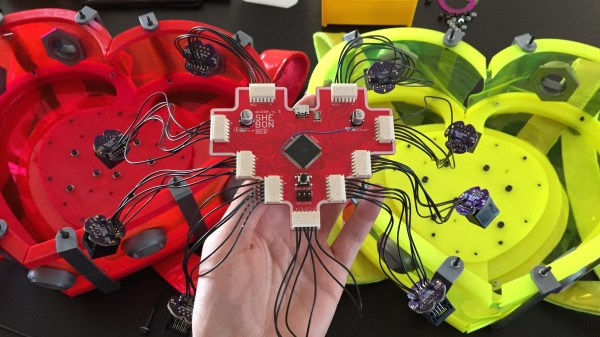
Among the many creations on show there was one that stood quite literally head and shoulders above the rest. [Chebe]’s colour stealing sound reactive LED headdress is a confection of Neopixels, organza, and transparent floor protectors on a wire frame, driven by a Lillypad wearable microcontroller board with a microphone and colour sensor attached. The resulting sound-and-colour-reactive display stood out across a crowded venue full of hackers who’d all made their own efforts to produce similar outfits, which is really saying something!

The Lillypad and LEDs are standard fare, but the wire part of this project isn’t, and that’s what makes it rather interesting from our perspective. Anyone can make something that goes over their head, but to make something that’s comfortable takes a bit of effort and thought. Have you ever tried a set of ill-fitting sunglasses? If you have then you might understand. In this case stiff garden wire is used, bent to shape and joined with rolled-up tape, before being covered with wound-on ribbon for extra comfort. A Hackaday scribe travels the field at a hacker camp, and though [Chebe]’s cranium is a little more petite than the Hackaday bonce it was certainly an enveloping fit when we tried it.

Anyone can attach an LED to an item of clothing and call it a wearable. But to be noticed like this one it has to be done with style. If you’ve not had your fill of this topic, we suggest you continue with the Hackaday Belgrade talk from our friend [Rachel “Konichiwakitty” Wong].

Robots Invade Your Personal Space

If you have ever had to complete a task such as building a LEGO model over a remote connection, you will know that the challenges are like an absurd grade school group project. The person giving directions often has trouble describing what they are thinking, and the person doing the work has trouble interpreting what the instructor wants. “Turn the blue block over. No, only half way. Go back. Now turn it. No, the other way. NO! Not clockwise, downward. That’s Upward! Geez. Are you even listening‽” Good times.

While you may not be in this situation every day, the Keio University of Japan has an intuitive way to give instructors a way to physically interact with an instructee through a Moore/Swayze experience. The instructor has a camera in typical pirate parrot placement over the shoulder. Two arms are controlled by the instructor who can see through stereoscopic cameras to have a first-person view from across the globe. This natural way to interact with the user’s environment allows muscle memory to pass from the instructor to the wearer.

For some of the other styles of telepresence, see this deep-sea bot and a cylindrical screen that looks like someone is beaming up directly from the holodeck.

Continue reading “Robots Invade Your Personal Space”

MIT Makes Washable LED Fabric

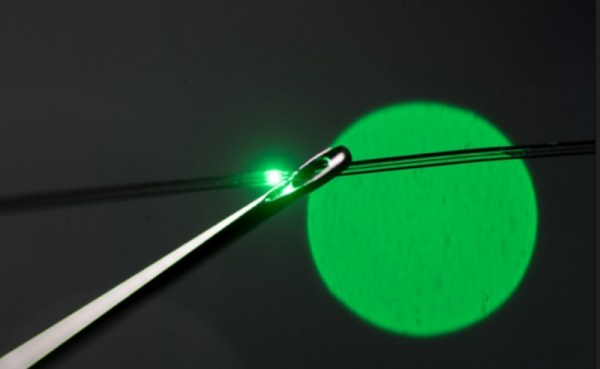
Let’s face it, one of the challenges of wearable electronics is that people are filthy. Anything you wear is going to get dirty. If it touches you, it is going to get sweat and oil and who knows what else? And on the other side it’s going to get spills and dirt and all sorts of things we don’t want to think about on it. For regular clothes, that’s not a problem, you just pop them in the washer, but you can’t say the same for wearable electronics. Now researchers at MIT have embedded diodes like LEDs and photodetectors, into a soft fabric that is washable.

Traditionally, fibers start as a larger preform that is drawn into the fiber while heated. The researchers added tiny diodes and very tiny copper wires to the preform. As the preform is drawn, the fiber’s polymer keeps the solid materials connected and in the center. The polymer protects the electronics from water and the team was able to successfully launder fabric made with these fibers ten times.

Continue reading “MIT Makes Washable LED Fabric”

Sonar In Your Hand

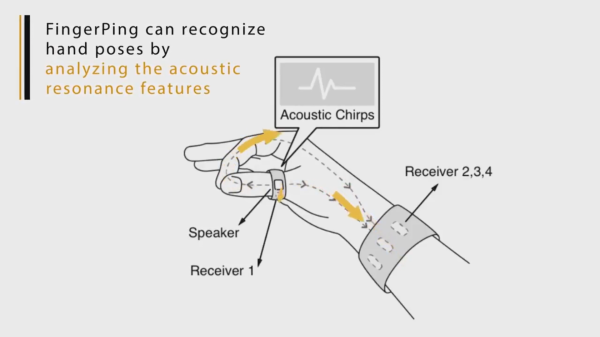
Sonar measures distance by emitting a sound and clocking how long it takes the sound to travel. This works in any medium capable of transmitting sound such as water, air, or in the case of FingerPing, flesh and bone. FingerPing is a project at Georgia Tech headed by [Cheng Zhang] which measures hand position by sending soundwaves through the thumb and measuring the time on four different receivers. These readings tell which bones the sound travels through and allow the device to figure out where the thumb is touching. Hand positions like this include American Sign Language one through ten.

From the perspective of discreetly one through ten on a mobile device, this opens up a lot of possibilities for computer input while remaining pretty unobtrusive. We see prototypes which are more capable of reading gestures but also draw attention if you wear them on a bus. It is a classic trade-off between convenience and function but this type of reading is unique and could combine with other bio signals for finer results.

Continue reading “Sonar In Your Hand”

Atltvhead - wearable interactive TV

RCA TV Gets New Life As Interactive Atltvhead

TVs are usually something you sit and passively watch. Not so for [Nate Damen’s] interactive, wearable TV head project, aka Atltvhead. If you’re walking around Atlanta, Georgia and you see him walking around with a TV where his head should be, introduce yourself! Or sign into Twitch chat and take control of what’s being displayed on the LEDs which he’s attached to the screen. Besides being wearable technology, it’s also meant to be an interactive art piece.

For this, his third version, the TV is a 1960’s RCA Victor Portable Television. You can see some of the TVs he found for previous versions on his hackaday.io page. They’re all truly vintage. He gutted this latest one and attached WS2812 LED strips in a serpentine pattern inside the screen. The LEDs are controlled by his code and the FastLED library running on an ESP8266. Power comes from four NiMH AA-format batteries, giving him 5 V, which he regulates down to 3.3 V. His phone serves as a WiFi hotspot.

[Nate] limits the commands so that only positive things can be displayed, a heart for example. Or you can tweak what’s being displayed by changing the brightness or make the LEDs twinkle. Judging by the crowds we see him attracting in the first video below, we’d say his project was a huge success. In the second video, Nate does a code walkthrough and talks about some of his design decisions.

Continue reading “RCA TV Gets New Life As Interactive Atltvhead”

Is That A Tweet On Your Belt Buckle Or Are You Just Happy To See Me?

What a time to be alive! The range of things you never knew you needed but absolutely must have expands at a breakneck pace, such that it’s now possible to pick up a belt buckle with an embedded LED matrix to scroll messages. We have no idea what the use case for something like this is, but some people will buy anything.

One such person was a friend of [Brian Moreau], who doubled down after being gifted the glowing bauble by turning it into a WiFi enabled Tweet-scrolling belt buckle. It appears to be a just for fun project, and to be honest one would need a heck of a belt for the buckle after his mods. He added an ESP8266 to take care of monitoring his Twitter account and driving the display on the belt buckle, a non-trivial task given that the thing is programmed with only two buttons that scroll through characters to compose a message. The microcontroller might have fit inside the original buckle or only added a little to its bulk, but [Brian] decided to replace the two coin cells powering it with an external 6-volt battery pack. That required a buck converter to power the ESP, so the whole thing ended up being thrown in a case and acting more like a neat display than a flashy fashion statement.

We’d bet some tradeoffs could be made to reduce the bulk and get that buckle back where it belongs, though. Once it does, maybe it’ll be part of a complete LED-laden ensemble, from head to toe.

Hacked Fitness Trackers Aim To Improve Mental And Physical Health

We all know that the mind can affect the body in dramatic ways, but we tend to associate this with things like the placebo effect or psychosomatic illnesses. But subtle clues to the mind-body relationship can be gleaned from the way the body moves, and these hacked fitness monitors can be used to tease data from the background noise of everyday movements to help treat mental health issues.

Over the last few years, [Curt White] of the Child Mind Institute has been able to leverage an incredibly cheap but feature-packed platform, the X9 Pro Sports Bracelet, a fitness band that looks more or less like a watch. Stuffed with an ARM Cortex processor, OLED screen, accelerometer, pulse sensor, and a ton of other stuff, the $35 wearable is a hacker’s dream. And hack it he did. One version of the bracelet is called Tingle, which is used to detect and avert body-focused repetitive behaviors (BFRBs), compulsive disorders that can result in self-harm through pulling at hair or pinching. The Tingle is trained to recognize the motions associated with these behaviors and respond with haptic feedback through the vibration motor. Another hacked X9 was attached to a dental retainer and equipped with sensors to monitor respirations intraorally, in an attempt to detect overdoses. It’s fascinating stuff, and the things [Curt] has done with these cheap fitness bands is mighty impressive.

This project is yet another entry in the 2018 Hackaday Prize, which is currently in the Robot Modules phase. Got an idea for something to make robots easier to build? Start a project page on Hackaday.io and get entered. Maybe your module will even feature a hacked fitness tracker.

Continue reading “Hacked Fitness Trackers Aim To Improve Mental And Physical Health”