Hackaday Links Column Banner

Hackaday Links: November 22, 2020

Remember DSRC? If the initialism doesn’t ring a bell, don’t worry — Dedicated Short-Range Communications, a radio service intended to let cars in traffic talk to each other, never really caught on. Back in 1999, when the Federal Communications Commission set aside 75 MHz of spectrum in the 5.9-GHz band, it probably seemed like a good idea — after all, the flying cars of the future would surely need a way to communicate with each other. Only about 15,000 vehicles in the US have DSRC, and so the FCC decided to snatch back the whole 75-MHz slice and reallocate it. The lower 45 MHz will be tacked onto the existing unlicensed 5.8-GHz band where WiFi now lives, providing interesting opportunities in wireless networking. Fans of chatty cars need not fret, though — the upper 30 MHz block is being reallocated to a different Intelligent Transportation System Service called C-V2X, for Cellular Vehicle to Everything, which by its name alone is far cooler and therefore more likely to succeed.

NASA keeps dropping cool teasers of the Mars 2020 mission as the package containing the Perseverance rover hurtles across space on its way to a February rendezvous with the Red Planet. The latest: you can listen to the faint sounds the rover is making as it gets ready for its date with destiny. While we’ve heard sounds from Mars before — the InSight lander used its seismometer to record the Martian windPerseverance is the first Mars rover equipped with actual microphones. It’s pretty neat to hear the faint whirring of the rover’s thermal management system pump doing its thing in interplanetary space, and even cooler to think that we’ll soon hear what it sounds like to land on Mars.

Speaking of space, back at the beginning of 2020 — you know, a couple of million years ago — we kicked off the Hack Chat series by talking with Alberto Caballero about his “Habitable Exoplanets” project, a crowd-sourced search for “Earth 2.0”. We found it fascinating that amateur astronomers using off-the-shelf gear could detect the subtle signs of planets orbiting stars half a galaxy away. We’ve kept in touch with Alberto since then, and he recently tipped us off to his new SETI Project. Following the citizen-science model of the Habitable Exoplanets project, Alberto is looking to recruit amateur radio astronomers willing to turn their antennas in the direction of stars similar to the Sun, where it just might be possible for intelligent life to have formed. Check out the PDF summary of the project which includes the modest technical requirements for getting in on the SETI action.

Continue reading “Hackaday Links: November 22, 2020”

Modern Network Adapter For Retro Computers

Universal Serial Bus, or USB, is so ingrained in modern computing that it’s hard to imagine a time without it. That time did exist, though, and it was a wild west of connector types, standards, and interfacing methods. One of the more interesting interfaces of the time was the SIO system found in 8-bit Atari computers which ended up sharing a lot of the features of modern USB, and its adaptability is displayed in this modern project which brings WiFi, Bluetooth, USB, and SD card slots to any old Atari with an SIO port.

The project is called FujiNet and it uses the lightweight protocol of SIO to add a number of modern features to the 8-bit machine. It’s based on an ESP32, and the chip performs the functions of a network adapter by bridging WiFi and Bluetooth to the Atari. It does this by simulating drives that would have potentially been used on the Atari in its time, such as a floppy disk drive, an RS232 interface, or a modem, and translating them to the modern wireless communication protocols. It even has the ability to emulate a printer by taking the output of the print job from the Atari and converting it to PDF within the device itself.

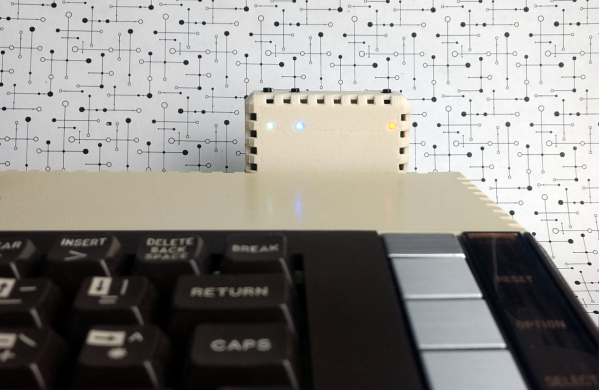
Not only does this bring a lot of functionality to the Atari, which you may be able to use to view sites like retro.hackaday.com, but the FujiNet is housed in a period-appropriate 3D-printed case that matches the look and feel of the original Atari. If you need a more generic solution for your retrocomputing networking adventures that isn’t limited to SIO, we recommend grabbing a Raspberry Pi to handle that.

Thanks to [Gavin] for the tip!

Rolling Your Own TiVo WiFi Adapter

The only thing more surprising than finding out TiVo actually put out a new 4K set-top box recently is learning that somehow they didn’t bother to build WiFi into the thing. You’re forced to buy a special wireless adapter to the tune of $60 USD to add the feature. We’d make a joke about the company living in the past, but frankly, it would be too easy.

Having to buy just one of these expensive dongles in 2020 would be insulting enough, but TiVo superfan [xxbiohazrdxx] needed four of them. Rather than hand nearly $250 to the antennae-headed overlords, they decided to reverse engineer the adapter and produce their own low-cost version. While the final result might not be as slim and svelte as the original, it does come in at less than 1/4 the price.

Operating under the assumption that the TiVo would only talk to a WiFi adapter based on the same Broadcom BCM43569 chipset used in the official one, [xxbiohazrdxx] started by trying to find a standard USB dongle that might be a drop-in replacement. Unfortunately, it looks like this particular chip was almost exclusively used in proprietary applications, most commonly as a WiFi board inside of smart TVs. But as it turns out, that wasn’t necessarily a deal breaker.

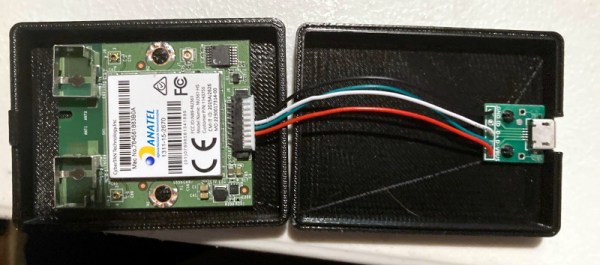
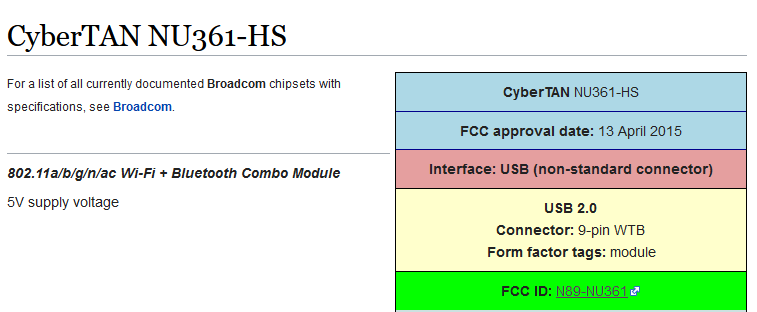
After some searching, [xxbiohazrdxx] eventually found the promising CyberTAN NU361-HS board. Not only was it based on the right chipset and ran from 5 volts, but its FCC ID entry had a complete pinout for the connector. This particular WiFi module is used in a number of budget TVs and is widely available as a spare part for less than $10. By combing the board and a USB breakout PCB inside of a 3D printed case, you’ve got a plug-and-play WiFi adapter that the TiVo thinks is the real deal.

There was a time when Hackaday was flooded with TiVo hacks, but it’s now been more than a decade since cheap carrier-provided DVRs ate the company’s lunch. Realistically, there’s an excellent chance that this post will be the only time a mention of the once-mighty DVR graces the front page in 2020. While the reign of the TiVo might be at its end, the impact it had as one of the first Linux-powered consumer devices will be etched in hacker history forever.

Long Range WiFi Broadcasts Open-Source Video Conferencing

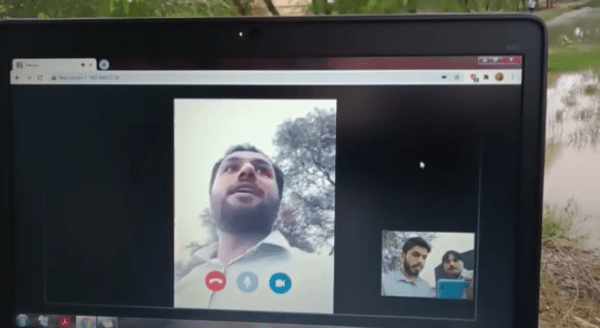
WiFi is an ubiquitous feature of the modern landscape, but due to power restrictions on most hardware alongside the high-frequency signal it’s typically fairly limited in range. This of course leads to frustration where a WiFi signal can be seen, but the connection is unreliable or slow. While most would reach for a range extender or other hardware bridge, [tak786] was able to roll out a better solution for his workplace by using a high-gain antenna and a single-board computer which gets him an amazing kilometer-wide WiFi network.

The build uses a 10 dBi antenna from TP-Link that’s rated for outdoor use and a single-board computer which acts as a sort of router. The antenna is placed at the top of a building which certainly helps with the extreme range as well. This setup doesn’t actually broadcast an open Internet connection, though. [tak786]’s employer needed a teleconferencing solution for their building, and he also created a fully open-source video conferencing solution called trango that can run on any LAN and doesn’t require an Internet connection. The WiFi setup in this build is effectively just a bonus to make the conferencing system more effective.

[tak786] is planning on releasing a whitepaper about this build shortly, but for now you can access the source code for the video conferencing system at his GitHub page. And, before anyone jumps to conclusions, apparently this is well within FCC rules as well. Some of the comments in the linked Reddit post suggest that with an amateur radio license this system could be pushed much further, too. If you need more range than a kilometer, though, it’s not too much more difficult to do once you have all the right hardware.

Automated Tools For WiFi Cracking

Knowing how WiFi networks can be attacked is a big part of properly securing them, and the best way to learn about it is to (legally) run some attacks. [Matt Agius] has been going down the WiFi-cracking rabbit hole, and in the process created Pwnagotchi Tools to automate the actual password cracking part.

The first step in cracking a WiFi network is to record the handshake that gets exchanged when a client connects to an access point. This has been made very simple thanks to Pwnagotchi, which turns a Raspberry Pi into an automated handshake collection tool and Pwnagothi Tools helps to automate the steps that follow. It downloads the handshakes (pcap files) from the pwnagotchi, and converts it to pmkid/hccapx files to use with the hashcat password recovery tool. Hashcat scripts can then be generated for the actual cracking using any of the attacks that [Matt] has compiled. WPA/WPA2 is slow to crack and requires a lot of processing power, so [Matt] also added the option to automatically provision AWS GPU instances to run the cracking task in the cloud. It also keeps track of the status of each of the handshakes being cracked.

As wireless networks and IoT devices become more pervasive, it’s important to know the dangers, and how to protect against them. WiFi and Bluetooth security is probably the easiest to learn about, but other networks are just as vulnerable when an RTL-SDR is used. Another option Flipper Zero, a hacking gadget for Sub-1 GHz networks inspired by Pwnagotchi, which recently hit $4.8 million in its Kickstarter campaign.

Adding WiFi To The Acorn Electron

In the continuing quest by countless hobbyists to allow every 1980s 8-bit home computer to experience the joys of an online experience that doesn’t involve a 9600 baud modem, [Roland Leurs] has created a cartridge-based module for the Acorn Electron that adds WiFi, which he showed off at the virtual ABug conference in September 2020.

The Acorn Electron is a Synertek 6502-based computer that was released in the UK in August of 1983. It’s a budget version of the well-known BBC Micro educational/home computer, with 32 kB of RAM and featuring BBC BASIC v2 in its ROM. [Roland]’s ElkWiFi card slots into an available cartridge slot, after which the onboard ESP8266 (ESP-1 module) can be enabled and used as a WiFi modem.

Acorn Electron with Plus 1 expansion, ElkWiFi and additional expansion card inserted.

The board features the Exar ST16C2552CJ dual UART chip, one channel of which connects to the ESP-1 module, with the other channel used as an uncommitted UART header. The control logic is implemented in VHDL and flashed to the onboard Xilinx CPLD, and a 128 kB RAM module is used as WiFi data buffer.

Although a definite niche product, reading through the forum thread makes one really appreciate the technical complexity and joy once things are beginning to work reliably. It also shows one of the few cases where an ESP-1 module is used for its original purpose: as an easy way to add WiFi functionality with full WiFi and TCP stack, without burdening the main CPU.

(Thanks, BaldPower)

ESP8266 Turned Secretive WiFi Probe Request Sniffer

When a Wi-Fi device is switched on, it starts spewing out probe requests to try and find a familiar access point. These probe requests contain the device’s MAC address and the SSID of the hotspot it’s looking for, which can potentially be used to identify a specific device and where it’s been. After experimenting with these probe requests, [Amine Mehdi Mansouri] has created OpenMAC, a tiny ESP8266 based sniffer that could be hidden anywhere.

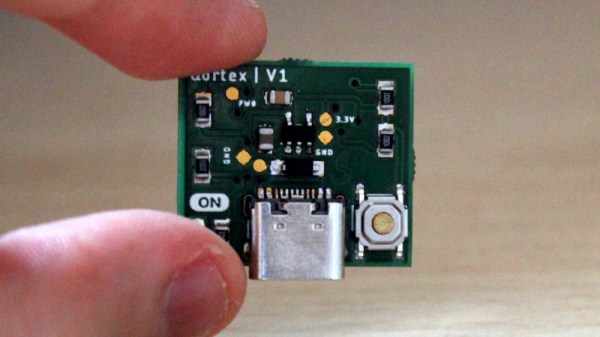
The device consists of an ESP-07S module, a regulator circuit for getting power from a USB-C connector, and a button for power cycling. An external antenna is required for the module, which can be selected based on the size or gain requirements for a specific deployment. [Amine] tested the OpenMAC at a local library (with permission), in combination with a number of his own little Wi-Fi repeaters to expand the reach of the network. All the recorded MAC addresses were logged to a server, where the data can be used for traffic analysis in and around the library, or even for tracking and locating specific devices.

This is nothing new, and is relatively common technique used for gathering information in retail locations, and could be also be used for more nefarious purposes. Newer versions of iOS, Android, and Windows 10 feature MAC address randomization which can limit the ability to track devices in this manner, but it isn’t always activated.

We’ve seen a number of projects that exploit probe requests. FIND-LF can be used for locating devices in your home, and Linger fools probe requests sniffers by replaying previously recorded requests.