A Robot In A Day

While building a robot (nearly) from scratch isn’t easy, it needn’t be a lengthy process.  Is it possible to build a bot in a single day? With some musical motivation (a 10 hour loop of the A-Team theme song), [Tyler Bletsch] answers with a resounding ‘yes’ in the shape of his little yellow robot that he built for a local robotics competition.

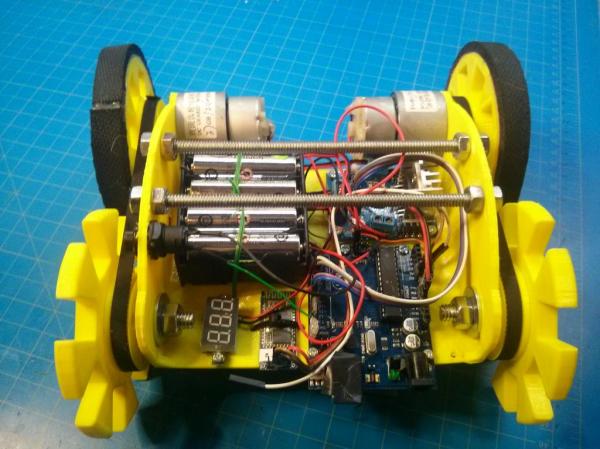
Designing and fabricating on the fly, [Bletsch] used Sketchup to design the chassis, and OpenSCAD to model the wheels while the former was being 3D printed. Anticipating some structural weakness, he designed another version that could bolt to wood if the original failed, but the addition of some metal support rods provided enough stability. Mouse pad material gave the wheels ample traction. An Arduino with the L298 control module receives input via an HC-06 Bluetooth board. Eight AA batteries provide 12V of power to two Nextrox mini 12V motors with an integrated voltmeter to measure battery life.

Continue reading “A Robot In A Day”

Hackaday Prize Entry: Reverse GPS

Every time you watch a SpaceX livestream to see a roaring success or fireball on a barge (pick your poison), you probably see a few cubesats go up. Everytime you watch a Soyuz launch that is inexplicably on liveleak.com before anywhere else, you’re seeing a few cubesats go up. There are now hundreds of these 10 cm satellites in orbit, and SatNogs, the winner of the Hackaday Prize a two years ago, gives all these cubesats a global network of ground stations.

There is one significant problem with a global network of satellite tracking ground stations: you need to know the orbit of all these cubesats. This, as with all Low Earth Orbit deployments that do not have thrusters and rarely have attitude control, is a problem. These cubesats are tumbling through the rarefied atmosphere, leading to orbits that are unpredictable over several months.

[hornig] is working on a solution to the problem of tracking hundreds of cubesats that is, simply, reverse GPS. Instead of using multiple satellites to determine a position on Earth, this system is using multiple receiving stations on Earth’s surface to determine the orbit of a satellite.

The hardware for [hornig]’s Distributed Ground Station Network is as simple as you would expect. It’s just an RTL-SDR TV tuner USB dongle, a few antennas, a GPS receiver, and a Raspberry Pi connected to the Internet. This device needs to be simple; unlike SatNogs, where single base station in the middle of nowhere can still receive data from cubesats, this system needs multiple receivers all within the view of a satellite.

The modern system of GPS satellites is one of the greatest technological achievements of all time. Not only did the US need to put highly accurate clocks in orbit, the designers of the system needed to take into account relativistic effects. Doing GPS in reverse – determining the orbit of satellites on the ground – is likewise a very impressive project, and something that is certainly a contender for this year’s Hackaday Prize.

The HackadayPrize2016 is Sponsored by:

Cheating At Video Games: Arduino Edition

[Javier] has put in his time playing Final Fantasy X. In the game, there’s a challenge where you have to dodge 200 consecutive lightning strikes by pressing a button at just the right time. [Javier] did this once, but when he bought a new PS Vita handheld, he wanted the reward but couldn’t bear the drudgery of pressing X when the screen lights up 200 times.

4987021466110559532

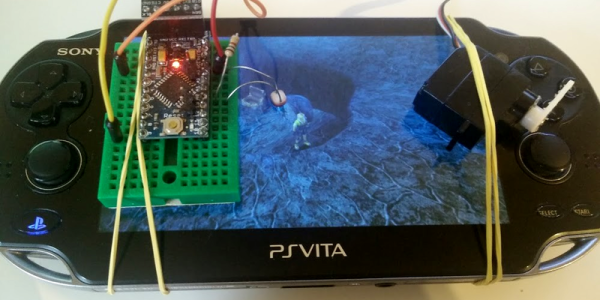
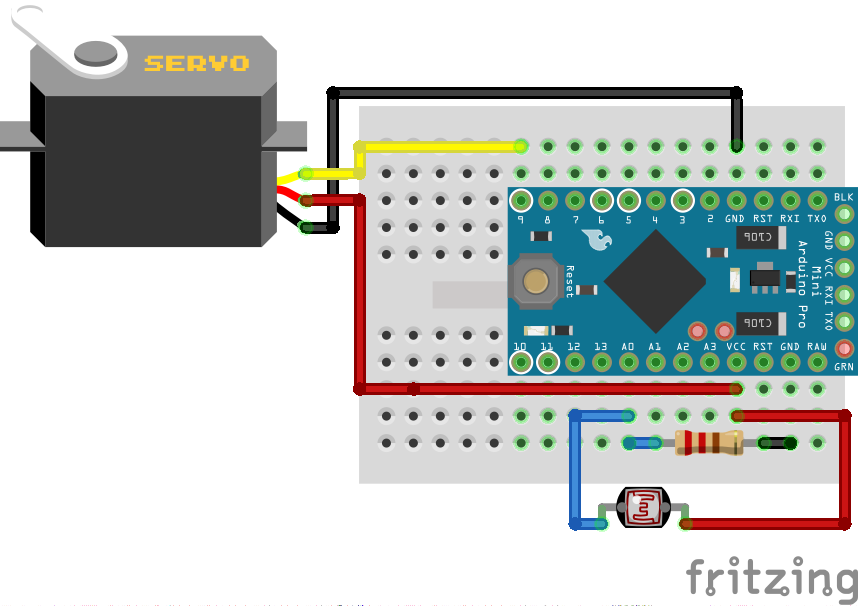
So he did what anyone would do: hooked up a light-dependent resistor to an Arduino and rubber-banded a servo to press the X button for him. It’s a simple circuit and a beautiful quick hack, all the more so because it probably only took him a half hour or so to whip up. And that’s a half hour better spent than dodging lightning strikes. According to his screen-shot, he didn’t stop at 200 dodges, though. He racked up 1,568 dodges, with a longest streak of 1,066. You can watch a video on his blog and pull the code out of his GitHub.

Why do this? Because that’s what simple computers are for. We hate these silly jumping mini-games with a passion, so we applaud anyone who cheats their way around them. And while not as hilarious as this machine that cheats at Piano Tiles, [Javier]’s hack gets the job done. What other epic video game cheats are we missing?

Skateboard Hackers Trick On 3D Printed Wheels

The team over at [Braille Skateboarding] is willing to ride just about anything. This week they’re testing out 3D printed skateboard wheels. We’re not just talking rolling around here, the [Braille] team takes their experiments out to the skate park and gives them to the locals to test out. Tail whips, jumps, ollies, and grinds were on the agenda. The skaters were a bit apprehensive, as this is the third time they’ve tested 3D printed wheels.

The first set shattered upon landing a jump. That set appears to have been made from PLA with about 10% infill. The second set were made from NinjaFlex, which had no shattering problems, but was so squishy that the wheels simply flattened under the weight of the riders. The third set, printed by [Nick Lindenmuth] work great. They have a bit of give, but don’t shatter. We’re guessing this set is either ABS or one of the more exotic filaments. It’s pretty amazing that 3D printers are capable of spitting out wheels that not only handle the load of rider, but the shock load of coming down from jumps and tricks.

Check out the video after the break. If you want to see more skateboard projects, check out this skateboarding themed Hacklet!

Continue reading “Skateboard Hackers Trick On 3D Printed Wheels”

Real World Race Track Is Real Hack

[Rulof] never ceases to impress us with what he comes up with and how he hacks it together. Seriously, how did he even know that the obscure umbrella part he used in this project existed, let alone thought of it when the time came to make a magnet mount? His hack this time is a real world, tabletop race track made for his little brother, and by his account, his brother is going crazy for it.

His race track is on a rotating table and consists of the following collection of parts: a motor, bicycle wheel, casters from a travel bag, rubber bands (where did he get such large ones?), toy car and steering wheel from his brother, skateboard wheels, the aforementioned umbrella part and hard drive magnets. In the video below we like how he paints the track surface by holding his paint brush fixed in place and letting the track rotate under it.

From the video you can see the race track has got [Rulof] hooked. Hopefully he lets his brother have ample turns too, but we’re not too sure. Some additions we can imagine would be robotics for the obstacles, lighting, sounds and a few simulated explosion effects (puffs of flour?).

Continue reading “Real World Race Track Is Real Hack”

What Could Go Wrong: Asynchronous Serial Edition

It’s the easiest thing in the world — simple, straightforward serial data. It’s the fallback communication protocol for nearly every embedded system out there, and so it’s one that you really want to work when the chips are down. And yet! When you need it most, you may discover that even asynchronous serial can cost you a few hours of debugging time and add a few gray hairs to your scalp.

In this article, I’m going to cover most (all?) of the things that can go wrong with asynchronous serial protocols, and how to diagnose and debug this most useful of data transfer methods. The goal is to make you aware enough of what can go wrong that when it does, you’ll troubleshoot it systematically in a few minutes instead of wasting a few hours.

Continue reading “What Could Go Wrong: Asynchronous Serial Edition”

The Unity Of Dance And Architecture

In an ambitious and ingenious blend of mechanical construction and the art of dance, [Syuko Kato] and [Vincent Huyghe] from The Bartlett School of Architecture’s Interactive Architecture Lab have designed a robotic system that creates structures from a dancer’s movements that they have christened Fabricating Performance.

A camera records the dancer’s movements, which are then analyzed and used to direct an industrial robot arm and an industrial CNC pipe bending machine to construct spatial artifacts. This creates a feedback loop — dance movements create architecture that becomes part of the performance which in turn interacts with the dancer. [Huyghe] suggests an ideal wherein an array of metal manipulating robots would be able to keep up with the movements of the performer and create a unique, fluid, and dynamic experience. This opens up some seriously cool concepts for performance art.

Continue reading “The Unity Of Dance And Architecture”