Wire Bender Aims To Take Circuit Sculptures To The Next Level

It doesn’t seem as though bending wire would be much of a chore, but when you’re making art from your circuits, it can be everything. Just the right angle in just the right place can make the difference between a circuit sculpture that draws gasps and one that’s only “Meh.”

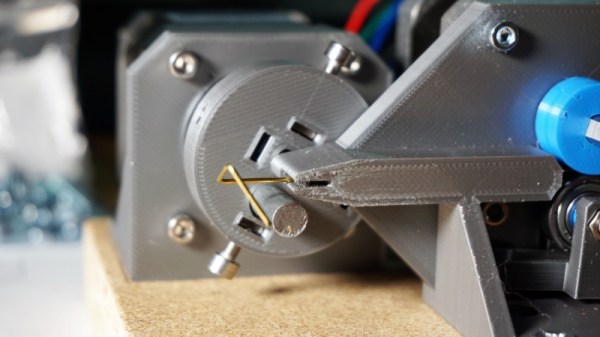
[Jiří Praus] creates circuit sculptures that are about as far away from the “Meh” end of the spectrum as possible. And to help him make them even more spectacular, he has started prototyping a wire-bending machine to add precision to his bends. There’s no build log at the moment, but the video below shows progress to date. All the parts are 3D-printed, with two NEMA 17 steppers taking care of both wire feed and moving the bending head. It appears that the head has multiple slots for tools of different shapes. For now, the wire is rotated around its long axis manually, but another stepper could be added to take care of that job.

[Jiří] tells us that while he loves making circuit sculptures like his amazing mechanical tulip, he hates repeating himself. He hopes this bender will make repeat jobs a little less tedious and a lot more precise, and we hope he goes forward with the build so we get to see both it and more of his wonderful works of circuit art.

Continue reading “Wire Bender Aims To Take Circuit Sculptures To The Next Level”
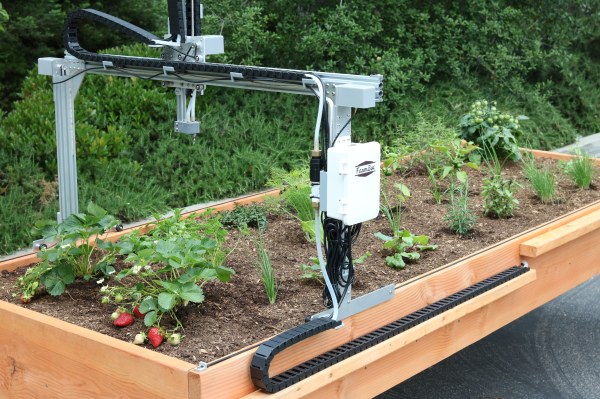
FarmBot Genesis XL gardening robot

FarmBot Unveils New CNC Gardening Robot Models

Across the Northern Hemisphere it is now summer and the growing season is in full swing. Vigorous plants that will soon bear tasty fruit are springing forth from the soil, but unfortunately so are a lush carpet of weeds that require the constant attention of the gardener. “If only there were a machine that could take that on!” she cries, and as it happens she’s in luck.

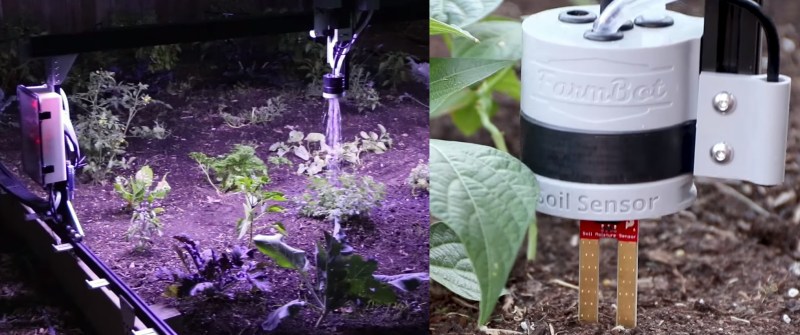
The FarmBot is an open-source robotic vegetable grower able to take care of all aspects of sowing and tending a vegetable plot. We first saw them five years as a semifinalist in the first Hackaday Prize. This is a CNC machine for the raised beds of your backyard garden. Give it power, water, and a WiFi connection, and FarmBot goes into service planting, watering, weeding, and monitoring the soil. Now they’ve shipped over a thousand of their Genesis model and today have announced of a pair of new models that promise to make their technology more accessible than it ever has been.

FarmBot moisture sensor and watering head
FarmBot has a tool changer. Soil moisture sensor and watering heads are shown here.

In a nod to Tesla, FarmBot is calling this their “Model 3 moment” — the new offering is smaller and leaner to appeal to a wider customer base than their well-heeled, CNC machine loving, early adopters. The new FarmBot Express and Express XL models are now shipped 95% pre-assembled to lower the bar on getting up and running.  They cover two sizes of planting bed: 1.2m x 3m or 2.4m x 6m, with an MSRP of $2295/2795 although there is currently an $800 launch discount available.

For us, FarmBot is the success story of an early Hackaday Prize entrant. From a great idea and a functional prototype, the project has successfully made the transition to commercial viability and holds a genuine promise of making the world a better place by helping people grow some of their own produce. Who knows, in five years time it could be your idea that’s reaching commercial viability, we think you should enter the Hackaday Prize too!

Ask Hackaday: How Can You Build For A Ten Millennia Lifespan?

There’s been a lot of news lately about the Long Now Foundation and Jeff Bezos spending $42 million or so on a giant mechanical clock that is supposed to run for 10,000 years. We aren’t sure we really agree that it is truly a 10,000 year clock because it draws energy — in part — from people visiting it. As far as we can tell, inventor Danny Hills has made the clock to hoard energy from several sources and occasionally chime when it has enough energy, so we aren’t sure how it truly sustains itself. However, it did lead us to an interesting question: how could you design something that really worked for 10,000 years?

Continue reading “Ask Hackaday: How Can You Build For A Ten Millennia Lifespan?”

School’s In Session With Arduboy Curriculum

It’s hard not to be impressed by the Arduboy. In just a few short years, [Kevin Bates] went from proof of concept to a successful commercial product without compromising on his original open source goals. Today, anyone can develop a game for the Arduboy and have it distributed to owners all over the world for free. If you’ve ever dreamt of being a game developer, the Arduboy community is for you.

Realizing the low-cost hardware and open source software of the Arduboy makes it an excellent way to learn programming, [Kevin] is now trying to turn his creation into a legitimate teaching tool. He’s kicking off this new chapter in the Arduboy’s life with a generous offer: giving out free hardware to educators all over the world. Anyone who wants to be considered for the program just needs to write-up a few paragraphs on how they’d utilize the handheld game system in their class.

[Kevin] already knows the Arduboy has been used to teach programming, but those have all been one-off endeavours. They relied on a teacher that was passionate enough about the Arduboy to put in their own time and effort to create a lesson plan around it. So one of the main goals right now is getting an official curriculum put together so educators won’t have to start from scratch. The community has already developed 16 free lessons, but they’re looking for help in creating more and translating them into other languages.

While the details are still up in the air, [Kevin] also plans to travel to schools personally and help them get their Arduboy classes off the ground. He’s especially interested in developing countries and other areas that are disadvantaged educationally. Believing that the Arduboy is as much a way to teach effective leadership and teambuilding as it is programming, he thinks this program can truly make a difference.

Since [Kevin] first Rickrolled us with his prototype in 2014, we’ve seen the Arduboy project spread like wildfire through the hacker community. From figuring out how to play its games on other gadgets to developing an expansion cartridge for the real thing, the Arduboy has already done its fair share of inspiring. Here’s hoping it has just as much of an impact on the next generation of hackers once they get their hands on it.

NASA’s “Green” Fuel Seeks Safer Spaceflight By Finally Moving Off Toxic Hydrazine

Spaceflight is inherently dangerous. It takes a certain type of person to willingly strap into what’s essentially a refined bomb and hope for the best. But what might not be so obvious is that the risks involved aren’t limited to those who are personally making the trip. The construction and testing of space-bound vehicles poses just as much danger to engineers here on the ground as it does to the astronauts in orbit. Arguably, more so. Far more individuals have given their lives developing rocket technology than have ever died in the cockpit of one of them.

Reddish brown exhaust of hydrazine thrusters

Ultimately, this is because of the enormous amount of energy stored in the propellants required to make a rocket fly. Ground support personnel need to exercise great care even when dealing with “safe” propellants, such as the classic combination of kerosene and liquid oxygen. On the other end of the spectrum you have chemicals that are so unstable and toxic that they can’t be handled without special training and equipment.

One of the most dangerous chemicals ever used in rocket propulsion is hydrazine; and yet from the Second World War to the present day, it’s been considered something of an occupational hazard of spaceflight. While American launch vehicles largely moved away from using it as a primary propellant, hydrazine is still commonly used for smaller thrusters on spacecraft.

When SpaceX’s Crew Dragon exploded in April during ground tests, the release of approximately one and a half tons of hydrazine and nitrogen tetroxide propellants required an environmental cleanup at the site.

But soon, that might change. NASA has been working on a project they call the Green Propellant Infusion Mission (GPIM) which is specifically designed to reduce modern spacecraft’s dependency on hydrazine. In collaboration with the Air Force Research Laboratory at California’s Edwards Air Force Base, the space agency has spearheaded the development of a new propellant that promises to not just replace hydrazine, but in some scenarios even outperform it.

So what’s so good about this new wonder fuel, called AF-M315E? To really understand why NASA is so eager to power future craft with something new, we first have to look at the situation we’re in currently.

Continue reading “NASA’s “Green” Fuel Seeks Safer Spaceflight By Finally Moving Off Toxic Hydrazine”

Logic And EEPROMs Bring VGA To Life, Sans Microcontroller

For whatever reason, the Video Graphics Array standard seems to attract a lot of hardware hacks. Most of them tend to center around tricking a microcontroller into generating the signals needed to send images to a VGA monitor. We love those hacks, but this one takes a different tack – a microcontroller-free VGA display that uses only simple logic chips and EEPROMs.

When we first spied this project, [PH4Nz] had not yet shared his schematics and code, but has since posted everything on GitHub. His original description was enough to whet our appetite, though. He starts with a 27.175-MHz clock and divides that by 4 with a 74HCT163, which has the effect of expanding the 160×240 pixels image stored in one of the EEPROMs to 640×480. Two 8-bit counters keep track of horizontal and vertical positions, while the other EEPROM takes care of generating the Hsync and Vsync signals. It’s all quite hackish, but it works. [PH4Nz] tells us that the whole thing is in support of a larger project: an 8-bit computer made from logic chips. We’re looking forward to seeing that one too.

This isn’t the first microcontroller-less VGA project we’ve seen, of course. Here’s a similar one also based on EEPROMs, and one with TTL logic chips. And we still love VGA on a microcontroller such as the ESP32; after all, there’s more than one way to hack.

Thanks to [John U] for the tip.

Exploring Basement Humidity With A Raspberry Pi

Sometimes a hack isn’t about building something cool. Sometimes it’s more tactical, where the right stuff is cobbled together to gather the information needed to make decisions, or just to document some interesting phenomenon.

Take this impromptu but thorough exploration of basement humidity undertaken by [Matthias Wandel]. Like most people with finished basements in their homes, [Matthias] finds the humidity objectionable enough to warrant removal. But he’s not one to just throw a dehumidifier down there and forget about it. Seeking data on how well the appliance works, [Matthias] wired a DHT22 temperature/humidity sensor to a spare Raspberry Pi to monitor room conditions, and plugged the dehumidifier into a Kill-A-Watt with a Pi camera trained on the display to capture data on electrical usage.

His results were interesting. The appliance does drop the room’s humidity while raising its temperature, a not unexpected result given the way dehumidifiers work. But there was a curious cyclical spike in humidity, corresponding to the appliance’s regular defrost cycle driving moisture back into the room. And when the dehumidifier was turned off, room humidity gradually increased, suggesting an unknown source of water. The likely culprit: moisture seeping up through the concrete slab, or at least it appeared so after a few more experiments. [Matthias] also compared three different dehumidifiers to find the best one. The video below has all the details.

We always appreciate [Matthias]’ meticulous approach to problems like these, and his field expedient instrumentation. He seems to like his creature comforts, too – remember the target-tracking space heater from a few months back?

Continue reading “Exploring Basement Humidity With A Raspberry Pi”